
Rotonda di San Lorenzo
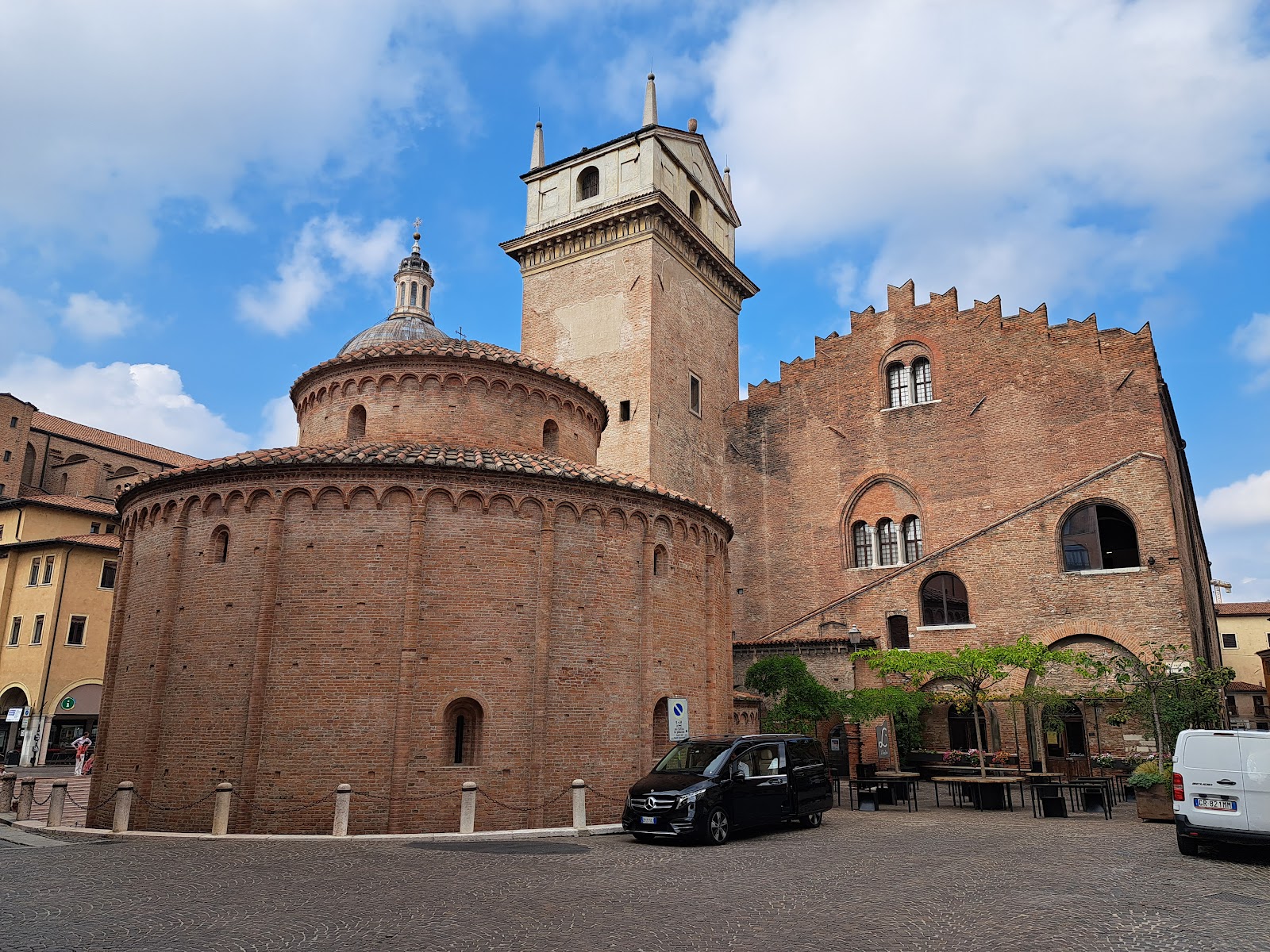
You descend a short flight of steps to reach the door — the Piazza delle Erbe has risen around this church for nine centuries, leaving it stranded roughly a metre and a half below the modern city. That small act of descent is your first clue that you are entering something genuinely old. The Rotonda di San Lorenzo is the oldest church in Mantua, built in the early 1080s in a central, circular plan that echoes the Church of the Holy Sepulchre in Jerusalem.
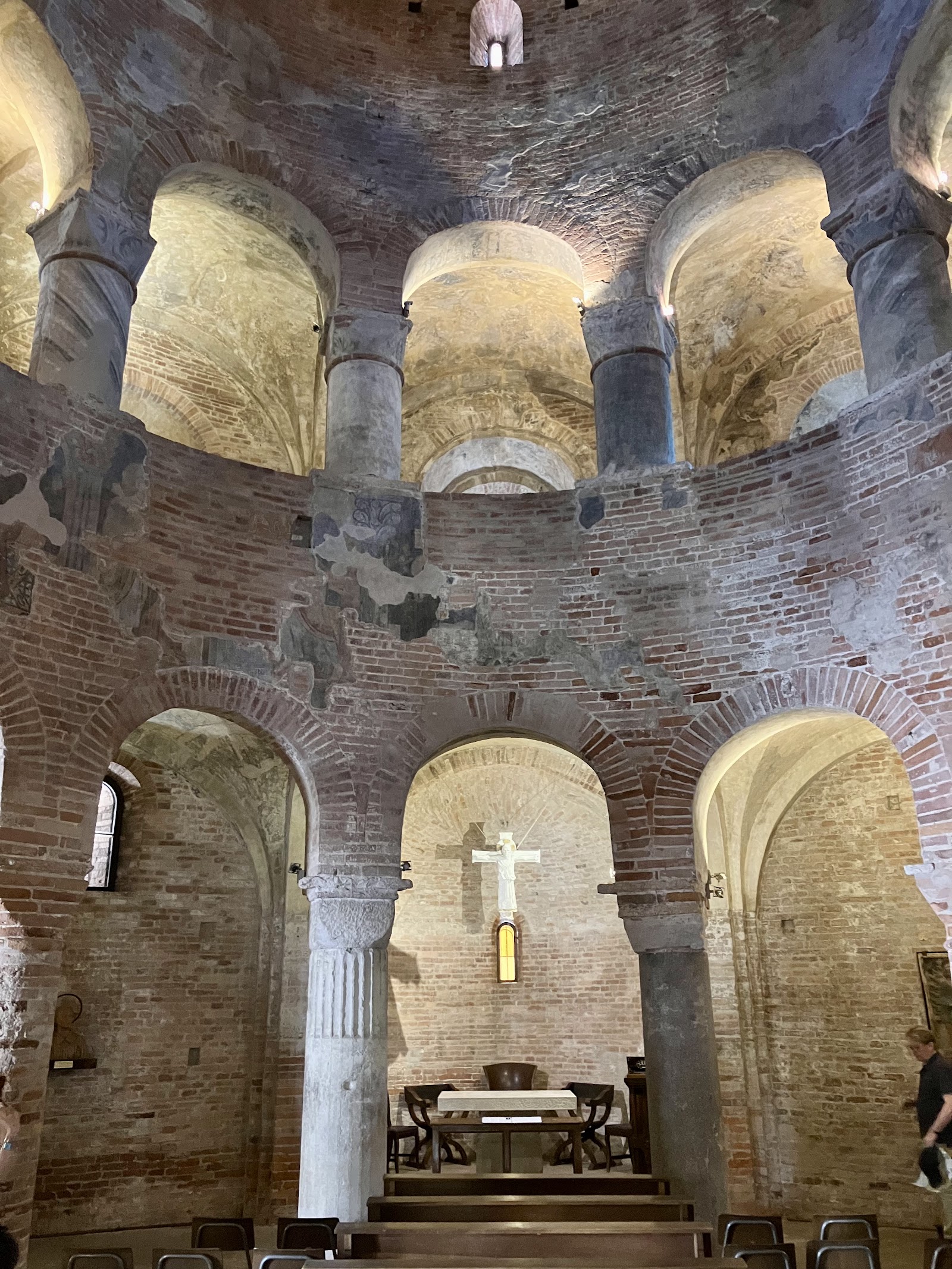
Inside, thick brick walls muffle the piazza above. A deambulatory of sturdy columns circles the nave, and above that runs a matronaeum — the upper gallery once reserved for women — where fragments of Byzantine-school frescoes from the 11th and 12th centuries survive on the curved walls.
💛 What travellers fall for
People who come back tend to time it for a weekday morning, when the light through the small windows moves slowly around the interior and the space is largely yours. Look up from the lower gallery before doing anything else — the geometry of columns, arches and dome reads most clearly from that angle.
The story behind Rotonda di San Lorenzo
Matilda of Canossa, the formidable countess who shaped so much of 11th-century northern Italian politics, commissioned the Rotonda between 1082 and 1083 — a date that appears in the plaster. Her intention was to replicate the symbolic form of the Church of the Holy Sepulchre in Jerusalem, making the circular plan a deliberate theological statement about the resurrection of Christ. The site itself may be older still: it probably stands over a Roman temple to Venus.
The building's later centuries were less reverent. Deconsecrated in 1579, it was stripped of its roof and absorbed into the adjacent Jewish quarter as a private courtyard, then used as a warehouse. It spent generations hidden behind the facades of ordinary shops until a rediscovery in 1908 brought it back into view. The dome was rebuilt in 1926, and the church was returned to worship that same year, eventually entrusted to the Dominican Fraternity. Mantua's UNESCO designation in 2008 formally acknowledged what the building already made plain.

Good to know
Entry is free, with a voluntary donation box at the door. The church sits directly on Piazza delle Erbe; from Mantua railway station it is roughly a kilometre on foot. Open daily, with a midday break on weekdays. Budget around twenty minutes inside.
Where is Rotonda di San Lorenzo?
More tickets & tours for Rotonda di San Lorenzo
Book directly at the provider
What travellers say about Rotonda di San Lorenzo
While Mantua is famous for its Renaissance splendor, the Rotonda di San Lorenzo offers something entirely different: a raw, mystical journey back to the 11th century. It is the oldest church in the city, and stepping inside feels like entering a time capsule. Unlike the rectangular basilicas nearby, this church is perfectly round. It was built in 1082 by the famous Matilda of Canossa, inspired by the Church of the Holy Sepulchre in Jerusalem. The most fascinating part of its history is that for centuries, this church disappeared. In the 1500s, the Duke (Guglielmo Gonzaga) closed it, and it was eventually swallowed up by private houses and shops built around and over it. It was only "rediscovered" and freed from the clutter in the early 20th century.
Absolutely breathtaking piece - a must visit in Mantova. It has a special atmosphere, and the pictures don't really do it justice. Free entry. It's really small, so you only need like ten minutes to take it in properly.
Adjacent to the Clock Tower. Free entry. There are two floors : the upper floor is the women's gallery - the space reserved for women however when we were there, just the ground level is open for visiting. Originally it was completely frescoed, now only fragments remain. Faded fresco portraying the Martyrdom of Saint Lawrence. Amazing that a church with a thousand year history, was hidden at least for three centuries. 1906 - is the year the municipality of Mantua authorised the construction of a road that connects Piazza Erbe to Porto Catena. For this reason, the houses that were close to the the market square were demolished and this treasure was discovered.
I would love to travel back in time to see this 11th century church when it was new. Sadly it was abandoned as a church in the 1500s. The few remaining frescoes are amazing.
Small place but should not miss it.
More of Mantua
Discover where to stay, what to do and the best deals for your trip.
Explore Mantua →More attractions in Mantua
All of Mantua →
Background adapted from Wikipedia (CC BY-SA) · map data © OpenStreetMap contributors · ratings & place photos via Google · other photos with per-image credit. Ticket links may earn us a commission at no extra cost to you.