
Castelvecchio
The equestrian statue of Cangrande I della Scala hangs on a concrete shelf in mid-air, suspended where two wings of the building meet across a void. That moment — a medieval warlord's effigy floating in space, framed by Carlo Scarpa's precise concrete and steel — tells you exactly what kind of place Castelvecchio is: not a ruin preserved under glass, but a living argument about how old things and new ideas can share a wall.
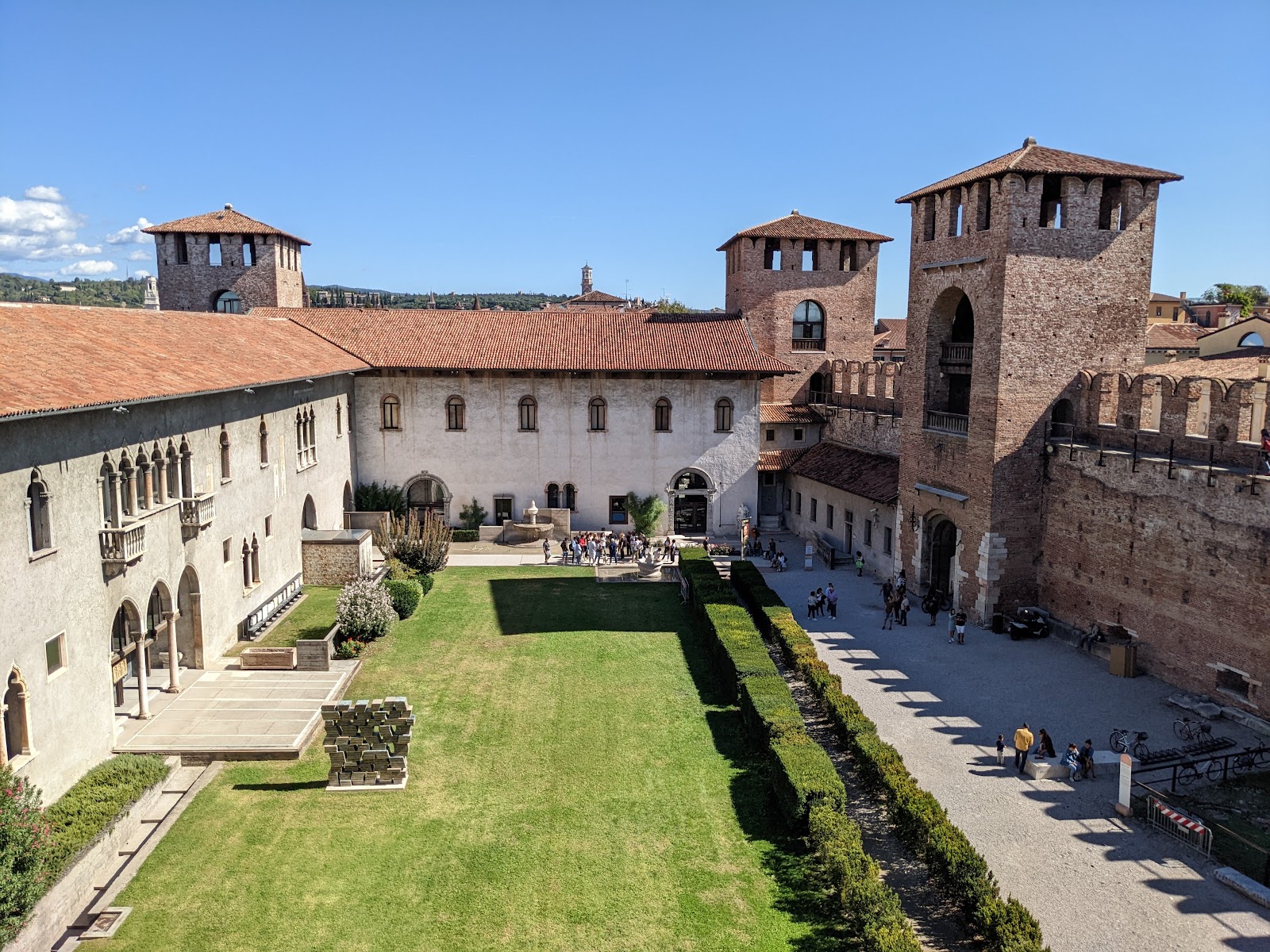
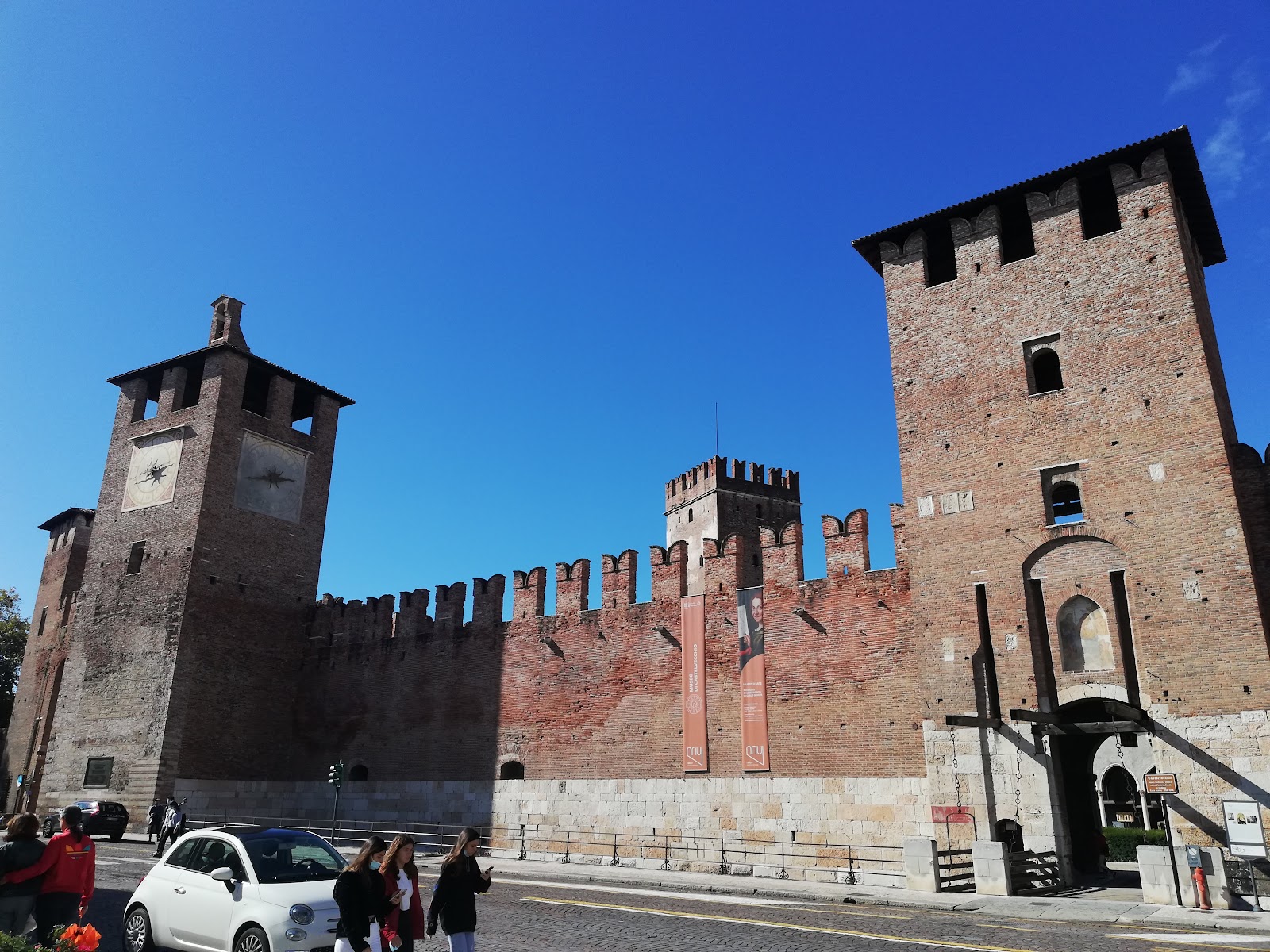
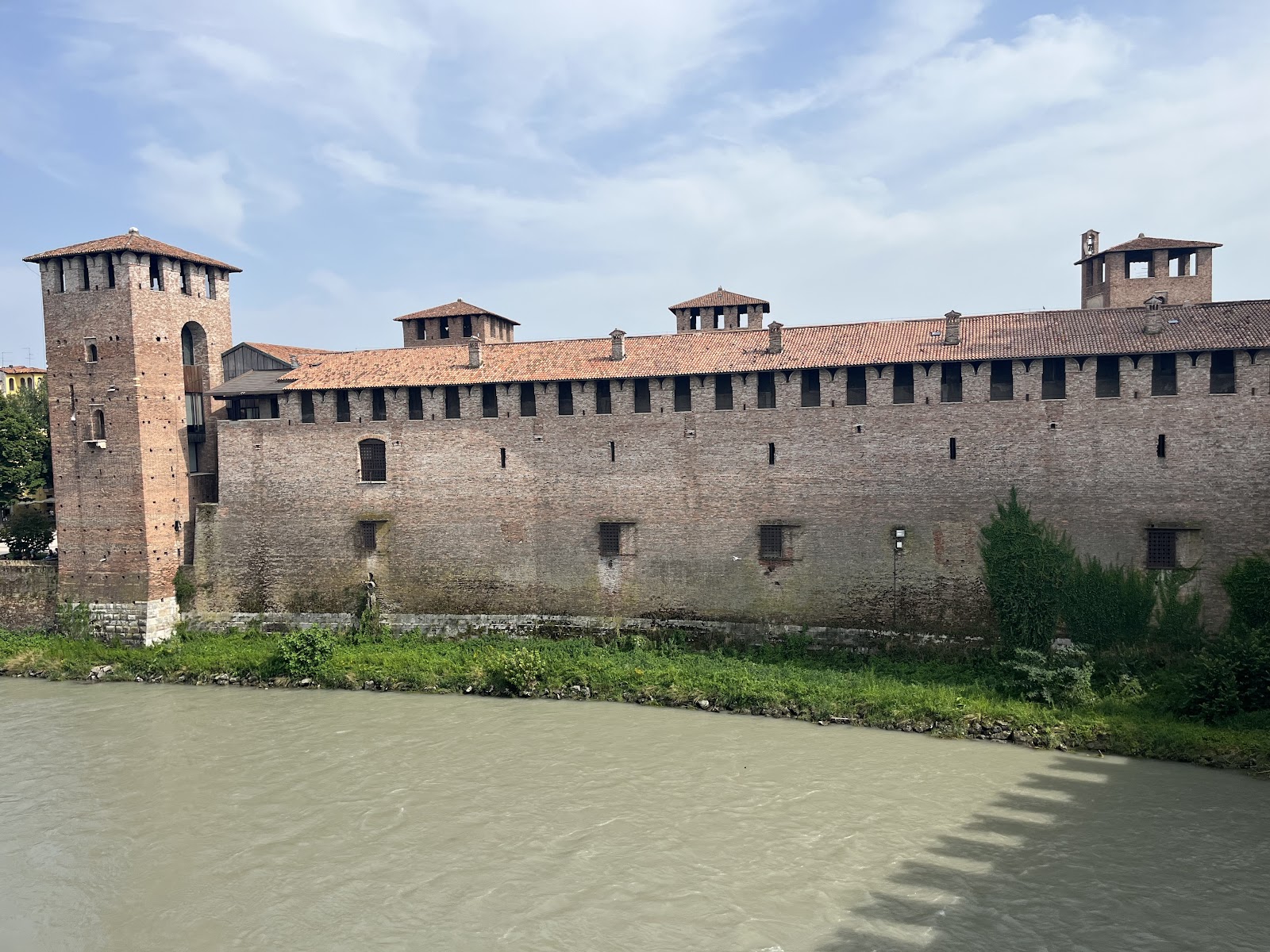
Built in red brick along the Adige, the fortress holds seven towers, a dry moat, and around thirty rooms of Veronese art spanning the Middle Ages onward. The attached Ponte Scaligero, with its largest arch spanning nearly 49 meters, is as much a part of the experience as anything inside.
💛 What travellers fall for
People who return tend to linger on the ramparts rather than rushing back to the galleries — the brick changes colour as the afternoon light shifts off the river. The lapidary courtyard at the entrance, full of stone fragments and Roman-era pieces, rewards a slow look before you ever buy a ticket.
The story behind Castelvecchio
Cangrande II della Scala began building Castelvecchio between 1354 and 1356, positioning it just outside the Roman city walls on a site that likely held an earlier Roman fortress. The castle was as much a refuge from his own subjects as a defence against Venice or the Gonzaga — a ruler's insurance policy in brick and mortar. Under Venetian rule it became a garrison, arsenal, and powder magazine; by 1759 it housed a military engineering school.
A first restoration between 1923 and 1926 under Forlati and Avena gave the complex a neo-Scaliger character. Then German forces demolished the bridge in 1945, and Allied bombing damaged the castle itself. Piero Gazzola rebuilt the Ponte Scaligero from materials recovered from the riverbed by 1951. The transformation that defines the place today came when Carlo Scarpa worked on the museum from 1959 to 1973, designing every doorway, staircase, and display fixture around specific works — a restoration that reads as a conversation rather than a correction.
Good to know
Open Tuesday to Sunday, 10 am to 6 pm; closed Mondays. Admission is €9 for adults. A 19-minute walk from Porta Nuova station, or bus 23 gets you there in about five minutes. Allow two to three hours; Tuesday mornings are noticeably quieter.
Where is Castelvecchio?
More tickets & tours for Castelvecchio
Book directly at the provider
What travellers say about Castelvecchio
A masterclass in restorative genius – Scarpa’s invisible hand The Castelvecchio in Verona is not just a medieval fortress and later a museum — it’s a palimpsest of time. But what makes it unforgettable isn’t only the historical artifacts, but Carlo Scarpa’s postwar restoration (1959–1973). Scarpa didn’t simply preserve; his genius lies in how he gently inserts a mix of modern materials — raw concrete, brass, steel, glass, and dark timber — into the ancient fabric. A symphony of materials and textures. A floating concrete bridge, suspended over a dry moat. A statue of St. George mounted on a cantilevered steel armature. Delicate glass panels set into heavy masonry, letting light wash over fresco fragments. Every detail is deliberate: the sharp, clean lines of a modern doorway contrasting with crumbling brick; a steel grid stairway that seems to hover; the way brass handrails echo the warmth of terracotta. It never feels jarring—rather, Scarpa makes you see the medieval structure anew by framing it with modern restraint. The old and new breathe together, each enhancing the other. If you love architecture, this isn’t just a museum — it’s a poem in concrete and light., modern and medieval. Scarpa’s work here is arguably his masterpiece. Don’t rush.
Castelvecchio is one of those places that reminds you why Verona is so much more than Romeo and Juliet. The 14th-century Scaligeri fortress itself is already breathtaking — battlements, towers, and the iconic bridge stretching over the Adige — but what Carlo Scarpa did with the museum renovation in the 1960s elevates this place into something truly exceptional. Scarpa’s intervention is a masterclass in how architecture and history can coexist without compromise. He didn’t restore the castle — he reinterpreted it. Exposed brickwork, raw concrete, and modernist detailing sit alongside medieval stone in a dialogue that feels bold yet deeply respectful. Every threshold, every ramp, every carefully placed window is a design decision worthy of study. The collection itself — medieval sculptures, Venetian paintings, armour, jewellery — is beautifully curated and given space to breathe. The way Scarpa frames the equestrian statue of Cangrande della Scala, suspended dramatically on an outdoor platform against the sky, is one of the great curatorial moments in any museum in the world. If you have even a passing interest in art, architecture, or history, Castelvecchio is not optional — it’s essential. One of the finest museums in Italy, full stop.
Very nice museum and castle to visit. The modern design of the building is noteworthy. I love the juxtaposition of bold steel beams used to support old bricks and stones.
It was a wonderful experience watching all the painting. There more than a dozen on Maddonna and the child but the best was pregnant Madonna. There were some very ancient biblical paintings. It is quite artistic and historic.
I loved the architecture of this castle. The walls are amazing. Take the walk over the old bridge leading up to it. Absolutely incredible art collection if you love renaissance paintings.
More of Verona
Discover where to stay, what to do and the best deals for your trip.
Explore Verona →More attractions in Verona
All of Verona →

Background adapted from Wikipedia (CC BY-SA) · map data © OpenStreetMap contributors · ratings & place photos via Google · other photos with per-image credit. Ticket links may earn us a commission at no extra cost to you.