
Castello Longobardo di Avellino
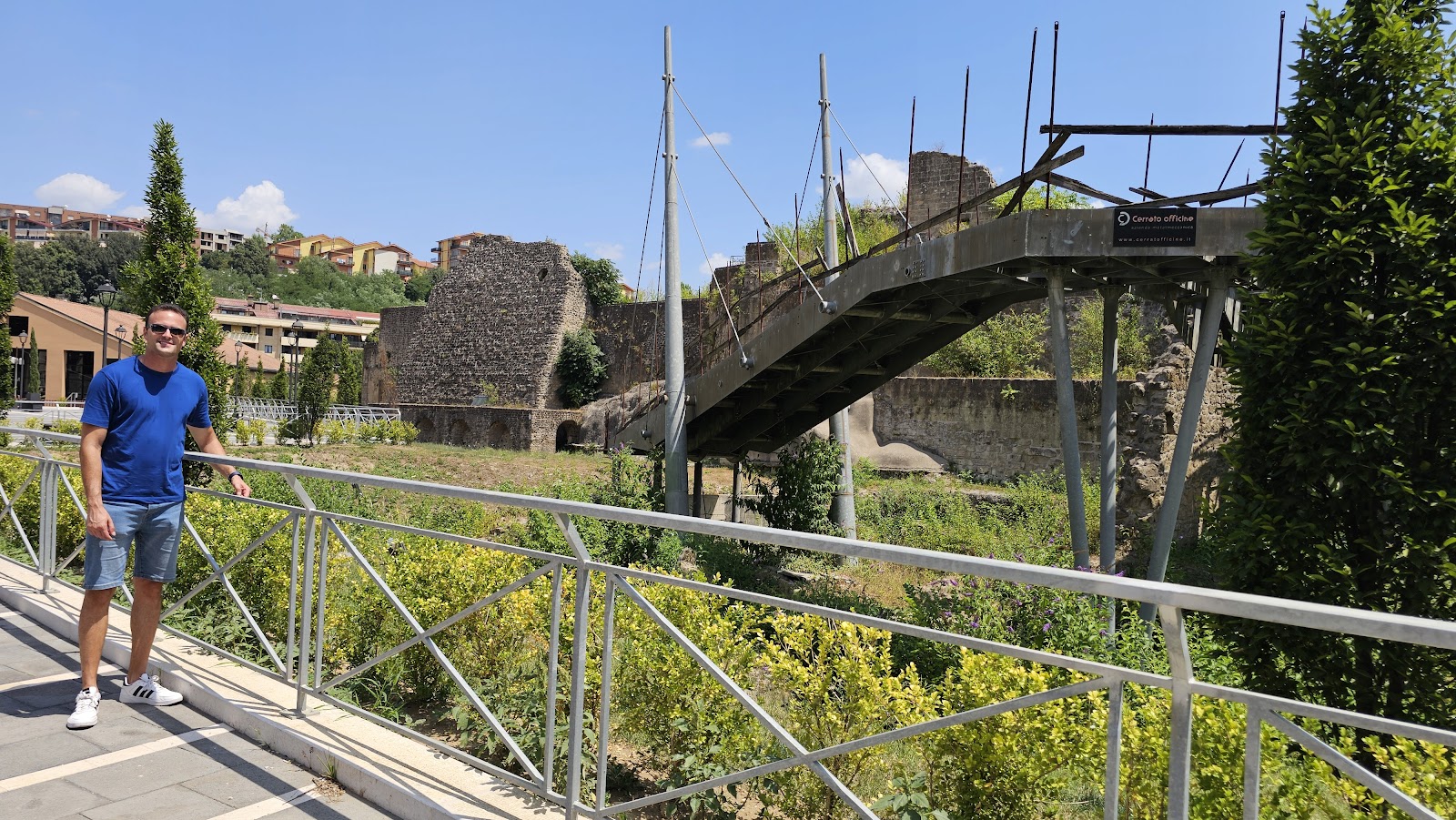
The Castello Longobardo sits at the lowest point of Avellino — unusual for a fortress in the Irpinian hills, where castles typically command heights. Two rivers, the Fenestrelle and the Rio San Francesco, wrap around three of its sides, and what remains today is a collection of ruins: a keep that still climbs past fifteen metres, a large cylindrical tower, stretches of curtain wall, and the ghost of a park that once held an artificial lake and a hunting lodge.
This is a place to visit with your expectations calibrated accordingly. The restoration project stalled in 2011 when construction work uncovered lead contamination in the front plaza, and it has not meaningfully resumed. What you get is raw, unmediated ruin — and a surprisingly layered history behind it.
💛 What travellers fall for
People who make the effort to book ahead through Distretto 6 tend to mention the same thing: standing inside the keep and looking out toward the Teatro Carlo Gesualdo across the city, you get a sense of how completely the castle once anchored Avellino's geography. The park remnants, with traces of the old lake, are easy to overlook — worth a slow circuit.
The story behind Castello Longobardo di Avellino
A gastaldo named Adalfiero I raised the castle between 884 and 896, during the last period of Lombard rule in the region. Within two and a half centuries it had become a place of considerable political weight: on 27 September 1130, Antipope Anacleto II issued the bull here that recognised Ruggero II as King of Sicily, setting the Norman kingdom of Sicily in motion. Holy Roman Emperors Lotario I and Enrico VI were both received within its walls.
The sixteenth century brought a different kind of life. Under Maria de Cardona, countess of Avellino, the castle drew poets — Bernardo Tasso among them. The Caracciolo family, who held it through the late sixteenth and into the eighteenth century, demolished the towers and crenellations and turned it into a palace, completing the park with its artificial lake. Marino II Caracciolo founded the Accademia dei Dogliosi here in the seventeenth century. Damage during the Masaniello revolt prompted the family to abandon the site for a palace in the city centre, and from the eighteenth century onward the castle declined steadily into the condition you find it in today.
Good to know
Access is by reservation only — contact Distretto 6 at 0825-1831479 or distretto6montoro@provincia.avellino.it before you visit. The site is ruins, so wear shoes you don't mind on uneven ground. Aim for mid-April to early June or September to early October to avoid summer heat.
Spring (mid-April to mid-June) and early autumn are the most comfortable windows — mild days, manageable crowds. Summer afternoons push well above 35°C and the open ruins offer little shade; if you visit in July or August, go early in the morning. Avellino sees more snow in winter than most of Campania, and the site has no shelter.
Where is Castello Longobardo di Avellino?
More tickets & tours for Castello Longobardo di Avellino
Book directly at the provider
What travellers say about Castello Longobardo di Avellino
Built in the late Middle Ages as a defensive structure, the castle of the Counts of Avellino was the center of political and military power and, over the centuries, a center of culture. During their reign, the Caracciolo family expanded the castle and created a park, the wonders of which were praised by many seventeenth-century travelers and writers. Around the eighteenth century, the Princes decided to build a new noble residence, today's Provincial Palace, condemning the ancient fortress to abandonment and decline.
It's a shame the castle can no longer be visited. It's truly a shame; it would have been a great tourist attraction.
The castle is closed and abandoned but could potentially be an excellent tourist attraction.
More of Avellino
Discover where to stay, what to do and the best deals for your trip.
Explore Avellino →More attractions in Avellino
All of Avellino →
Background adapted from Wikipedia (CC BY-SA) · map data © OpenStreetMap contributors · ratings & place photos via Google · other photos with per-image credit. Ticket links may earn us a commission at no extra cost to you.