
Sanctuary of Hercules Victor

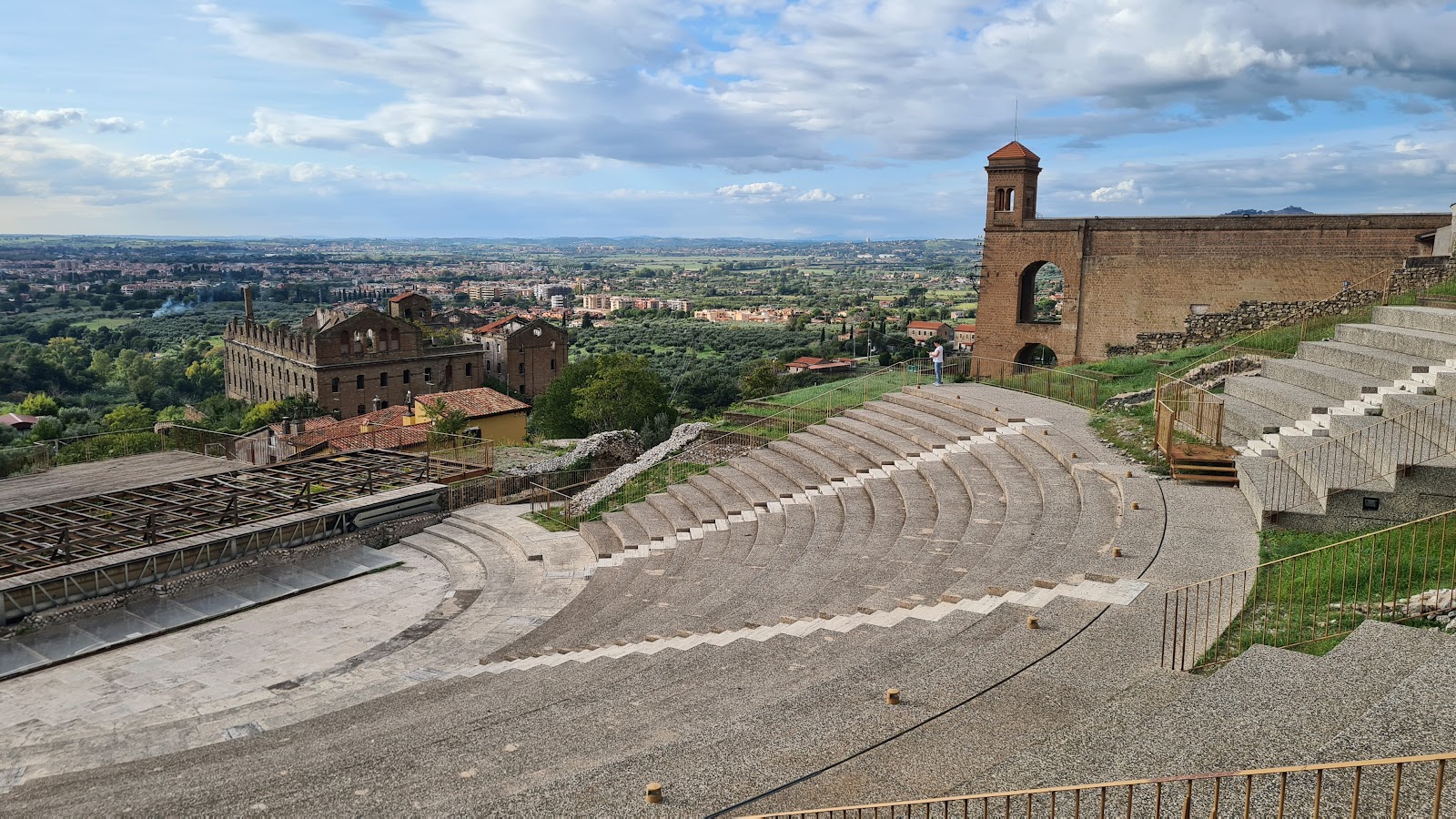
Standing on the plain below Tivoli's hill town, the Sanctuary of Hercules Victor gives you a sense of scale that the centre of Rome rarely allows. The temple's podium alone rises 25 metres — its gabled roof once painted yellow, visible from Rome across the Campagna. This was the largest Italic sanctuary dedicated to Hercules in the ancient world, second in the entire Mediterranean only to the sanctuary at Cádiz.
What makes the site stranger and more layered than most is what happened between antiquity and now: for over four centuries, from the construction of Villa d'Este in 1570 until 1993, the sanctuary served as an industrial complex — foundries, nail factories, paper mills, a power station. Tivoli was the first city in Italy to light itself with hydroelectric power, in 1886, and the first to send alternating current to Rome, in 1892. The ancient and the industrial share the same ground here.
💛 What travellers fall for
People who've been more than once tend to walk out along Via San Valerio — a cobbled street that follows the old Via Valeria, a continuation of the Via Tiburtina — rather than doubling back the way they came. The small on-site museum of recovered artefacts is easy to miss but worth the ten minutes, especially the stretch of original Roman road.
The story behind Sanctuary of Hercules Victor
Construction began in the 160s BC, riding the wave of Hellenistic influence that followed Rome's final conquest of Greece in 146 BC. A structural collapse interrupted the work, and when building resumed — sometime before 82 BC — the plan was redesigned entirely. The result was an octastyle temple on a high podium, flanked by two-storey porticoes crowded with statuary, a theatre seating up to 3,600 built into the hillside, and a covered road (Via Tecta) tunnelled beneath the whole complex. Monumental fountains lined the stairways, each set with miniature figures of Hercules.
The sanctuary had a social life as well as a religious one. A college of musicians — tibicines — made it one of the most frequented in Italy. The ancient priestly college of the Salii performed ceremonial dances here, and Virgil records that cult songs were celebrated on the Ides of August. Augustus himself administered justice under the arcades on multiple occasions. The oil merchant Marcus Octavius Herennius is thought to have carried the cult of Hercules Victor to Rome during the late Republic.

Good to know
Reach Tivoli by rail from Termini or Tiburtina, or by Co.Tra.L. bus from Ponte Mammolo (Metro B). The visit averages an hour. A combined ticket covers Villa d'Este and Villa Adriana. Free on the first Sunday of each month and on several national holidays. Closed 25 December and 1 January.
Summer visits mean full sun on an open plain — bring water and a hat. Spring and autumn are easier, with mild temperatures and good light for the stonework. In winter the site stays open but hours shorten; the surrounding landscape, stripped back, makes the scale of the ruins easier to read.
Where is Sanctuary of Hercules Victor?
More tickets & tours for Sanctuary of Hercules Victor
Book directly at the provider
What travellers say about Sanctuary of Hercules Victor
Most of Hercules Sancturay is not accessible to public. Basically all the original structure is gone, either covered by cement or built completely new. The Museum is half empty. The Theater was the sadest part. Everything is newly constructed in the place where the Theater once stood.
I enjoyed seeing the Sanctuary of Hercules Victor in TIVOLI, Italy. The wired temple was a nice way to imagine what once was, then strolling through the tunnels, etc. was also delightful. We had a private tour guide so she was very informative. If it's worth the entrance fee is up to you, but I will say that the entire place was ours on this weekend morning. That's always refreshing while traveling in Italy. I would have given 5 stars but there really isn't that much to see. Hopefully some investors will finish the entire temple of Hercules, that would be better in my opinion.
Worth every penny of the 10€ entrance fee. The place is big and there’s a lot to see. I am especially impressed by the architecture of museum building inside. I love the window treatments. With the sky of Tivoli, they turn into paintings and blend so well with the ancient arts. The building look well constructed with great materials. The stairs were marble placed on top of metal. The statues were placed on top of wood structures. They were all treated to every detail.
This place could be enhanced way better. Ticket price is not worth it, as for its major part is not visitable due to work in progress. You can reach this place in around 10 minutes by feet. I do not suggest coming here, as there are better places in the area of Tivoli
An interesting place with a huge history! Unfortunately it is not very popular. During our visit (on a Saturday), we were the only couple of tourists. It is worth going down the streets of Tivoli and the difficult walk back.
More of Tivoli
Discover where to stay, what to do and the best deals for your trip.
Explore Tivoli →More attractions in Tivoli
All of Tivoli →
Background adapted from Wikipedia (CC BY-SA) · map data © OpenStreetMap contributors · ratings & place photos via Google · other photos with per-image credit. Ticket links may earn us a commission at no extra cost to you.