
Porta Reale
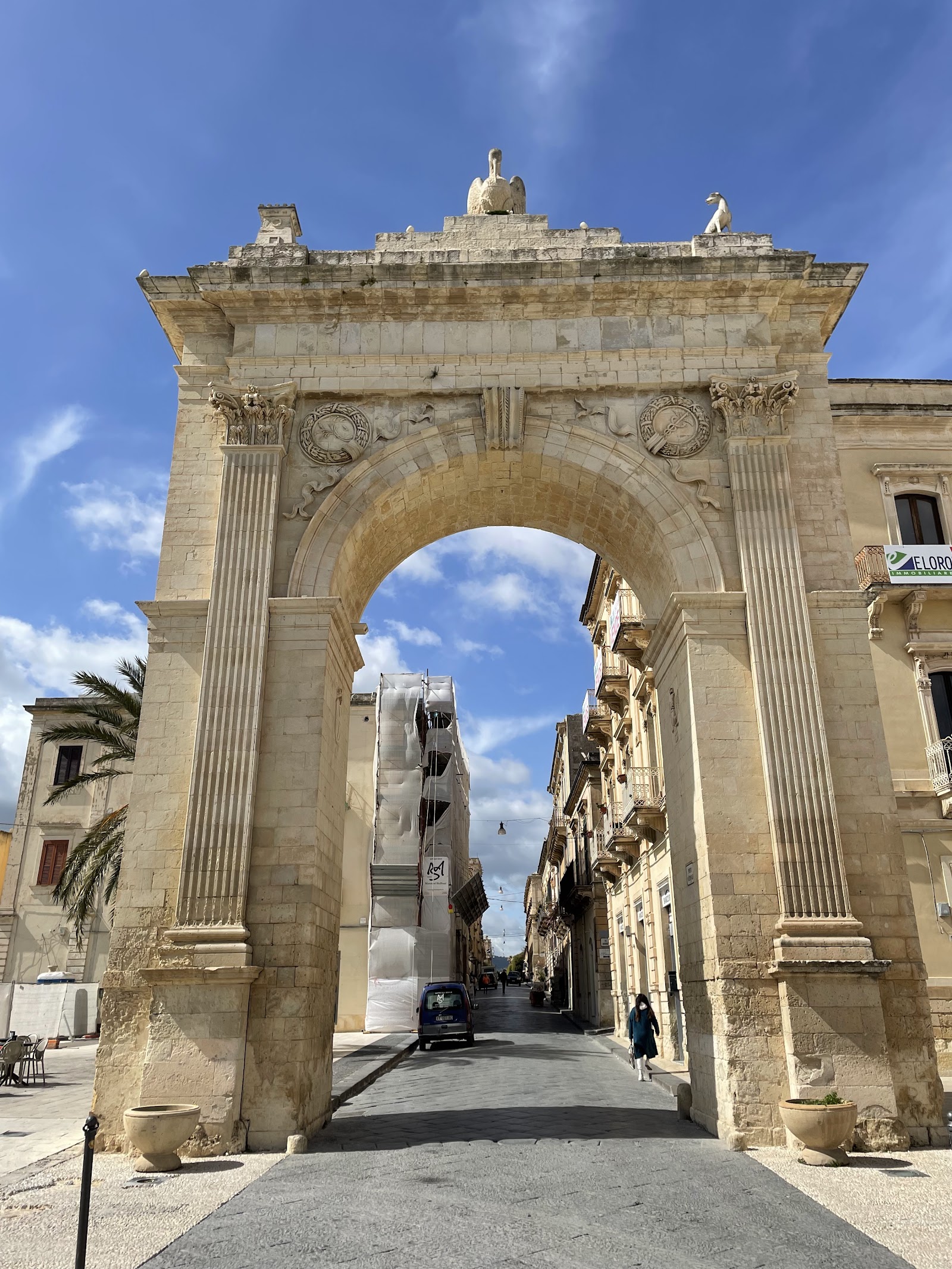
The first thing you notice is the layering: a pointed medieval arch sitting inside a later round one of pale travertine, two different centuries of stonework pressed together like pages in a book. This is Porta Reale — also called Porta Vecchia — the southeastern gate through Grosseto's Medici walls, and the city's main entrance for more than two centuries. Below the arch, two bronze plaques face outward: one marks a 1328 siege, the other the partisans who died in the city's liberation. History here is not curated behind glass.
Pass through and you step into Piazza del Sale — the salt square, named for the commodity that once made this city worth fortifying at all. The River Ombrone, which carried salt upstream toward Florence, once ran close enough to this gate that you could almost hear it.
💛 What travellers fall for
People who return to Grosseto tend to arrive through this gate on foot rather than by car, taking the tree-lined promenade along the top of the Mura Medicee before descending to street level here. The double passage through the walls — two arches in sequence — is easy to miss if you're moving fast. Stand in the middle and look up.
The story behind Porta Reale
The gate's origins go back to 1262, when Captain of the People Vigoroso Cittadini built it as the southern entrance to Grosseto's medieval walls, then called Porta Cittadina. It survived the wholesale redesign of the city's defenses commissioned by the Medici in the 1560s — engineer Baldassarre Lanci drew up the new hexagonal walls in 1564, work began in 1565, and his son Marino and later Simone Genga and Alessandro Pieroni saw it through to completion in 1593. The gate was absorbed into the new fortifications and renamed Porta Reale, becoming the city's sole formal entrance.
In 1854, renovations removed the medieval watchtower, leaving the distinctive double-arch profile visible today. Leopold II of Tuscany had already stripped away most of the smaller towers and guard posts in the preceding decades. When a second gate was cut into the northern walls in 1755 — and a third blasted open by American bombing in April 1943, a gap the city chose to keep — Porta Reale finally ceded its monopoly on the city's comings and goings, and was quietly renamed Porta Vecchia.
Good to know
The gate is open air and free to pass through at any hour. Spring and early autumn are the most comfortable seasons for lingering. The gate itself is the draw; there's no interior to enter. From here, the Cattedrale di San Lorenzo and Piazza Dante Alighieri are a short walk into the historic center.
Spring (mid-April to mid-June) and early autumn (September to early October) are the most comfortable times to stand and look closely at the stonework. Summer afternoons can push past 35°C, though an afternoon mistral sometimes offers relief; winter is mild but can be sharp after dark.
Where is Porta Reale?
More tickets & tours for Porta Reale
Book directly at the provider
What travellers say about Porta Reale
Located high on the hill it’s a birth place for Sicilian architecture and fashion for its day. Ruled by a royal family Marquis. A place worth visiting. The architecture like no other. Grand Buildings , statutes and churches. The power and wealth is seen.
The Porta Reale is not just a gate; it is the official, majestic threshold that welcomes you into the heart of Noto's UNESCO-listed Baroque splendor. It serves as the dramatic start to the famous main street, Corso Vittorio Emanuele. Built in 1838 to honor the visit of King Ferdinand II of Bourbon (hence its alternative name, Ferdinandea), the gate is a beautifully executed piece of neoclassical architecture. It immediately sets the tone for the grandeur you are about to witness in the city. The gate is notable for its ornamental carvings: a siren (symbolizing the wealth of the sea), a tower (symbolizing the city’s strength), and a lion (symbolizing the virtue and power of the King). It’s a great piece of historical symbolism to observe before you step through the arch. Stopping here is essential. It provides a striking photograph and perfectly frames the view of the Corso stretching ahead, inviting you to begin your exploration of the "Stone Garden" of Noto.
Loved Noto, the local craft vendors set up along the street entrance great idea for those who cannot walk far or do hills. The beautiful wide open courtyard gave a peak into the towns immense history of preservation of the church and growth for the future.
Noto with its beautiful arch as you enter, is stunningly beautiful and was one of my favourite towns while visiting Sicily. Noto’s baroque buildings and architecture are beautiful, its centre is compact and easy to visit with bars and restaurants coupled with a relaxed atmosphere.
Nice day trip from Syracuse. Easy train ride to and from. Scenic street with churches and buildings. It is a climb to town from station. Would plan on about 3bhours with lunch there.
More of Grosseto
Discover where to stay, what to do and the best deals for your trip.
Explore Grosseto →More attractions in Grosseto
All of Grosseto →

Background adapted from Wikipedia (CC BY-SA) · map data © OpenStreetMap contributors · ratings & place photos via Google · other photos with per-image credit. Ticket links may earn us a commission at no extra cost to you.