
Piazzale delle Corporazioni

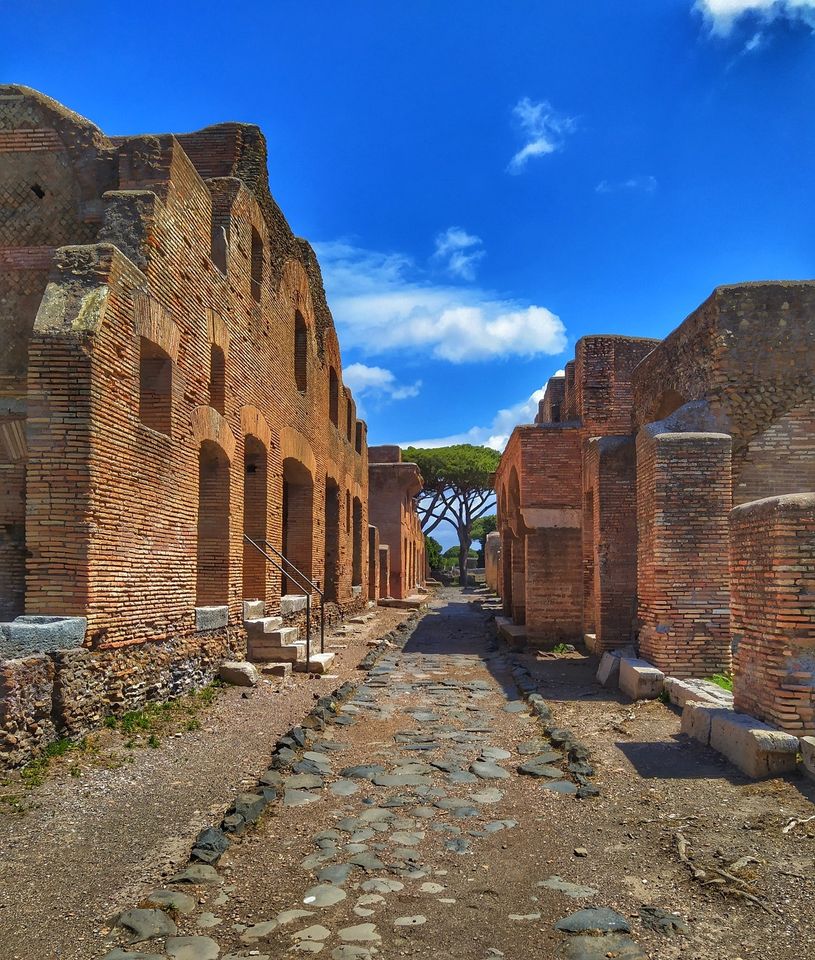
Walk around the back of the Theatre of Ostia Antica and you step into one of the most legible commercial spaces left from the ancient world. The Piazzale delle Corporazioni is a large rectangular portico — 107 by 78 metres — that once housed around 40 trade guilds, each with its own office opening onto a long corridor. The floors of those offices are still mostly there: more than 1,000 square metres of mosaic pavement showing dolphins, grain measures, cargo ships, and the lighthouse at Portus.
This was Rome's logistics hub made permanent in stone and tile. Shipowners from across the empire — navicularii, negotiantes — registered here, and the mosaics they commissioned to mark their doorways tell you exactly what each guild dealt in.

💛 What travellers fall for
People who come back tend to slow down with the mosaics rather than rushing the circuit. Crouch low on the corridor side to read the inscriptions alongside the imagery — the guild names are still legible on several panels. The central temple to Ceres, raised on its podium at the plaza's heart, gives you the best elevated view of the mosaic field as a whole.
The story behind Piazzale delle Corporazioni
Agrippa, Augustus's son-in-law and the empire's most capable builder, initiated the complex around 18–17 BC as a porticus post scaenam — a covered walkway where theatre audiences could shelter or stroll between performances. Its first life was civic and recreational rather than commercial.
Under Claudius the plaza level was raised and a proper portico added. By the 2nd century AD the floor had been entirely re-laid in mosaic and the corridor subdivided among guild offices; the brick dividing walls visible today date to the 3rd century. The central tetrastyle temple on a high podium was built just before AD 96, likely under Domitian, and dedicated to Ceres — goddess of harvest and grain — to whom merchants offered sacrifices before and after dangerous sea crossings.

Good to know
Take Metro Line B to Piramide, then the Roma Lido commuter train to Ostia Antica — a ten-minute walk from the station. The site closes Mondays. Adults pay €18; free on the first Sunday of the month. Wear shoes with grip: the paths are uneven and the mosaic surfaces are protected but the surrounding ground is rough.
May through October gives you the most workable conditions — temperatures between 21 and 28°C and relatively little rain, with July the driest month by far. November is the wettest month on the calendar and the mosaics, already vulnerable outdoors, look their grimmest under low skies; if you visit in winter, the short afternoon closing hours (4:30 PM from late October through February) mean you need an early start.
Where is Piazzale delle Corporazioni?
More tickets & tours for Piazzale delle Corporazioni
Book directly at the provider
What travellers say about Piazzale delle Corporazioni
Amazing! This was once the corporate complex of Ostia Antica that included the theater. It was an open shopping forum. You can't visit the archeological site without finding this treasure. The mosaic guild signs for each storefront are very well preserved. You can pretty much see what each store offered just by looking at the floor designs displayed at the entrances. You'll also see great views of the theater as you're walking along the square. The observation point at the theater was closed due to restoration in May 2025. I totally recommend viewing the entire complex from the top of the theater when it reopens. Do plan your trip before or after the winter months. The mosaics are covered during that time to protect them. They were all uncovered during our visit in early May.
Great to see Roman city life so easily, you walk and walk, climb stairs and see everything for yourselves. It was a city of around 50.000 people and around 17.000 of them were slaves. You can easily recognise the communal baths and toilets to theatre and merchant places. Should be at your 10 great things to do around Rome list. Also great for kids because you can see everything for yourself, our kids loved it. Kids have free entrance and the fee for adults was only €8 in 2016. You can easily spend 4 hours here, so take something to drink and food with you. But there is also a nice place to eat something.
Beautiful open space with scattered statues, eerily beheaded and de-limbed. Relaxed here for a little while before exploring the rest of this beautiful city.
Beautiful this place. Take a guide with
Unfortunately (or fortunately), you might visit during the winter months, when the precious mosaics are covered to protect them from the elements and temperature changes, thus preventing you from fully admiring the beauty of the place. And this time, I was unlucky. However, the importance of the site is palpable regardless, even without seeing the mosaics that tell the story of the place and provide visual evidence of certain practices (among the most famous is supposedly the one depicting the transshipment of goods). It is a vast rectangular area (the long side is over one hundred meters, Editor's note) that had a portico: it was designed together with the theater during the time of Augustus, but it was only during the time of Claudius (mid-1st century AD) that the porticoes were added, and later a raised temple dedicated to some still-unclear deity was erected at its center. Subsequently, the portico was doubled in size, and the areas of the various rooms (about sixty) dedicated to the various commercial guilds present were identified (it is no coincidence that during the twenty-year period, this very square was taken as an artistic and organizational model, when the guilds regained strength). It is believed that the square, the portico, the temple, and the theater were a single whole, not only architecturally but also functionally, and that these mosaics were a sort of advertising banner, funded by private individuals. You'll find it either by approaching from the Via degli Scavi or by turning right onto the Decumanthus near the Theater, which forms an ideal backdrop. Need some info? Leave a like and check out other reviews of Ostia, Rome, and beyond.
More of Ostia Antica
Discover where to stay, what to do and the best deals for your trip.
Explore Ostia Antica →More attractions in Ostia Antica
All of Ostia Antica →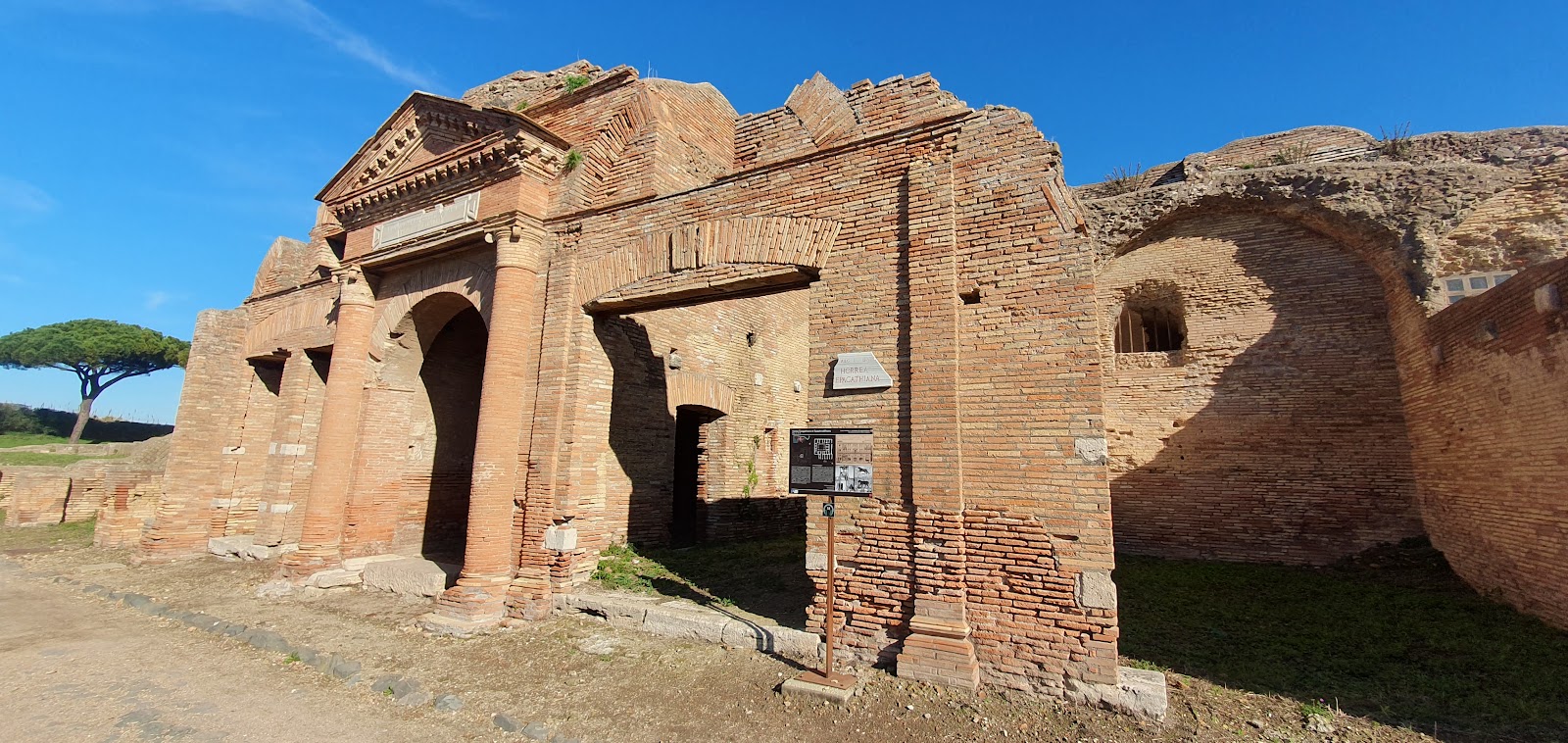

Background adapted from Wikipedia (CC BY-SA) · map data © OpenStreetMap contributors · ratings & place photos via Google · other photos with per-image credit. Ticket links may earn us a commission at no extra cost to you.