
Kanchanaburi War Cemetery
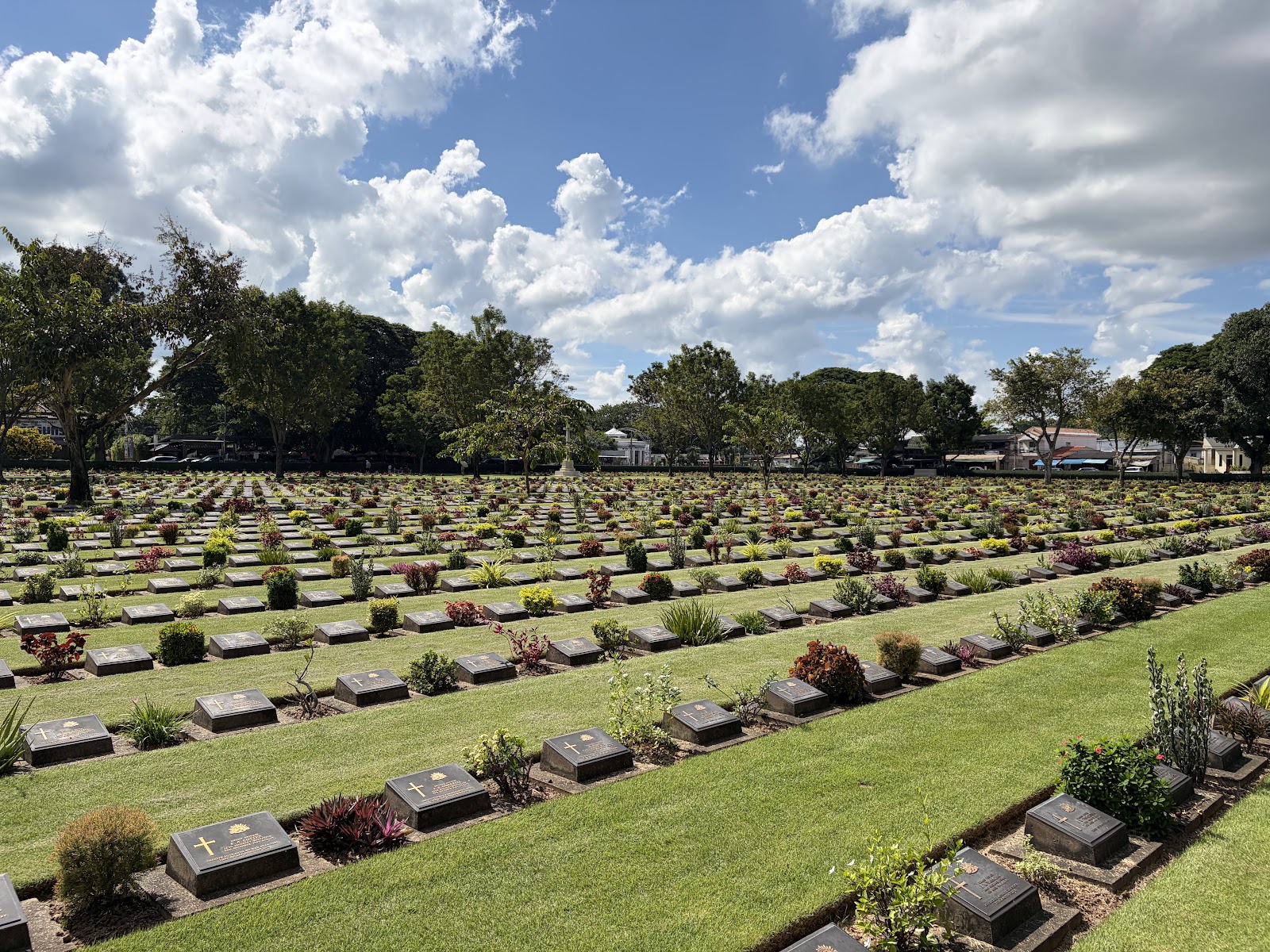
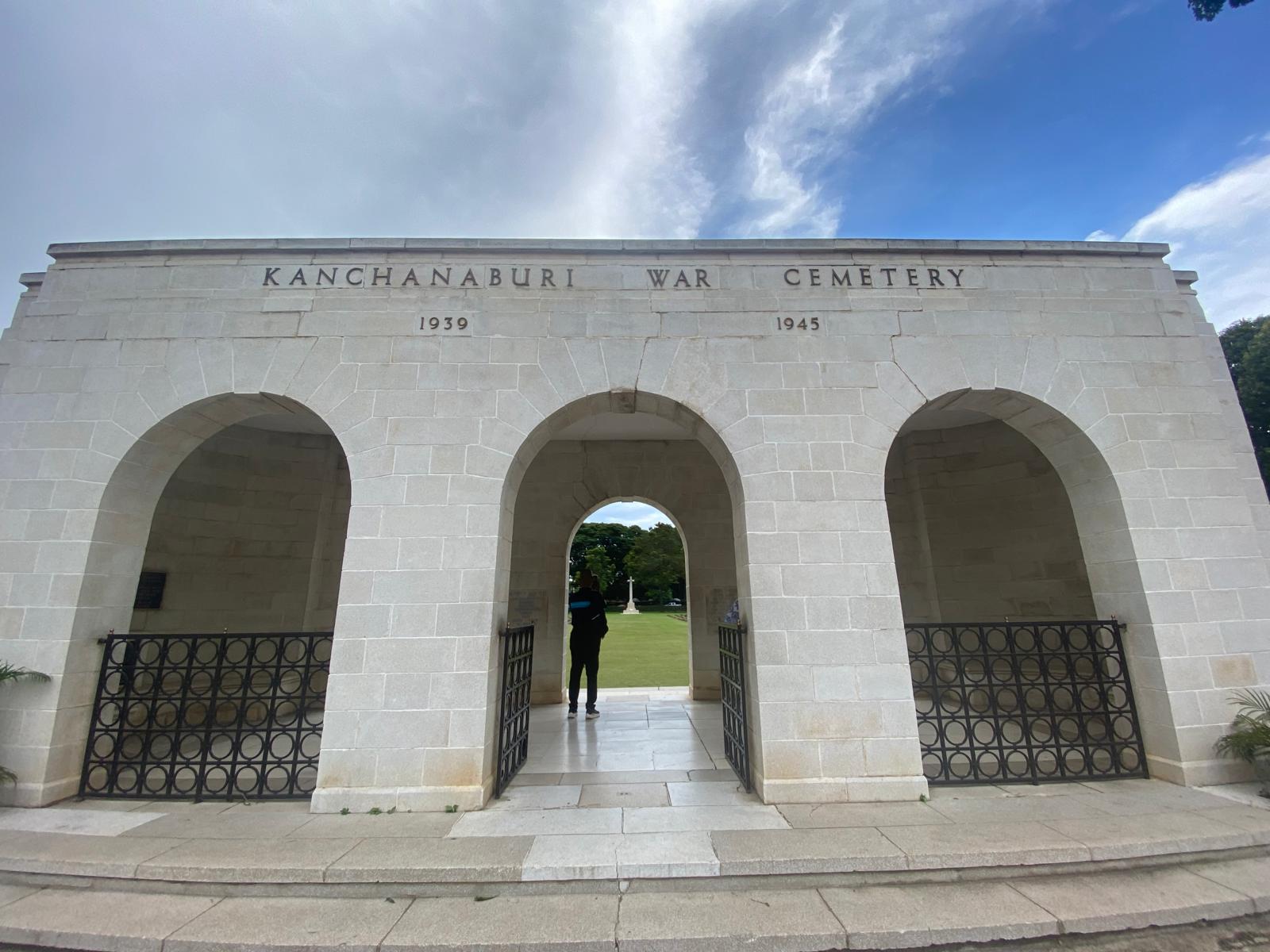
The rows begin almost immediately after you pass through the triple stone arches on Saeng Chuto Road — 6,982 graves laid out across 27,200 square metres of level turf, each one a name recovered from the chaos of the Burma Railway. Most visitors arrive expecting a monument and find instead something quieter: a working garden, tended for decades by a team of six under Senior Head Gardener Wittaya Dabkaew, where the grass is close-cut and the markers are clean.
The graves are arranged by nationality — British on the right, Australian front-left, Dutch to the rear-left — and two of them hold the cremated ashes of 300 men who died in a cholera outbreak at Nieke camp in May and June of 1943. A small plaque in the entrance building records eleven Indian soldiers buried elsewhere, in Muslim cemeteries, so they are not forgotten here either.
💛 What travellers fall for
People who come back tend to walk the full perimeter before anything else — past the Cross of Sacrifice at the far end, around to the Stone of Remembrance on the right, then slowly back through the Dutch section. The Thailand–Burma Railway Centre sits just across the side road and fills in the historical framework that the cemetery itself, by design, leaves to silence.
The story behind Kanchanaburi War Cemetery
Construction of the Thailand–Burma Railway began in June 1942, with Japanese planners setting a 14-month deadline. Two labour forces worked inward from opposite ends — one from Siam, one from Burma — meeting at Konkuita in October 1943. The human cost was catastrophic: Allied prisoners of war and Asian labourers died of disease, exhaustion and violence in large numbers along the line.
After the war, the Army Graves Service transferred all graves from the southern section of the railway — Bangkok to Nieke — to this site. On 24 August 1954, the Thai government and the Allies agreed to establish the permanent cemetery. Architect Colin St Clair Oakes designed the layout, and the Commonwealth War Graves Commission has maintained it ever since.

Good to know
Kanchanaburi is 129 km northwest of Bangkok; trains run from Hualamphong on weekends, stopping roughly 45 minutes for cemetery visits. The station is a ten-minute walk away. Entry is free. Open weekdays 08:00–17:00, Saturday until noon. Watch the uneven pavement at the entrance — it's a genuine trip hazard.
Kanchanaburi is warm year-round. The dry season, roughly November through February, makes for the most comfortable visit; the wet season brings afternoon downpours that can make the turf slippery. Go early in the morning regardless of season — the light is gentler and the grounds quieter.
Where is Kanchanaburi War Cemetery?
More tickets & tours for Kanchanaburi War Cemetery
Book directly at the provider
What travellers say about Kanchanaburi War Cemetery
This cemetery is an essential stop in Kanchanaburi to honor the nearly 7,000 Allied POWs who died during the construction of the "Death Railway." Free Entry.Despite being located near a main road, the cemetery is incredibly quiet. Thanks to the local driving culture, there is very little noise from traffic—just the soft sound of passing vehicles—which keeps the environment calm and respectful. Signage: There are informative displays in both English and Thai, making it very easy to understand the history and significance of the site. Maintenance: The grounds are immaculately kept, creating a beautiful and somber memorial Hours: Officially open from 8:00 AM to 5:00 PM. It is a deeply moving experience and a must-visit to pay your respects and learn about the sacrifices made here during WWII.
An impressive and well-maintained cemetery and historical site. It stands out as one of the better memorial of Thailand‘s history and the location‘s involvement in World War II. It is shocking when you see the pure number of graves here. And that’s only a part of the Western POW that died in Kanchanaburi. And nothing compared to the total numbers of victims here (including locals and Tamils). An important reminder of the devastating power of war.
The grounds are immaculate, with rows of headstones set among carefully kept lawns and flowers. Walking through the cemetery is a quiet and reflective experience, especially knowing the history connected to the Thailand–Burma Railway. It’s a solemn but important place to visit when in Kanchanaburi. The atmosphere encourages respect and reflection, and it serves as a meaningful tribute to those who lost their lives during World War II. A simple, dignified, and moving memorial.
The situation and the end result is just flat out sad and horrifying. A beautiful cemetery for such an unnecessary loss of life. I found victims ranging in age from 21 to 55 and one female. A large section of unknown soldiers. The burial sites of the unknowns in the world always hit me the hardest. From the American pioneers, Custer's Last Stand, this cemetery and beyond.....
Kanchanaburi War Cemetery, located on Sangchuto Rd. in Downtown Kanchanaburi, was a worthy visit historical spot in Kanchanaburi. It was a cemetery for POW during WW II who passed away during the construction of the renowned Death Railway. It was well kept. It wad the 2nd most popular tourist attractions in Kanchanaburi.
More of Bangkok
Discover where to stay, what to do and the best deals for your trip.
Explore Bangkok →More attractions in Bangkok
All of Bangkok →

Background adapted from Wikipedia (CC BY-SA) · map data © OpenStreetMap contributors · ratings & place photos via Google · other photos with per-image credit. Ticket links may earn us a commission at no extra cost to you.