
House of the Vettii

The first thing you see when you cross the threshold of the House of the Vettii is a painting of Priapus, weighing his oversized phallus against a bag of money on a set of scales. The Romans took it as a sign of prosperity. The Victorian archaeologists who excavated the house between 1894 and 1896 were less sanguine — they buried several of the murals under protective dirt rather than let visitors see them.
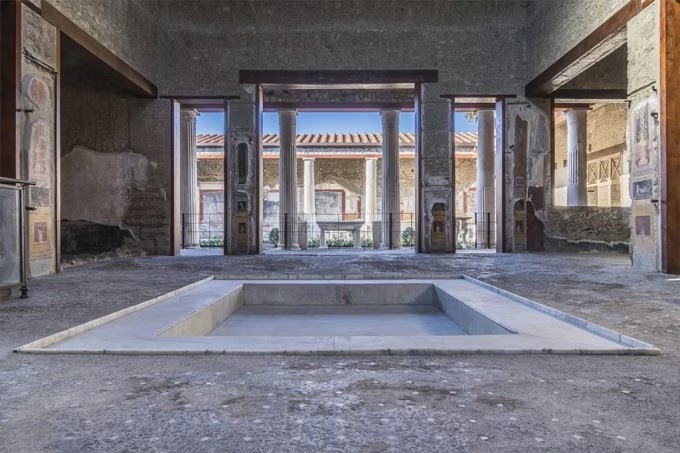
What survived that prudishness, and the two millennia before it, is one of the most complete domestic interiors in Pompeii. The house reopened in January 2023 after twenty years of restoration, and the Fourth Style frescoes — mythological scenes, a famous frieze of Cupids at work making wine and perfume and jewellery — look as deliberate as the day they were painted.

💛 What travellers fall for
People who return tend to slow down in the large peristyle garden, where the layout of the planting beds has been reconstructed. The Cupid frieze in the main reception room rewards a second look — pick out the sequence of trades depicted and you start reading it less as decoration and more as a statement of where the owners' money came from.
The story behind House of the Vettii
Aulus Vettius Conviva and Aulus Vettius Restitutus were freedmen — formerly enslaved people who had bought or earned their freedom — who built their fortune, most likely through the wine trade, into something considerable enough to own one of the largest private houses in Pompeii. Conviva held the office of Augustalis, the highest civic rank available to freedmen under the imperial system.
The house as visitors see it today was largely rebuilt and redecorated after the earthquake of 62 AD, seventeen years before Vesuvius buried it. The wall paintings were executed in what art historians call the Pompeiian Fourth Style — dense mythological narratives across four bedrooms and a dining room. The absence of a tablinum, the room typically used by a Roman paterfamilias to receive clients, is one small tell that the Vettii were writing their own version of respectability rather than inheriting it.
Good to know
The house is included in the standard Pompeii park ticket. Enter via Porta Marina, a short walk from Pompei Scavi station on the Circumvesuviana line from Naples (36 min, €3.40). April–May and September–October are the most comfortable months. The site is entirely on foot over ancient cobblestones — wear sturdy shoes.
The house sits within the open archaeological park, so summer heat matters. June through August temperatures can push past 35°C with little shade inside the ancient city. April, May, September, and October offer temperatures between 18 and 24°C and longer light — the more practical choice for a long visit.
Where is House of the Vettii?
More tickets & tours for House of the Vettii
Book directly at the provider
What travellers say about House of the Vettii
Absolutely amazing that so much of this has survived for 2000 years! Casa dei Vettii is probably the best house to visit in Pompeii. Huge and beautiful!
Really is the star of the show . The artefacts the murals the ceilings and floor tiling areall on show at their best and from a time that is incomprehensible. It truly is amazing and deserves to be at the top of everything that Pompeii professes to be and is. Do not miss this make it at the top of your must see list if you go to Pompeii. This is the original and first areas to be considered excavated and was why I returned 35 years later. Magnificent breath catching history at its best.
This luxurious residence houses an impressive collection of Fresco decorations typical of the wall paintings in the houses of rich Pompeian traders. The excavation techniques used made it possible to preserve, in almost all the rooms in the complex, the fourth-style figure paintings completed after the earthquake of 62 A.D..The brothers Aulus Vettius Restitutus and Aulus Vettius Conviva commissioned their Fresco decorations from one of the leading artists; workshops so that their home would be not only a comfortable residence but also a status symbol. The house is divided into two areas firstly, the part in which the family lived, laid out around the main Atrium and the Peristyle with its beautiful garden (this house does not have the Atrium and the peristyle which was used as a sort of office for the household business. This was where the tabulae, or accounts and other documents, were kept. 'Tablinum which was traditionally built between the two, opposite the main entrance); and secondly, the part where the servants lived and worked, on the right of the entrance hall and centred around a small Atrium with a Lararium. The wall facing the entrance is decorated with a Fresco of Priapus weighing his phallus on a pair of scales and a sheep with the attributes of Mercury, the god of financial income, which here serve to protect the house from bad luck and as propitiatory symbols of wealth. The Atrium is decorated with scenes depicting sacrifices, hunts and cupids while two strong-boxes are anchored to stone blocks in the floor.The decision to site them here can probably be explained by the desire of the masters of the house to underline their wealth and importance. The rooms laid out on the left of the entrance hall are decorated with mythological subjects, which are described below.On the right-hand wall in the first room we can see a Fresco depicting the myth of Leander swimming towards his beloved Hero, while the opposite wall portrays Ariadne abandoned by Theseus on Naxos.
One of the most beautiful house in Pompei. It’s very interesting to see all the beautiful paintings. They are beautiful preserved. Take time to visit them!
The Casa dei Vettii, or House of the Vettii, is an exquisite example of Pompeian architecture, showcasing the opulence and cultural vibrancy of its time. This splendid residence features elaborate frescoes that depict mythological scenes and lavish ornamentation, reflecting the wealth of its former owners. The harmonious layout, including a stunning atrium and lush garden, invites visitors to envision the lively social gatherings that once took place within its walls. As you explore the intricately decorated rooms, you are transported into a world of ancient luxury and artistry, making the Casa dei Vettii a must-visit destination for anyone interested in the rich history of Pompeii. Each detail tells a story, revealing the intimate connection between art, culture, and daily life in this captivating ancient city.
More of Pompeii
Discover where to stay, what to do and the best deals for your trip.
Explore Pompeii →More attractions in Pompeii
All of Pompeii →

Background adapted from Wikipedia (CC BY-SA) · map data © OpenStreetMap contributors · ratings & place photos via Google · other photos with per-image credit. Ticket links may earn us a commission at no extra cost to you.