
House of Neptune and Amphitrite
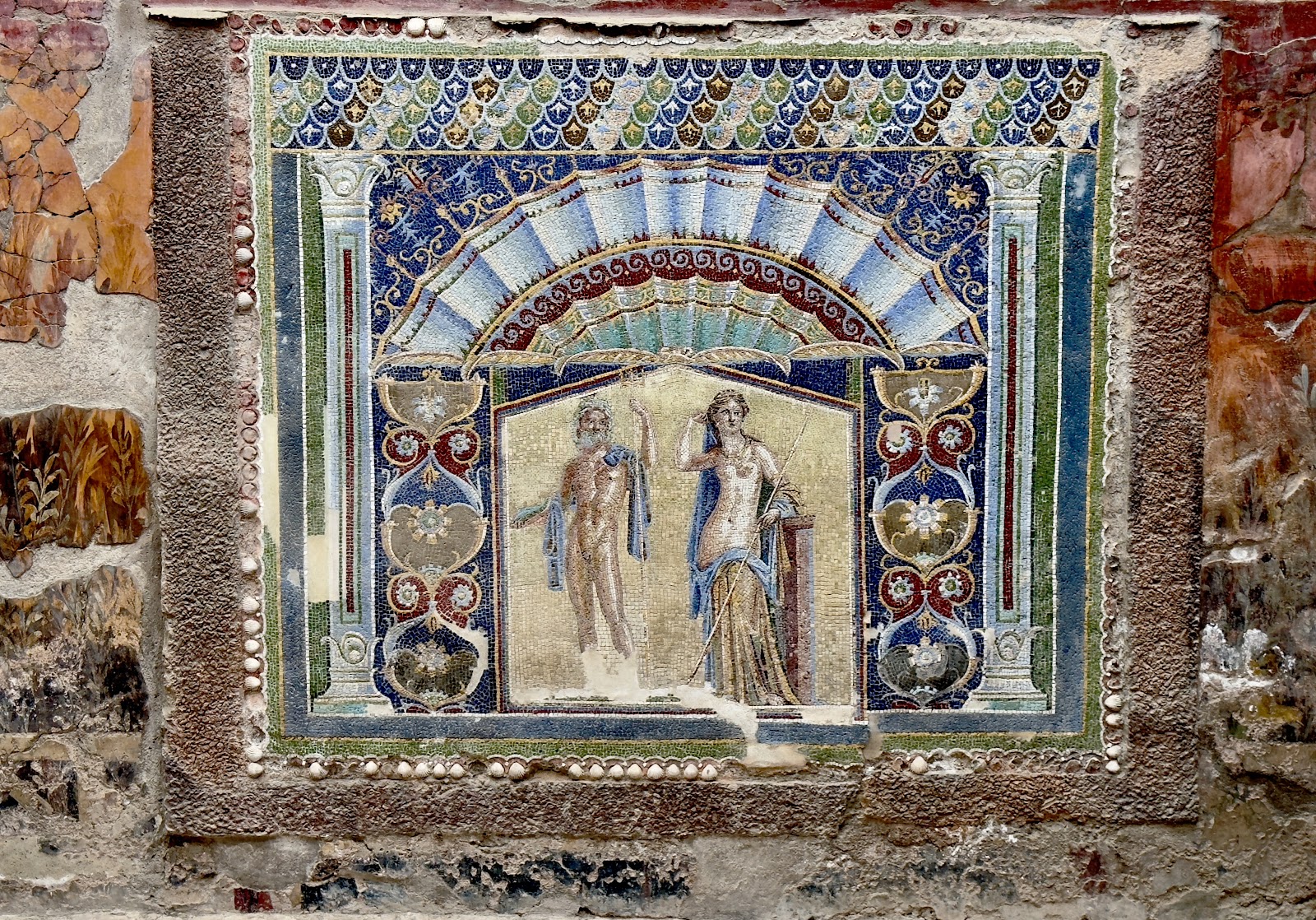
The mosaic stops you mid-step. Neptune stands with his trident, Amphitrite beside him holding a long staff, both rendered in tiny pieces of blue glass — likely imported from Alexandria — that still hold their colour after two thousand years under volcanic rock. The frame around them is made of sea shells.
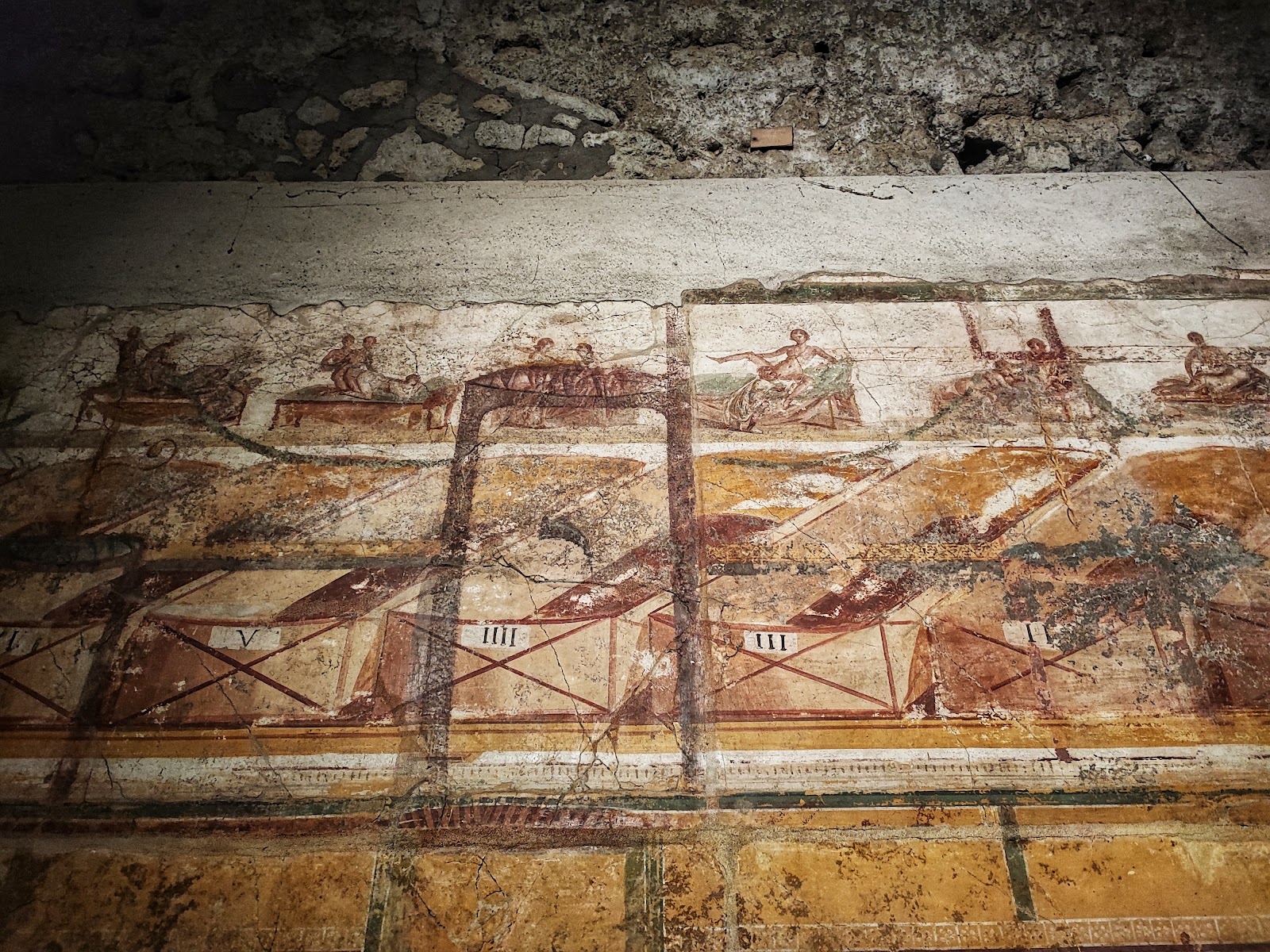
This was a merchant's house, compact at around 200 square metres, built in the first century CE on what was then Herculaneum's busiest street. On one side, a summer dining room with a marble basin fountain. On the other, a wine shop whose wooden railings and original wine racks survived the eruption of 79 CE intact.

💛 What travellers fall for
People who've visited more than once tend to slow down at the wine shop rather than the mosaic — the wooden fittings, still standing after two millennia, have a quieter kind of power. Also worth pausing at the atrium corner, where a small lararium once held a bronze Jupiter and a herma of Hercules.
The story behind House of Neptune and Amphitrite
The house was built sometime in the first century CE and buried on 24 August 79 CE when Vesuvius erupted. It lay sealed beneath metres of volcanic material until 1738, when excavations — triggered by a farmer sinking a well — began revealing Herculaneum's streets.
No owner's name has ever been confirmed, but the layout tells a story: a respectable atrium house with a street-facing wine shop that the owner almost certainly leased out rather than ran himself. The mosaic that gives the house its modern name was almost certainly a statement of wealth — glass paste in those colours, at that scale, was not cheap.

Good to know
Take the Circumvesuviana or Campania Express to Ercolano Scavi — about 20 minutes from Naples, then an 8-minute walk. Hours run 8:30am–7:30pm (April–October), shorter in winter. Entry is free the first Sunday of each month. Skip hunting for the frescoes and lararium remnants here — they're in the Naples Archaeological Museum.
Where is House of Neptune and Amphitrite?
More tickets & tours for House of Neptune and Amphitrite
Book directly at the provider
What travellers say about House of Neptune and Amphitrite
A mosaic depicting Neptune and Amphitrite is on the wall of a nymphaeum designed for banquets on Cardo IV Superiore in ancient Herculaneum, Italy.
Herculaneum is completely different from Pompeii and absolutely worth a visit. Here the pyroclastic flow protected the roofs of the buildings and made it harder for treasure hunters to loot the place in the 1500s. It is far smaller than Pompeii but also very richly appointed. Herculaneum was a seaside resort for very rich Romans, and it shows in the way, the villas are decorated. We spent an hour and a half here on a guided tour, and could’ve spent three hours here.
Yep
not to miss
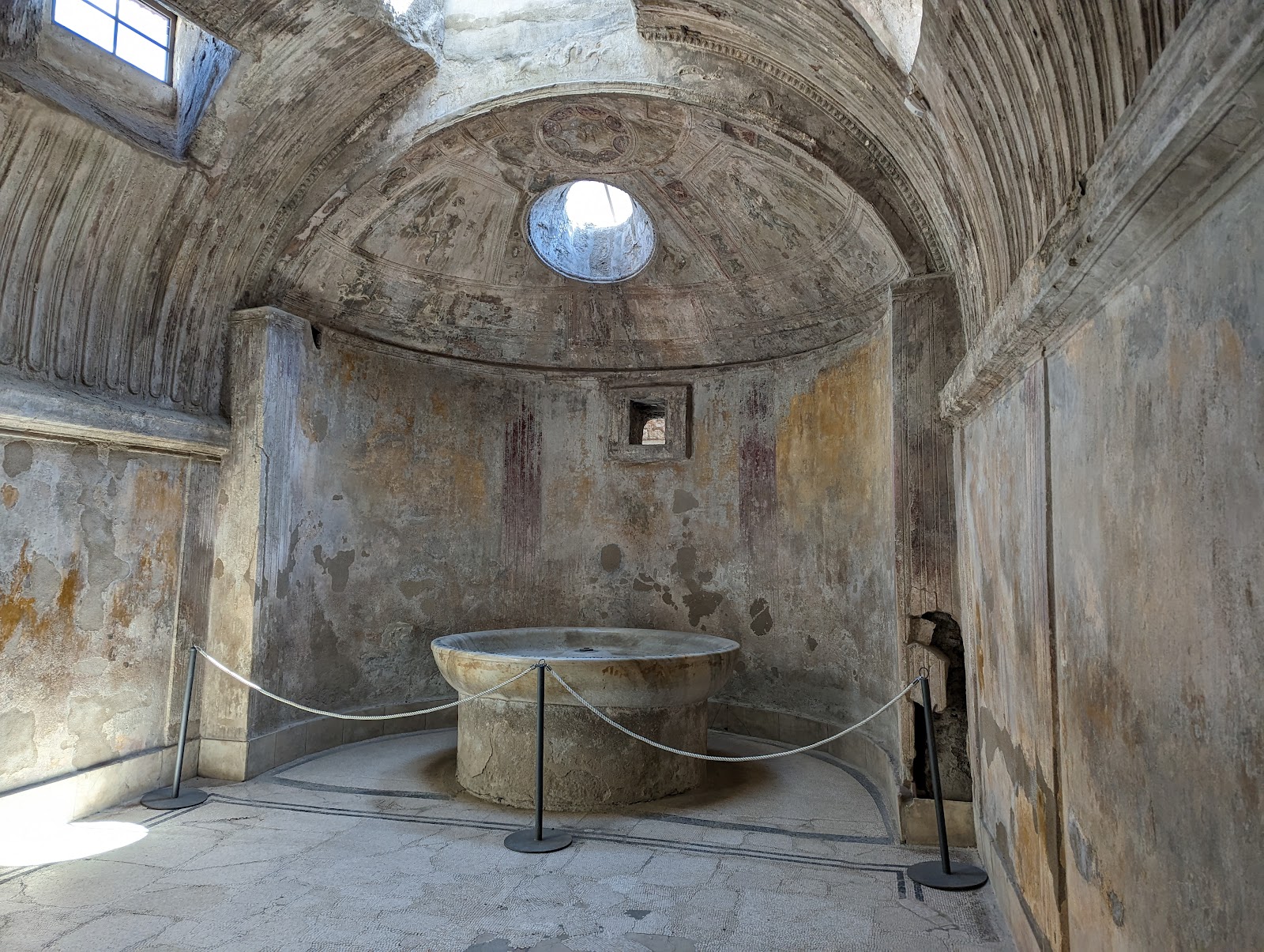
Herculaneum: a time capsule on the Gulf of Naples Where Pompeii carries the fame, Herculaneum whispers its story – but with more power than you might suspect. Smaller, more intimate, and surprisingly better preserved, this ancient city offers an experience you don't just see, but feel. What makes Herculaneum unique is the stunning state in which the houses, mosaics, and wooden structures have been preserved. The smaller streets and compact layout create an intense sense of intimacy, as if you are walking through a neighborhood where the residents have just left. The baths are impressive in their detailing – from the marble benches to the decorated walls – and clearly demonstrate how refined daily life here once was. In Herculaneum, you are not guided by the ruins, but by the feeling that you have traveled through time yourself. Those looking for less crowds, more detail, and a deeper sensory experience of Roman life will find a hidden gem in Herculaneum. A place where the past comes tangibly close.
More of Herculaneum
Discover where to stay, what to do and the best deals for your trip.
Explore Herculaneum →More attractions in Herculaneum
All of Herculaneum →

Background adapted from Wikipedia (CC BY-SA) · map data © OpenStreetMap contributors · ratings & place photos via Google · other photos with per-image credit. Ticket links may earn us a commission at no extra cost to you.