
Fushimi Inari Taisha
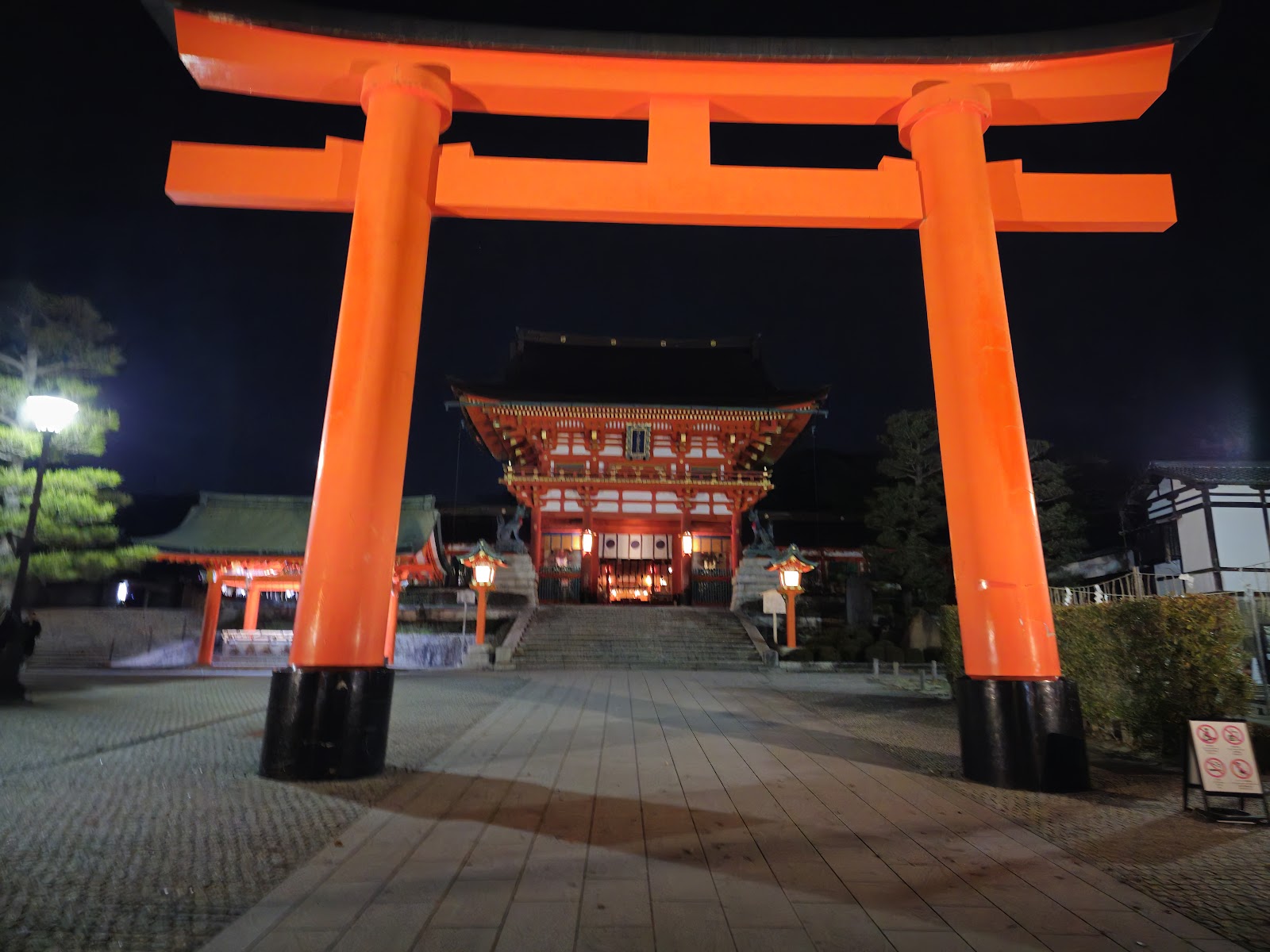
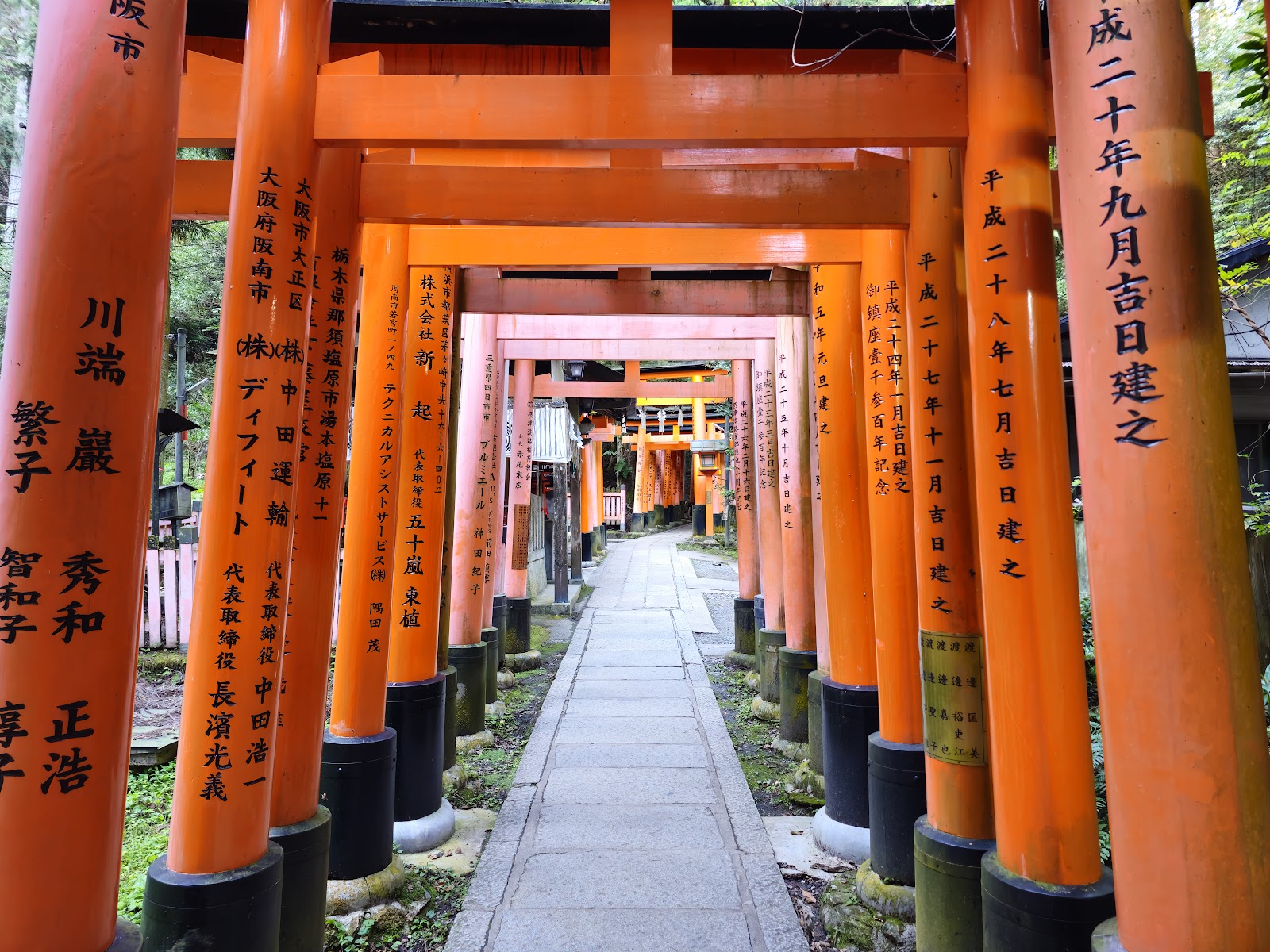
The first torii gate at Fushimi Inari Taisha stands close enough to Inari Station that you pass through it before you've fully arrived. Then another, and another — until you're inside the Senbon Torii, a corridor of roughly 800 vermilion gates stacked so tightly they filter the daylight orange. This is the lower section, and it's where most visitors stop.
Beyond it, a 4-kilometre trail climbs the 233-metre holy mountain of Inariyama, past fox statues clutching keys in their mouths, past teahouses and smaller shrines, all the way to the summit at Ichinomine. The full circuit takes two hours and most of the crowds don't make it past the halfway point.
💛 What travellers fall for
People who've done the full loop tend to say the same thing: leave early or arrive after dark. The Senbon Torii at 6 a.m. or by lantern-light is a different place entirely. Stop at Yotsutsuji intersection on the way up — about 30 minutes in — where the trees open onto a wide view south over Kyoto. The inari sushi sold at the trailside stalls is worth trying here rather than in the city.
The story behind Fushimi Inari Taisha
The shrine traces its founding to 711 CE, when Hata no Irogu of the Hata clan — immigrant settlers from the Korean Peninsula — enshrined Inari Okami on one of the three peaks of Mount Inari. The Hata were among Kyoto's most powerful early families, and their shrine grew accordingly: by 942 it had been elevated to the highest rank in the Shinto hierarchy. In 816, at the request of the monk Kūkai, the main structures were relocated to their current position on the mountain.
The Honden, the main shrine building, dates to 1499 and is designated an Important Cultural Asset. The Romon Gate came later — donated in 1589 by Toyotomi Hideyoshi, who had prayed here the previous year for his mother's recovery. The torii gates that line the trails were added incrementally by merchants and guilds across the Edo period, a tradition of donation that eventually produced the roughly 10,000 gates standing today.

Good to know
Take the JR Nara Line from Kyoto Station to Inari — five minutes, second stop, and the shrine entrance is directly in front of you. Entry is free, the trail is open around the clock. Avoid the lower gates between 9 a.m. and 4 p.m. if crowds bother you. Budget two hours minimum for the full mountain circuit.
Spring and autumn are the most comfortable seasons for the hike — cherry blossoms appear on the lower slopes in spring, and the deciduous trees turn in November. Summer is hot enough to make the climb genuinely taxing; go at dawn or after sunset. Winter brings thin crowds and, occasionally, snow on the upper trails, which changes the atmosphere considerably.
Where is Fushimi Inari Taisha?
More tickets & tours for Fushimi Inari Taisha
Book directly at the provider
What travellers say about Fushimi Inari Taisha
If you're planning to visit Fushimi Inari, do not show up at 11 AM — that's when the crowds turn this spiritual place into a tourist conveyor belt of selfie sticks and Instagram posing. You want to be there at 5 AM. Yes, 5 in the morning. I got lucky and arrived early. Here's the game-changer: instead of following the main crowd up the easier left path, take the right-hand path (the steeper one). It's a proper hike, but you'll have the entire mountain practically to yourself while everyone else is bottlenecked on the "easy" route. By the time you reach the summit, the descent becomes effortless — and you'll see everything the latecomers see, except you'll actually have space to breathe and take beautiful photos without fighting through a wall of people. Meanwhile, the 11 AM crowd wastes hours shuffling through crowds for worse views and worse pictures. Bottom line: Early bird gets the torii gates (and the serenity). The steep right path is worth every step.
I recently visited Fushimi Inari Taisha, and it was one of the highlights of my trip to Kyoto. We decided to go in the afternoon, and it turned out to be a great choice because there were fewer people than we expected. The atmosphere was much more peaceful, making it easier to enjoy the walk and take photos without large crowds. I would definitely recommend visiting either at sunrise or before sunset, just as we did, since these times offer a more relaxed experience and beautiful lighting. One of the best things about Fushimi Inari Taisha is that entry is completely free, making it an excellent attraction for any traveler. The shrine is famous for its impressive network of more than 10.000 torii gates, which create a unique and unforgettable path through the forested hillside. Walking beneath these vibrant red gates is a truly special experience and gives the place a magical atmosphere. The grounds are well maintained, and there are several spots along the trail where you can stop to admire the views of Kyoto. Overall, I highly recommend visiting Fushimi Inari Taisha. It is a beautiful, iconic destination that combines history, culture, and nature into an unforgettable experience.
A truly iconic and unforgettable visit, famous for its endless rows of vermilion torii gates winding up the mountainside. Walking through the gates feels both atmospheric and unique, offering a striking blend of nature, spirituality, and tradition. It is highly recommended to go early in the morning, as the sheer volume of tourists can quickly become overwhelming later in the day. Visiting early allows for a much more peaceful and immersive experience. One useful tip is to also look at the reverse side of the torii gates, where you can see the inscriptions and dedications—an often overlooked detail that adds deeper meaning to the walk. Overall, a must-visit landmark in Kyoto that is both visually stunning and culturally significant.
This is one of the most iconic and memorable places in Japan. The famous rows of red torii gates create a truly unique atmosphere that you won’t find anywhere else. Walking through the gates feels almost surreal — it’s peaceful, cultural, and very photogenic. The deeper you go, the quieter it gets, which makes the experience even more special. It’s also free to enter, which makes it very worth it for the experience you get. If you enjoy walking and exploring, this place is perfect. Along the way, you’ll find small shrines, scenic spots, and even some viewpoints overlooking Kyoto. But Be prepared — it can be physically tiring. The full hike goes uphill and can take quite some time, especially if you go all the way to the top. If you’re not used to walking or if your stamina is limited, it might feel exhausting. The lower area is usually very crowded, especially during peak tourist hours. It can feel a bit too packed, which takes away from the peaceful experience. Also, since it’s an outdoor hike, weather plays a big role. It can get very hot in summer or slippery during rainy days. This is a must-visit, especially for first-time visitors to Japan. Just make sure to pace yourself, wear comfortable shoes, and don’t feel pressured to go all the way to the top — even a partial walk is already worth it.
If you're visiting Kyoto, Fushimi Inari Taisha is absolutely worth your time. The thousands of bright vermilion torii gates create one of the most iconic and photogenic walks in Japan. While many people stop at the famous gate tunnels near the entrance, continuing further up the mountain offers a much quieter atmosphere, beautiful forest scenery, and fewer crowds. I recommend arriving early in the morning or later in the evening to enjoy the experience more comfortably. The shrine grounds are open 24 hours, making it possible to avoid peak tourist hours. Wear comfortable shoes if you plan to complete the full hike, as the trail can take around 2 to 3 hours round trip. Along the route, there are several viewpoints, smaller shrines, and local food stalls where you can take breaks. The combination of cultural significance, natural surroundings, and unique architecture makes this one of the most memorable places in Kyoto
More of Kyoto
Discover where to stay, what to do and the best deals for your trip.
Explore Kyoto →More attractions in Kyoto
All of Kyoto →
Background adapted from Wikipedia (CC BY-SA) · map data © OpenStreetMap contributors · ratings & place photos via Google · other photos with per-image credit. Ticket links may earn us a commission at no extra cost to you.