
Fontana dell'Elefante
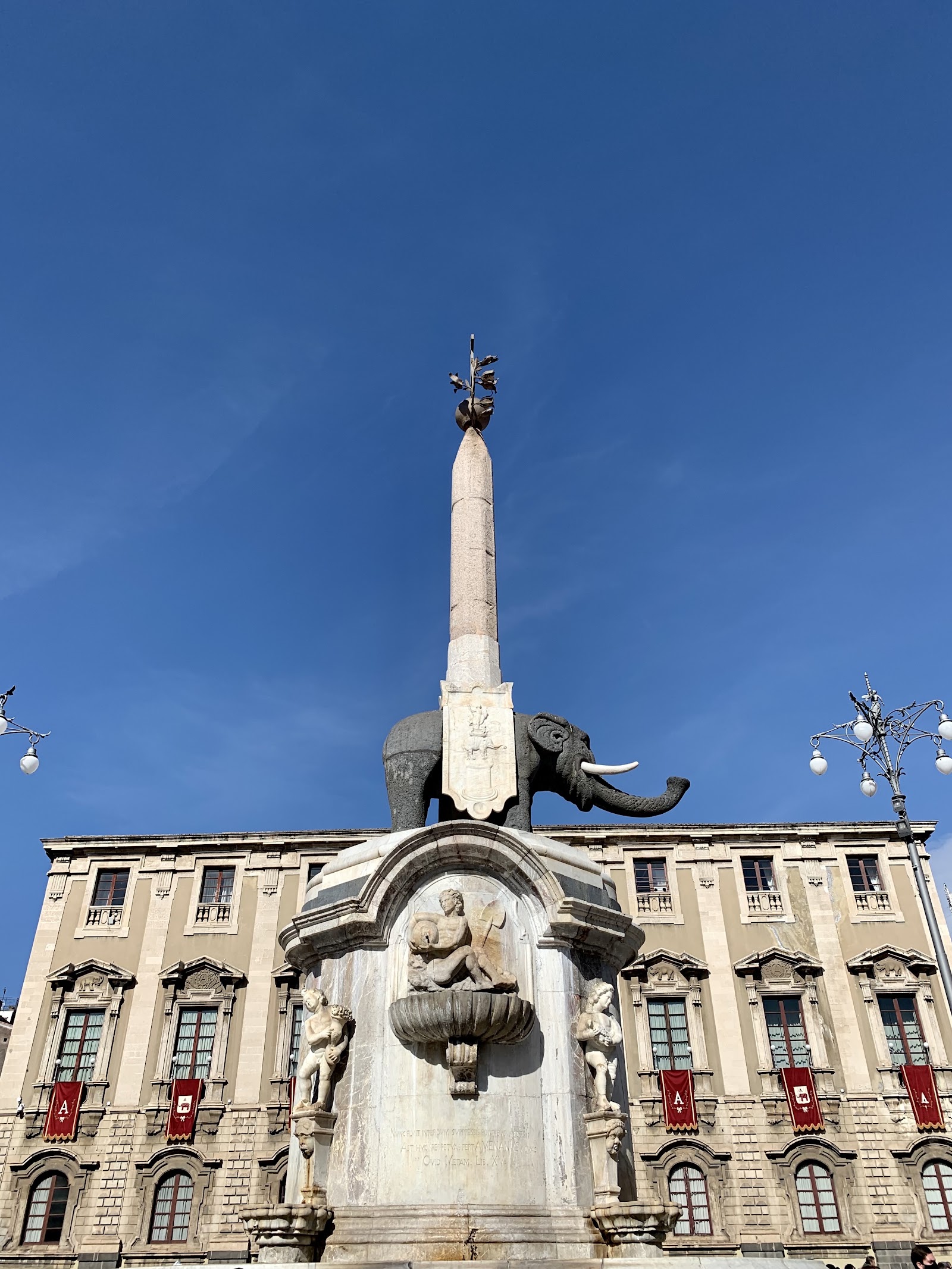
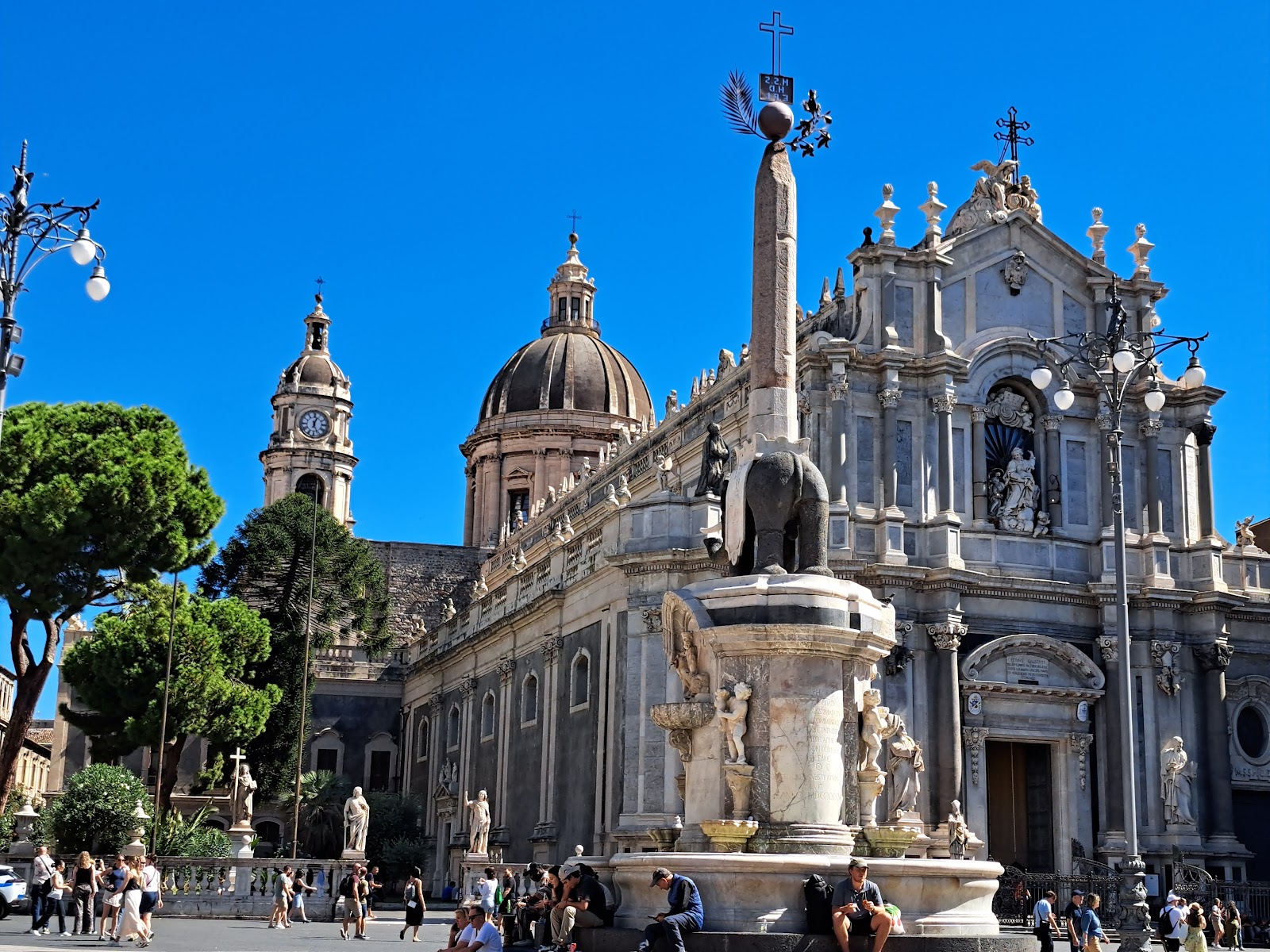
At the centre of Piazza del Duomo stands a small black elephant carved from a single block of lava stone, age unknown, balancing an Egyptian obelisk on its back. Catanians call it u Liotru — a name that, through dialect drift, traces back to the Greek word for sun-measurer, because the elephant also functions as the gnomon of a sundial set into the piazza's paving.
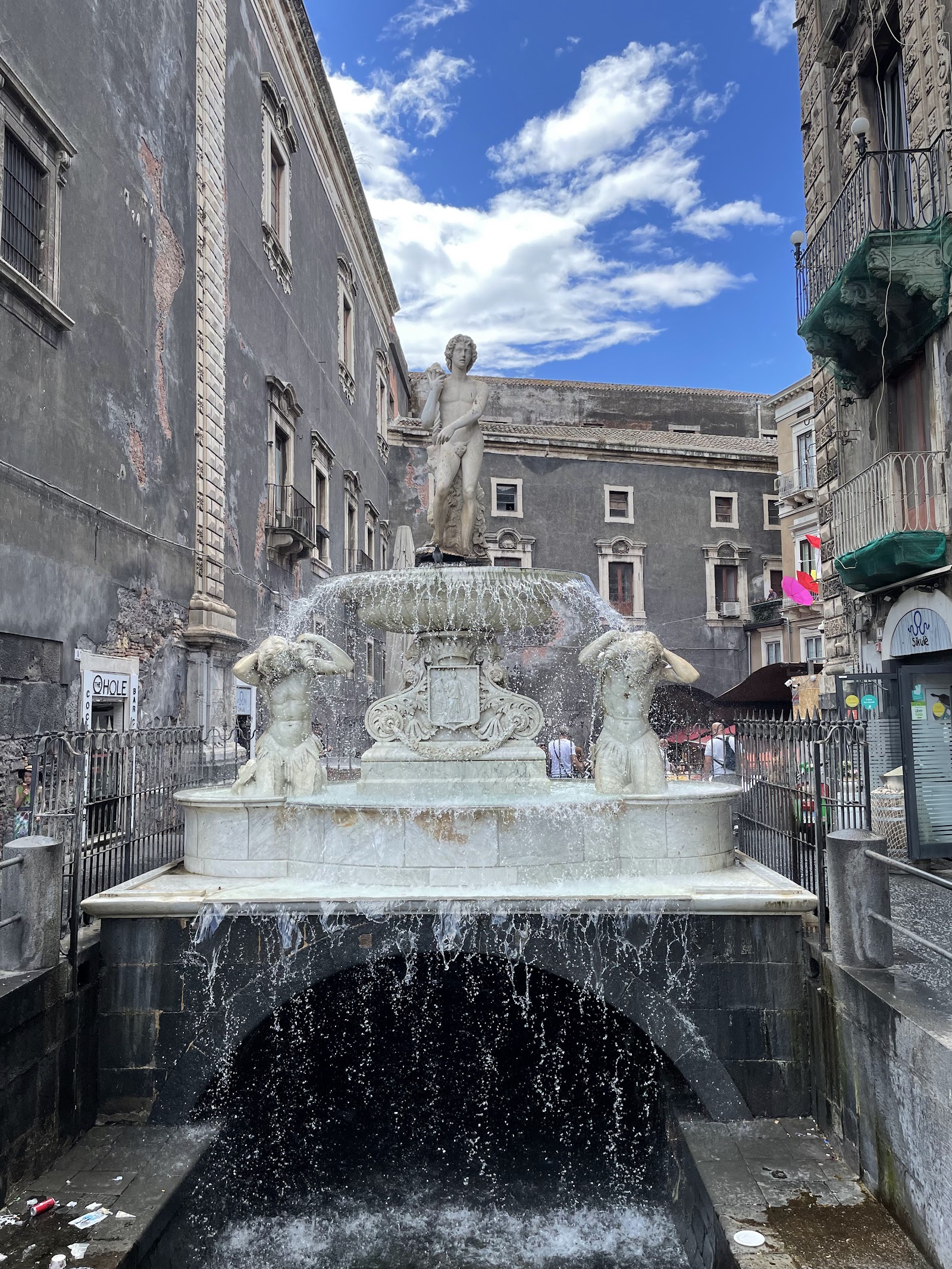
The fountain is the city's emblem, its coat of arms, its shorthand. Two river figures flank the marble base — the Simeto and the Amenano — and water jets fall into a shallow basin below. The obelisk above carries no true hieroglyphics, only Egyptian-style figures arranged decoratively, their meaning unresolved after nearly three centuries.
💛 What travellers fall for
People who come back to Catania tend to check in on the elephant first, before anything else. Worth crouching down to look at the base: the white limestone fangs and pale eyes that Vaccarini added during restoration are easy to miss from standing height, and they change the animal's expression entirely.
The story behind Fontana dell'Elefante
The fountain was designed by Giovanni Battista Vaccarini, a Palermo-born architect, between 1735 and 1737 — part of the wholesale rebuilding of Catania after the earthquake of January 11, 1693 levelled much of the city. Vaccarini found the elephant statue already in Catania, its origins uncertain, and set it on a white marble pedestal in the piazza's centre, completing the composition with a granite obelisk 3.66 metres high, thought to originate from Syene.
The fountain has been revised repeatedly since: a basin added in 1757, an iron fence and small garden installed in 1826, a second basin in 1905, and the fence removed again in 1998. A restoration funded by the Italian government and local authorities was completed in 2013. The elephant itself had been chosen as Catania's civic symbol as far back as 1239.
Good to know
The piazza is open around the clock with no entry fee. Early morning is quieter and the low light catches the basalt well. Catania Centrale station is about a 20-minute walk; several AMT buses stop nearby. No interior to enter — plan for 20 minutes here, then continue along Via Etnea or down to the Mercato della Pescheria.
Summer in Catania is hot and dry; the white marble of the piazza reflects heat noticeably by midday in July and August. Spring and autumn offer mild temperatures that make lingering in the square comfortable. Winter visits are rarely cold enough to deter, and the piazza is quieter.
Where is Fontana dell'Elefante?
More tickets & tours for Fontana dell'Elefante
Book directly at the provider
What travellers say about Fontana dell'Elefante
Visited Catania for a city break. Would thoroughly recommend. People are friendly. It felt safe. Food is delicious with lots of choice and very reasonably priced. There are great places to visit. Highlights include the amphitheatre is well worth a visit, also the band stand as a viewpoint, the museum next to the cathedral has a great vista from the top, and of course Etna, although it was snowing when we visited.
You simply cannot miss the city's central square with its elephant fountain. It is always bustling—both day and night. It is safe, and there are plenty of tourists.
The Fontana dell’Elefante, affectionately known as “u Liotru,” is one of the most charming and iconic symbols of Catania. Located in the bustling Piazza Duomo, this unusual monument immediately captures attention with its whimsical design and deep cultural significance. At its center stands the famous black lava stone elephant, a figure that has become inseparable from the city’s identity. Its expressive, almost playful appearance contrasts beautifully with the elegant Baroque elements that surround it. The fountain’s composition is both unexpected and captivating. The elephant supports an Egyptian-style obelisk, creating a striking visual combination that feels at once historic, mystical, and delightfully quirky. This unlikely pairing sparks curiosity and invites visitors to explore its legends, many of which reflect Catania’s complex past and the clever imagination of its people. The location of the fountain enhances its appeal. As the focal point of the square, it offers a perfect vantage point to take in the cathedral, surrounding palaces, and the lively urban atmosphere. Whether visited in the golden morning light or during the vibrant evening hours, the monument feels alive, continuously engaging locals and travelers alike. Beyond its artistic qualities, the Fontana dell’Elefante serves as a beloved cultural emblem. It represents resilience, humor, and the unique spirit that defines Catania. Spending time near the fountain provides not only a visual treat but also a glimpse into the soul of the city. For anyone exploring Catania, “u Liotru” is an essential stop—memorable, distinctive, and deeply connected to the character of the place.
Day or night worth visiting. So much of history and stories at this square. Been there for 5 consecutive evenings and every time there were multiple live singers performing. The Elephant Fountain from 1737 had garden around until 1998, fountain contains depictions of 2 Catania's rivers. Elephant became symbol of Catania. An ancient tale claims a dwarf elephant lived in Sicily and defended early Catanese people from wild animals. Or that the 8th-century magician Eliodoro (hence "Liotru") created the lava stone elephant to protect Catania from Etna's eruptions and to be kept as a magical talisman. Elephant is made from basalt - cooled down lava as a reminder of Mount Etna vulcano. It was inspired by the 'Elephant and obelisk' from 1667, standing in Minerva, Rome. That one carries real Egyptian obelisk with hieroglyphs. One in Catania has meaningless hieroglyphs-like carvings.
A wonderful place set in historic surroundings. The atmosphere is both charming and authentic, giving you a real sense of the city’s heritage. It’s an ideal spot to enjoy the beauty of the architecture and the stories hidden in its walls. Highly recommended for anyone interested in history and culture
More of Catania
Discover where to stay, what to do and the best deals for your trip.
Explore Catania →More attractions in Catania
All of Catania →
Background adapted from Wikipedia (CC BY-SA) · map data © OpenStreetMap contributors · ratings & place photos via Google · other photos with per-image credit. Ticket links may earn us a commission at no extra cost to you.