
Tomb of the Diver
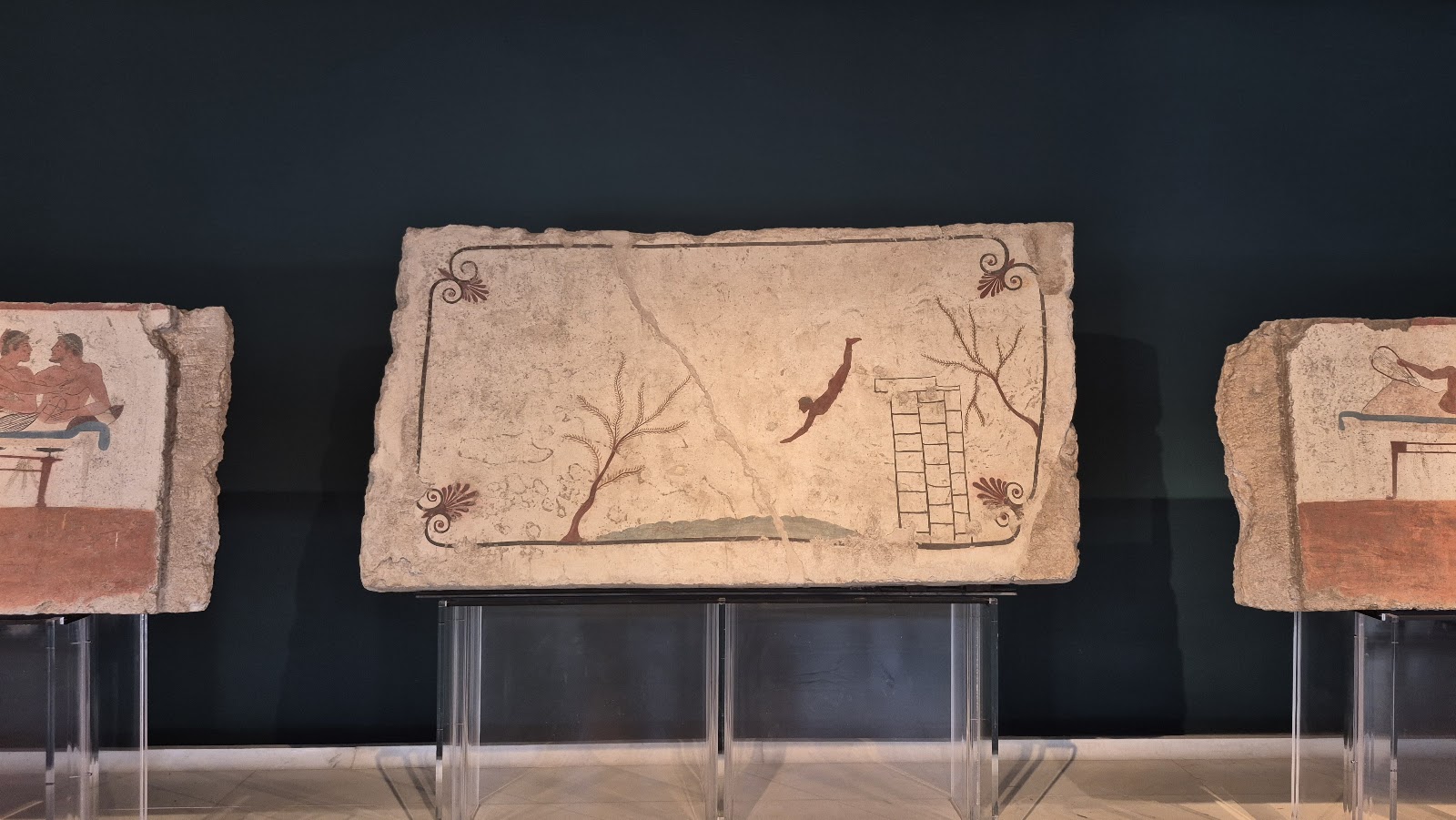
The ceiling is what stops you. Five limestone slabs form the tomb, and on the one laid flat above the body, a lone figure arcs through the air — arms out, head down, dropping toward a thin strip of water painted at the base of the image. Every other Greek funerary fresco from this era fills its walls with gods and heroes. This one put a diver on the roof.
The Tomb of the Diver sits inside the Paestum Archaeological Museum, about 1.5 kilometres from the temples you walked past to get here. The four surrounding slabs show a symposium — wine, lyres, a boy beside a krater — rendered in black, red, green, and Egyptian blue, the last pigment expensive enough to mark the deceased as someone of consequence.
💛 What travellers fall for
People who come back to Paestum tend to mention the same thing: they didn't linger long enough the first time. Give the tomb room to work. The no-flash rule is enforced, and rightly so — the colours read better in the ambient light anyway. Arrive at the museum before the afternoon tour groups clear the temples and redirect inside.
The story behind Tomb of the Diver
On 3 June 1968, Italian archaeologist Mario Napoli was excavating a small necropolis south of Paestum when his team uncovered a travertine sarcophagus sealed by five painted limestone slabs. The tomb dated to around 500–475 BCE, placing it in the era of the Greek colony of Poseidonia — but who made it is still debated. Scholarly analysis has since pushed back against straightforward Greek or Etruscan attribution, with archaeometric evidence pointing toward a local artisanal tradition: the work of Paestum's own elite culture, neither imported nor imitated.
The frescoes were executed in true fresco technique — pigment into wet plaster — with a stylus used to incise the design before colour was applied. Two distinct hands are thought to have worked across the five slabs, names unknown.
Good to know
The tomb lives in the Paestum Archaeological Museum, open daily 8:30–19:30 (closed 25 Dec, 1 Jan, 1 May; reduced hours first and third Mondays). One ticket — €15 March–November, €10 December–February — covers the museum and the archaeological site for three days. Trains from Salerno take around 45 minutes.
Where is Tomb of the Diver?
More tickets & tours for Tomb of the Diver
Book directly at the provider
What travellers say about Tomb of the Diver
By modifying the spaces inside the Museum, an entire room has been rightly dedicated to the display of this tomb. Everyone can now admire it in all its beauty... A truly speaking document of the customs and culture of a civilization...
Beautiful work with fantastic colors and execution
It's the same old work, but it's enchanting every time. Truly unique.
The Tomb of the Diver is a fresco-painted coffin discovered in 1968 in Paestum (Salerno) in Campania, dating to 480-470 BC. It is the only known example of Greek wall painting from a Greek city dating to before the 4th century BC. Its name derives from the famous scene on the lid, which depicts a young man diving from a pylon into the water, an image interpreted as a metaphor for the passage from life to death.
Spectacular, both the temples and the museum
More of Paestum
Discover where to stay, what to do and the best deals for your trip.
Explore Paestum →More attractions in Paestum
All of Paestum →

Background adapted from Wikipedia (CC BY-SA) · map data © OpenStreetMap contributors · ratings & place photos via Google · other photos with per-image credit. Ticket links may earn us a commission at no extra cost to you.