
Temple of Apollo (Syracuse)

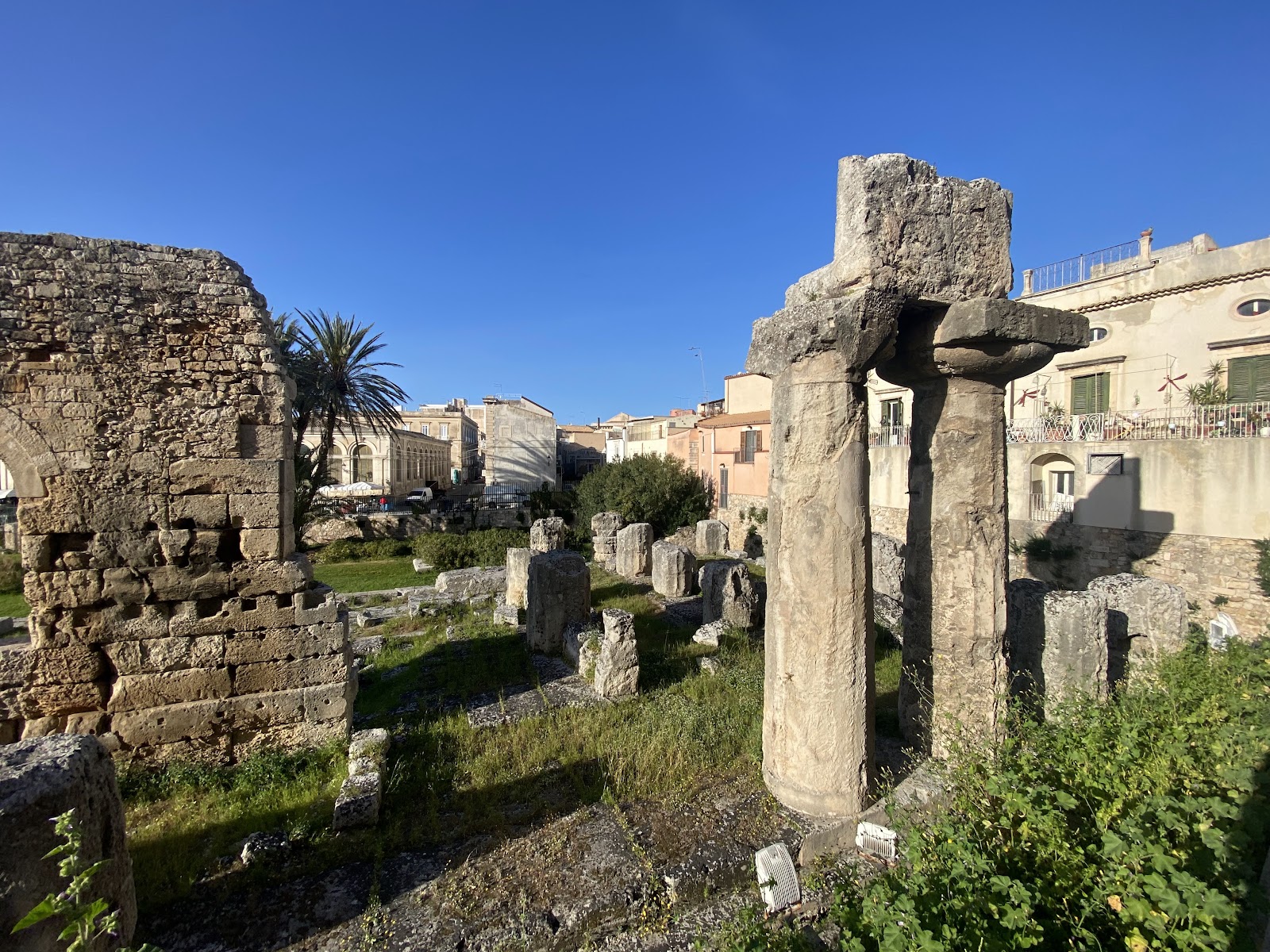
At the foot of the bridge onto Ortigia, before you've properly arrived anywhere, you find two columns standing in an open pit — thick, slightly bulging, cut from the yellowish local stone the Syracusans called giurgiulena. This is the Temple of Apollo, raised around 575 BC, which makes it one of the oldest Doric temples in all of Sicily.
What you're looking at is a transitional moment in stone: the point where builders in the Greek west stopped mixing timber with masonry and committed fully to column and lintel. The stylobate stretches 55 by 21 metres, and the original plan ran to six columns across and seventeen along each flank — squat proportions that give the ruin a grounded, almost stubborn presence.
💛 What travellers fall for
People who return to Ortigia tend to use this as a quiet orientation point before heading deeper into the island. Come early, before the bridge traffic picks up, and walk the three accessible sides slowly — the surviving column drums reward close attention, and the carved inscription on the crepidoma, naming Kleomenes as the man who 'made' this temple, is easy to miss at a distance.
The story behind Temple of Apollo (Syracuse)
Syracuse was founded by Corinthian settlers in 734 BC, and by the early sixth century the city had accumulated enough confidence — and stone — to attempt something monumental. The temple went up around 575 BC, its colonnade marking one of the first times builders in Sicily replaced a wooden superstructure entirely with stone. An archaic inscription carved into the upper step records that a man named Kleomenes, son of Knidieidas, 'made' it for Apollo; scholars debate whether he was the architect, the master builder, or a patron.
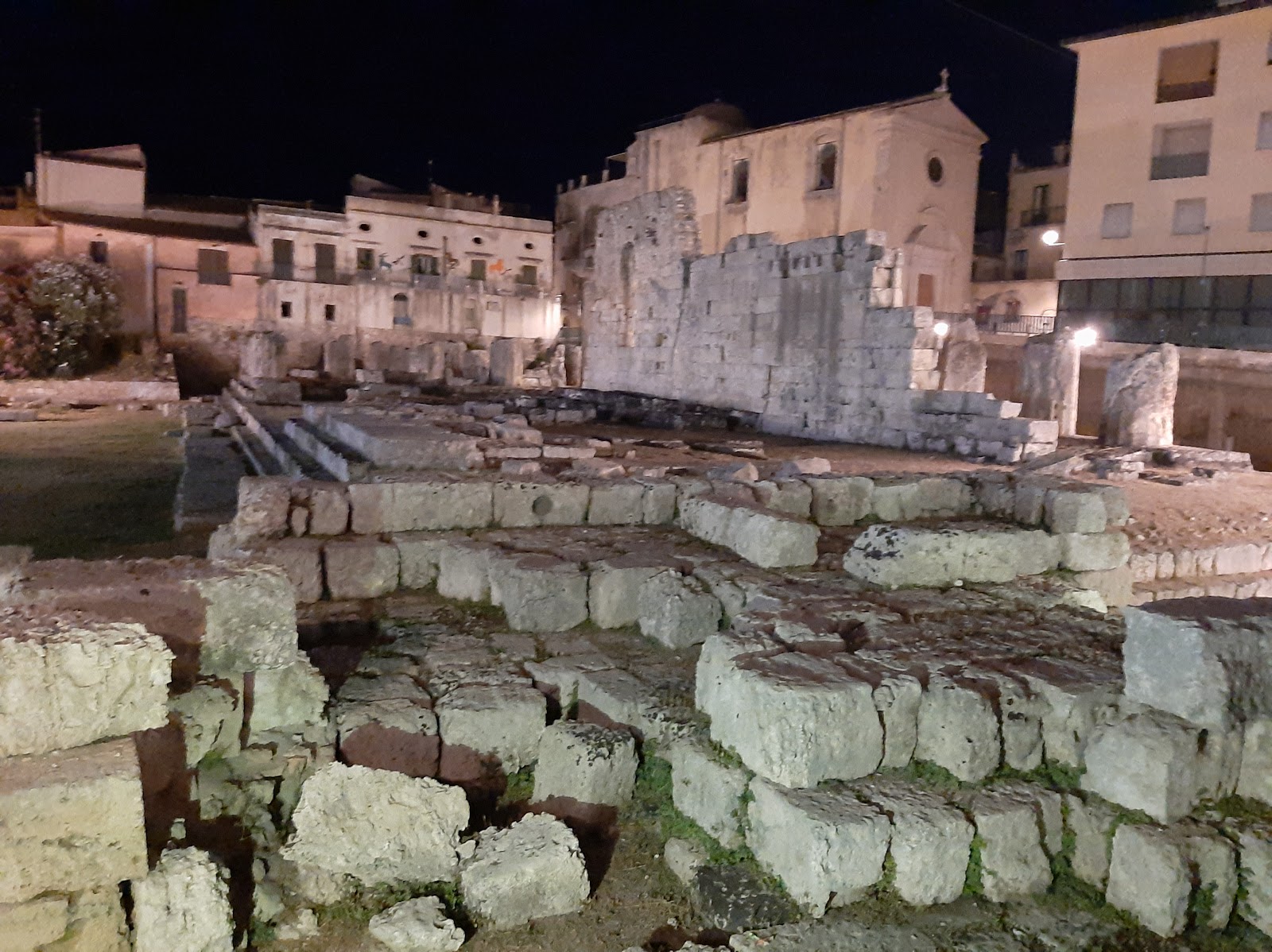
The centuries that followed rewrote the building completely. It became a Byzantine church — the front steps and traces of a central doorway survive from that conversion — then an Islamic mosque under the Emirate of Sicily, then the Church of the Saviour under the Normans, then a Spanish barracks in the sixteenth century, then private housing. The columns were still buried inside that barracks when the archaeologist Paolo Orsi led excavations around 1890 and brought the full plan back into the open air.
Good to know
Entry is free and the site is open-air, so there are no hours to worry about. You can't enter the excavated area, but three sides are visible at close range. Budget 15–20 minutes here. Parcheggio Talete and Parcheggio della Marina are both nearby, open around the clock, and take payment at the machine.
Syracuse runs hot from June through August — temperatures can climb past 40°C when Saharan wind pushes in from the south, and the exposed excavation site offers no shade. Mid-April to mid-May and mid-September to mid-October give you comfortable warmth without the intensity; winter is mild but can turn rainy and windy.
Where is Temple of Apollo (Syracuse)?
More tickets & tours for Temple of Apollo (Syracuse)
Book directly at the provider
What travellers say about Temple of Apollo (Syracuse)
Overall, it's a nice historical attraction and a must see if you traveling through the city. There is a nice market attached to it and many restaurants, coffee shops and small streets to wonder around in the area.
Original Temple erected by the Greeks who conquered the Island of Ortigia in 700BC and preserved by the Romans when they conquered in 200BC. Ruins are what remains after the devastating earthquake that later rocked the area and killed an estimated 80,000 residents.
The Temple of Apollo is the very first piece of history that greets you as you cross into Ortigia, immediately setting the tone for the ancient wonders awaiting on the island. Standing right near the entrance, this site is genuinely impressive due to its age and scale. This temple is one of the most important surviving examples of Greek architecture in Sicily and is considered one of the oldest Doric temples in the entire Western world, dating back to the 6th century BC. While today only remnants of the columns and the foundation remain, these fragments powerfully attest to the temple's monumental size and the incredible depth of history beneath modern Syracuse. What makes the Apollon Temple truly fascinating is its layered history. Over the centuries, it was converted into a Byzantine church, then a mosque during the Arab domination, and finally a Norman church, before being used as a Spanish barracks. The visible ruins you see today—the columns and the surrounding walls—tell this complex story of constant architectural reuse and transformation across 2,600 years. It’s an unmissable historical sight right at the entry of Ortigia, perfectly positioned for a quick, awe-inspiring stop before diving into the maze of the island's Baroque streets.
There is more to this ruined temple than expected. Despite it's central location, walking around to the top and looking back down on it is remarkably peaceful. Well worth stopping by on your trip to Ortigya (though also hard to miss!)
A beautiful and atmospheric glimpse into ancient history right at the entrance to Ortigia. The Temple of Apollo may be in ruins, but its massive stone columns still carry an incredible sense of presence and age—you can really feel the weight of centuries here. What makes it even more special is how seamlessly it sits within the modern city, surrounded by everyday life yet standing as a reminder of Sicily’s deep Greek heritage. It’s not a site that takes long to visit, but it’s absolutely worth stopping by. The open setting means you can appreciate it from different angles, especially in the changing light throughout the day. A perfect starting point for exploring Ortigia and a must-see for anyone interested in history, architecture, or simply soaking up the unique character of Syracuse.
More of Siracusa
Discover where to stay, what to do and the best deals for your trip.
Explore Siracusa →More attractions in Siracusa
All of Siracusa →

Background adapted from Wikipedia (CC BY-SA) · map data © OpenStreetMap contributors · ratings & place photos via Google · other photos with per-image credit. Ticket links may earn us a commission at no extra cost to you.