
Staglieno Cemetery
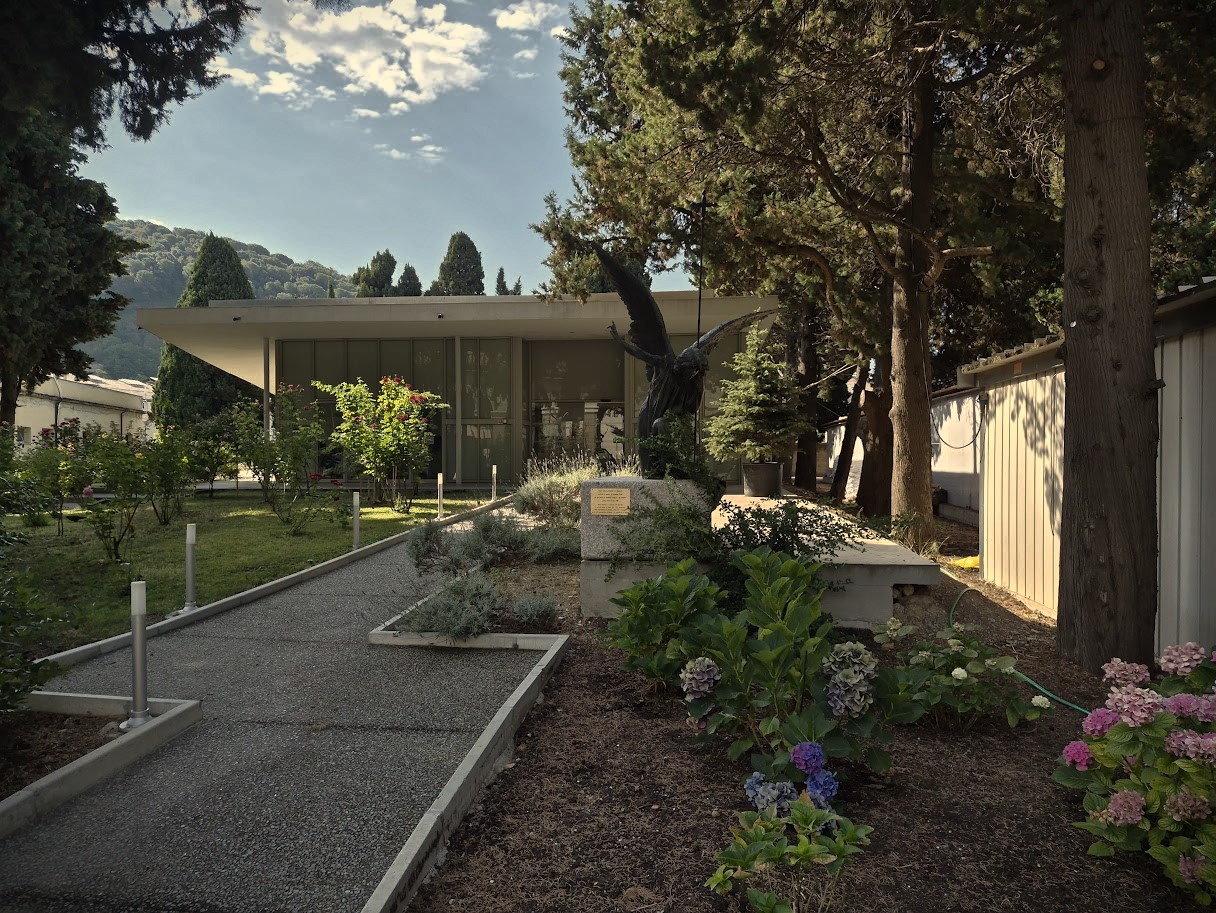
Staglieno is a cemetery that people come to on purpose, not by accident. It covers 33 hectares on a Genoese hillside, and within the first ten minutes you'll understand why Mark Twain wrote about it in 1869 and why Nietzsche kept returning in the 1880s. The statues here are not allegorical figures in robes — they are middle-class widows in Victorian dress, merchants caught mid-gesture, a peasant woman holding a string of walnuts exactly as she sold them in life. The place is still in daily use: funerals happen while you walk.
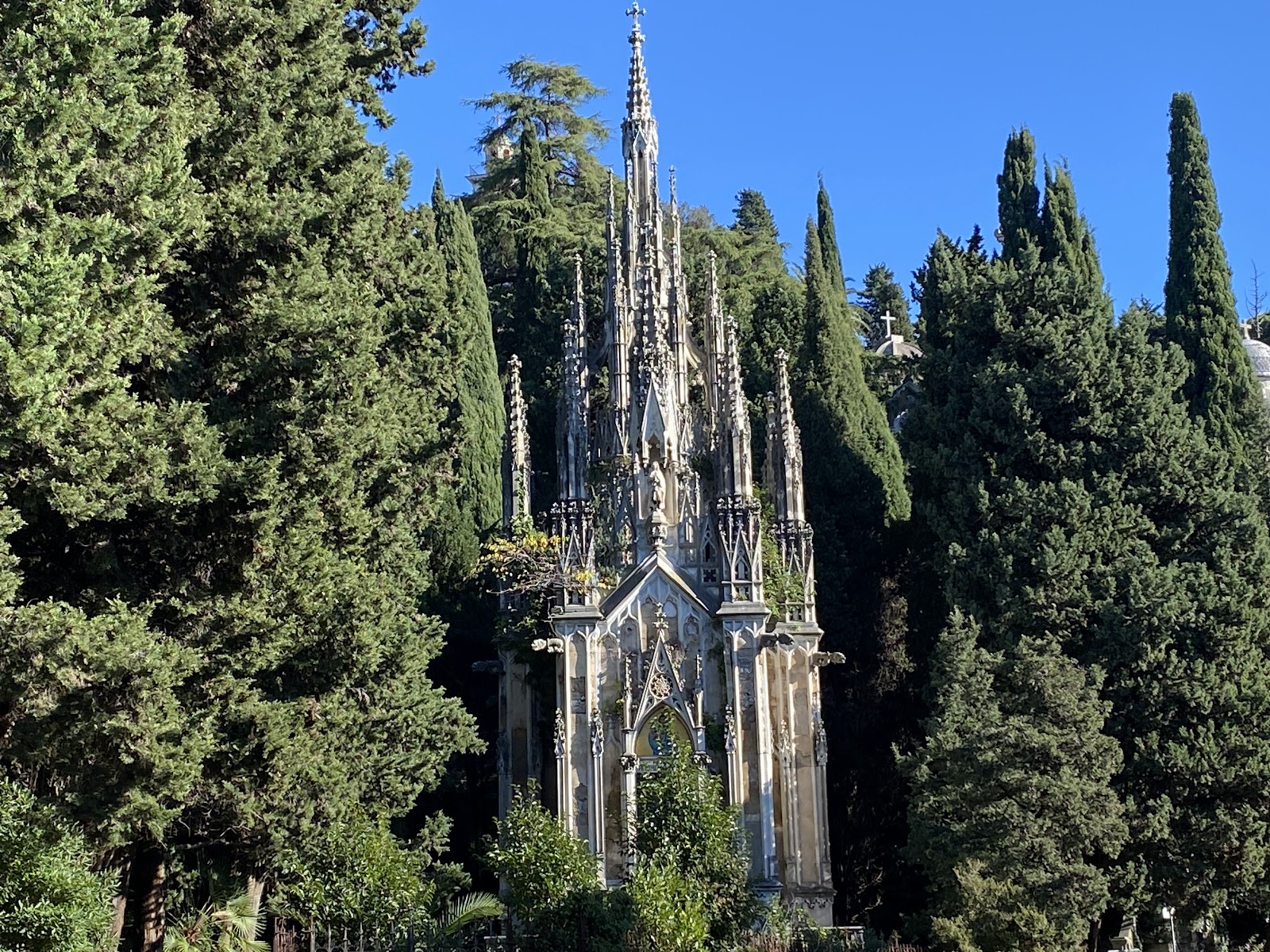
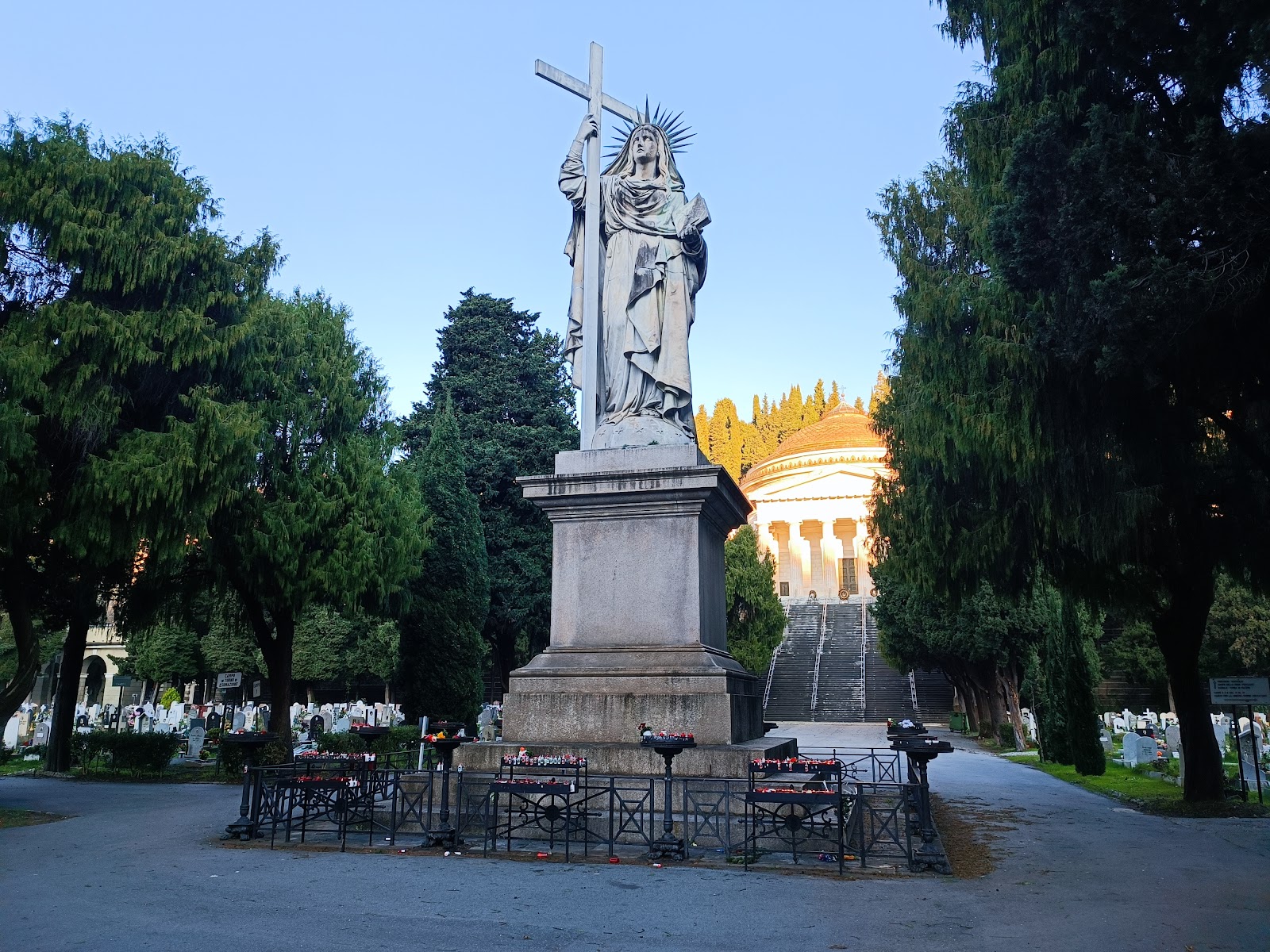
The scale takes adjustment. Terraces climb the hill in layers — colonnaded porticoes at the base, family mausoleums rising into the tree line above, a Pantheon-inspired rotunda anchoring the centre. The Joy Division album cover was photographed here. So was Constance Wilde buried here, far from Dublin and London.
💛 What travellers fall for
People who return tend to map their own route rather than following the guided circuit. Find the Caterina Campodonico tomb early — the nut-seller holding her walnuts is easy to miss in the lower galleries. Save the Raggio Chapel for when the light is high; its white Carrara marble reads completely differently in afternoon shadow. The internal CS shuttle is worth knowing about on hot days.
The story behind Staglieno Cemetery
The cemetery exists because of Napoleon. His 1804 Edict of Saint-Cloud banned burials inside towns and churches, forcing Italian cities to plan dedicated grounds beyond their limits. Genoa commissioned architect Carlo Barabino, whose neoclassical design was approved in 1835 — the same year cholera killed him before a stone was laid. His assistant Giovanni Battista Resasco inherited the project and saw it through to the opening on 2 January 1851, with construction continuing until 1880.
Resasco's plan gave the hillside a monumental grammar: a hemicycle of Doric columns, a domed Pantheon at its centre, and room for the family mausoleums that Genoese merchant wealth would fill across the following decades. Sculptor Giulio Monteverde completed the Oneto tomb angel in the 1880s, a work that circulated internationally and shaped how the cemetery's reputation spread. Separate plots for Protestant, Jewish and British communities were added over time; the British section holds 352 war graves across two world conflicts.
Good to know
Bus lines 13 and 14 from Brignole, or line 34 from Principe, reach the entrance in 15–25 minutes. Entry is free; guided tours cost €5 and leave at 10:00, 11:30 and 15:00 with no booking required. Allow at least two hours. Wear shoes with grip — the uphill paths are uneven and some stairs have deteriorated.
Spring and autumn give the most comfortable walking conditions on the hillside terraces. Summer visits are manageable in the morning hours before the exposed upper avenues heat up; the colonnaded porticoes offer shade throughout the day.
Where is Staglieno Cemetery?
More tickets & tours for Staglieno Cemetery
Book directly at the provider
What travellers say about Staglieno Cemetery
One of the most unusual places I’ve ever visited! Dark and gloomy, yet beautiful at the same time. Definitely worth a visit — and below are a few useful tips. Be sure to check for storm warnings in advance (you can do this on the cemetery’s website), otherwise you might end up facing closed gates! Plan at least an hour and a half — trust me, there’s plenty to see. Be prepared for a lot of walking, as the cemetery is built on a slope. There are buses running across the grounds, which you can use to reach the more remote sections
A wonderful place to see magnificent high quality sculptures. There is an information office with very kind local staff. Get a free map and the free introduction book (also in English) there. Be careful of the old guy who sells those materials in the cemetery. Those material are free. The local bus n. 34 goes to this cemetery and it’s the final stop. I also recommend to check the website before go there as sometimes it’s closed for strong winds or some maintenances.
The Staglieno Cemetery was officially opened to the public on January 1, 1851. Although it was still largely unfinished at that date, its specific architectural, functional, and symbolic physiognomy had already been established. The design had been entrusted in 1835 to civic architect Carlo Barabino (1768-1835)—he was responsible for much of Genoa's neoclassical style and the construction of iconic buildings such as the Teatro Carlo Felice, the Palazzo dell'Accademia, and many others—but he was unable to complete the project due to his sudden death in 1835 during the great cholera epidemic. The task of developing the project was then entrusted to his pupil and collaborator Giovanni Battista Resasco (1798-1871), whose plan was approved in 1840. Work began in 1844 in the area of Villa Vaccarezza in Staglieno, which was still largely sparsely inhabited and not far from the city centre. It’s worth a visit. Free entry. Good information on place and free map.
Amazing sculptures/tombs. Easy to get to by bus. Recommended
This is a cemetery on an epic scale. It can be viewed as two sections; the formal quadrangle with vast two storey galleries lined with statuary and cremation urn compartments, and the informal layout which, much like Genova itself, is carved out of the hillside. The Genoese take death seriously. Sumptuous monuments tell a story with life size family members grieving over the deceased surrounded by angels to help them on the journey to the afterlife. Others like to compare themselves to gods posing majestically. The quality and indeed the quantity of statuary is remarkable. On the hillside is a village of the dead with named roads, monuments as big as churches, some that look like small houses, and again full of statuary. The tree-lined roads go on forever. And steps lead off these to off-road terraces cut in to the slope, each an individual avenue of graves. There is a lot of steps. Some have subsided and restoration is never ending. No space is left empty. Urn compartments are stacked 5m high and step ladders are provided for changing flowers in the vases and batteries in the lanterns. Even the roofs of the galleries are lined with cremation urn compartments. I always say if you want to understand the history of a place look at its architecture. In the case of Genova, you should also look at this cemetery.
More of Genoa
Discover where to stay, what to do and the best deals for your trip.
Explore Genoa →More attractions in Genoa
All of Genoa →
Background adapted from Wikipedia (CC BY-SA) · map data © OpenStreetMap contributors · ratings & place photos via Google · other photos with per-image credit. Ticket links may earn us a commission at no extra cost to you.