
Cathedral of San Lorenzo

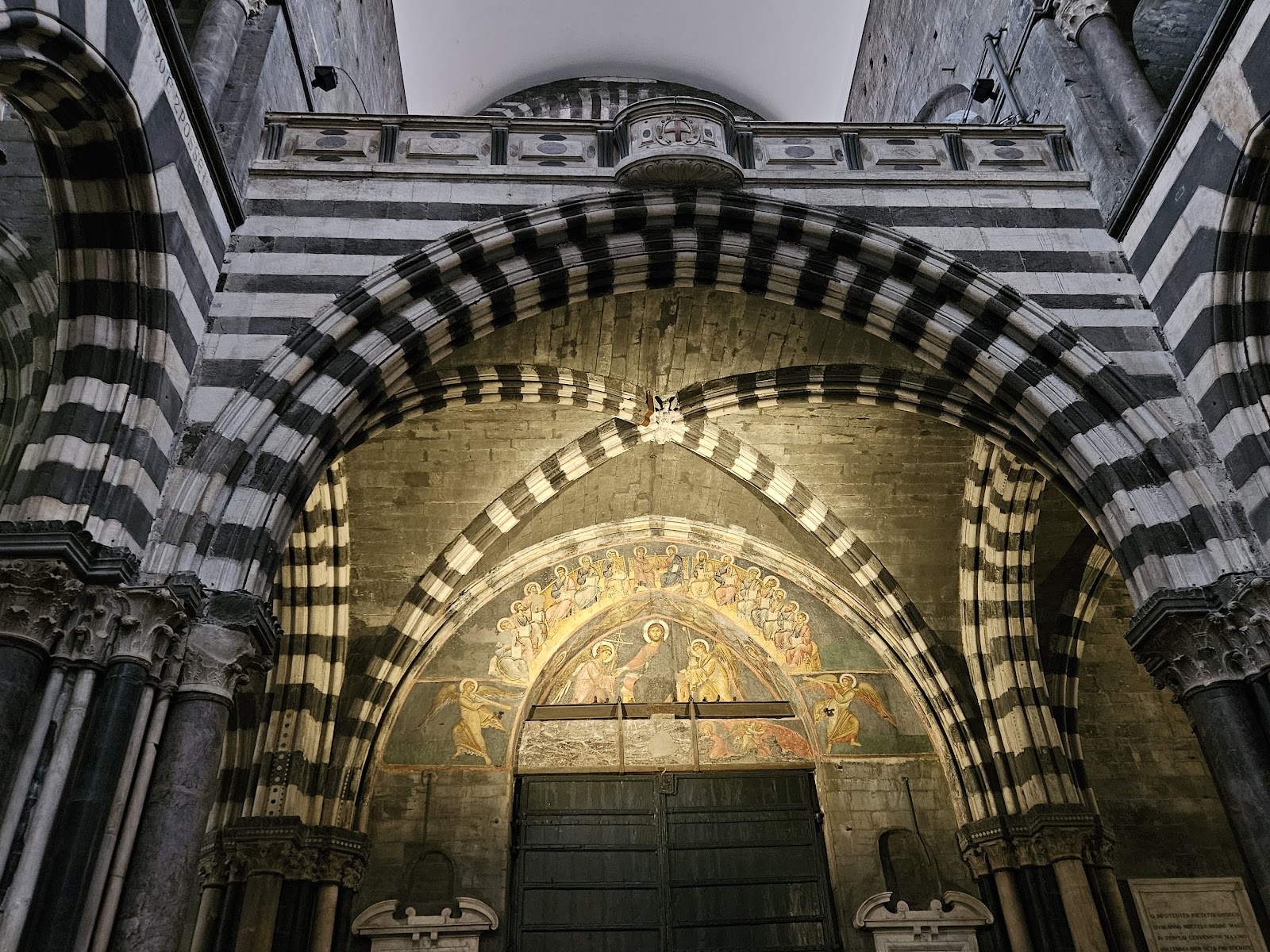
The striped black-and-white marble façade of San Lorenzo stops you mid-step — those horizontal bands of Ligurian slate and white marble have marked the entrance to Genoa's cathedral since 1312, and they still read as something almost graphic, almost modern. The piazza in front is small enough that you're practically at the portal before you've registered the scale of the place.
Inside, the nave stretches back through centuries of accumulated decisions: Romanesque side aisles, Gothic arches, a floor and dome reworked by Renaissance architect Galeazzo Alessi in the 16th century, and Baroque frescoes by Lazzaro Tavarone gilding the apse. It's not a single vision but a long conversation between builders, each generation leaving its mark.

💛 What travellers fall for
Return visitors tend to go straight downstairs to the Museo del Tesoro — the underground treasury holds the Sacro Catino, a green glass dish long believed to be the Holy Grail, and a Byzantine reliquary said to contain a fragment of the True Cross. Give it time; the collection is small but genuinely strange. Then find the unexploded British bomb, still sitting in the right aisle since February 1941.
The story behind Cathedral of San Lorenzo
A church has stood on this site since at least the 5th or 6th century, though the first written record of San Lorenzo dates to 878. The episcopal seat moved here from San Siro in 1007, and construction of the current structure began in the early 12th century under the Magistri Antelami — master builders and stonemasons from the Valle d'Intelvi near Como — with Pope Gelasius II consecrating the building in 1118.
The 13th and 14th centuries brought the distinctive Gothic façade and the rebuilding of the inner colonnades after a fire in 1296 during Guelph-Ghibelline conflicts. The Chapel of San Giovanni Battista was added in 1448 to house relics of John the Baptist brought from the Holy Land, with sculpture by Domenico Gagini and Andrea Sansovino. Galeazzo Alessi reshaped the nave and dome in the mid-16th century; Lazzaro Tavarone added his frescoed Stories of San Lorenzo in the 17th. The external stairway and its two stone lions arrived as late as 1894–1900, the work of sculptor Carlo Rubatto.
Good to know
Metro San Giorgio is 270 metres away. The cathedral nave is free; the treasury costs €6 and closes Tuesdays. Tower access runs 11:00–16:00 daily for €5. Cover shoulders and knees. An hour is enough for both the main church and the treasury combined.
Where is Cathedral of San Lorenzo?
More tickets & tours for Cathedral of San Lorenzo
Book directly at the provider
What travellers say about Cathedral of San Lorenzo
Free admission. Very nice stain glass and ceiling. 5 euro admission to the tower for a good view of the surroundings and also of the inside of the cathedral.
Impressive cathedral that features the typical black and white marble stripes which were a symbol of medieval Genoese nobility. The church, without 5o Genoese Gothic architecture, was completed in the early 14th century. The Interior is primarily Romanesque, with Renaissance and Baroque additions in later centuries. Watch the lion sculptures besides the stairs at the front.
Beautiful sights from all angles thought the cathedral. The tower tour (€5 on our visit) is well worth it (if you are physically able). Lots of great new views of the interior from the elevated position, and wonderfully views of the city as well.
Beautiful must visit for any one of any religion the history and charm of Genoa and its Cathedral’s is lovely. Free and quick 10 min visit inside is all you need so don’t pass it up.
c Church of Jesus and Saints Ambrogio and Andrea The Church of Jesus and Saints Ambrogio and Andrea (Chiesa del Gesù e dei Santi Ambrogio e Andrea) is recognized as one of the finest examples of Baroque art in Genoa and is known locally as "the Church of Jesus" (Chiesa del Gesù). Historical and Artistic Overview Location: It is located in Piazza Matteotti, directly next to the Doge's Palace (Palazzo Ducale). Foundation: The current church was erected between 1589 and 1606 by the Jesuits, replacing an older 6th-century church dedicated to Saint Ambrosio, Bishop of Milan, who had sought refuge in Genoa to escape the Lombards. Design: Designed by the Jesuit architect and painter Giuseppe Valeriano, the interior is adorned with lavish decorations of colored marble, gold, and frescoes that cover every corner. Treasures The church contains priceless works of art, most notably: Rubens' works: It contains two famous paintings by the Flemish artist Peter Paul Rubens; The Circumcision of Christ (La Circoncisione), located on the main altar since 1605, and the Miracles of Saint Ignatius (Miracoli di Sant'Ignazio). Guido Reni's painting: Including the Assumption (L'Assunzione) by the renowned Italian artist Guido Reni. Frescoes: The ceiling and walls are adorned with magnificent frescoes by the Carloni brothers (Giovanni and Jovane Battista), representing the pinnacle of Genoa's Baroque art. Visiting Information: Admission: The church is free and a perfect destination for art lovers, especially on rainy days. Opening Times: Normally open on weekdays from 8:30 a.m. to 12:30 p.m. and from 4:00 p.m. to 7:15 p.m. (closes Monday mornings). Mass: Masses are celebrated regularly; it is advisable to avoid sightseeing during services out of respect for the congregation.
More of Genoa
Discover where to stay, what to do and the best deals for your trip.
Explore Genoa →More attractions in Genoa
All of Genoa →
Background adapted from Wikipedia (CC BY-SA) · map data © OpenStreetMap contributors · ratings & place photos via Google · other photos with per-image credit. Ticket links may earn us a commission at no extra cost to you.