
Shibuya Scramble Crossing
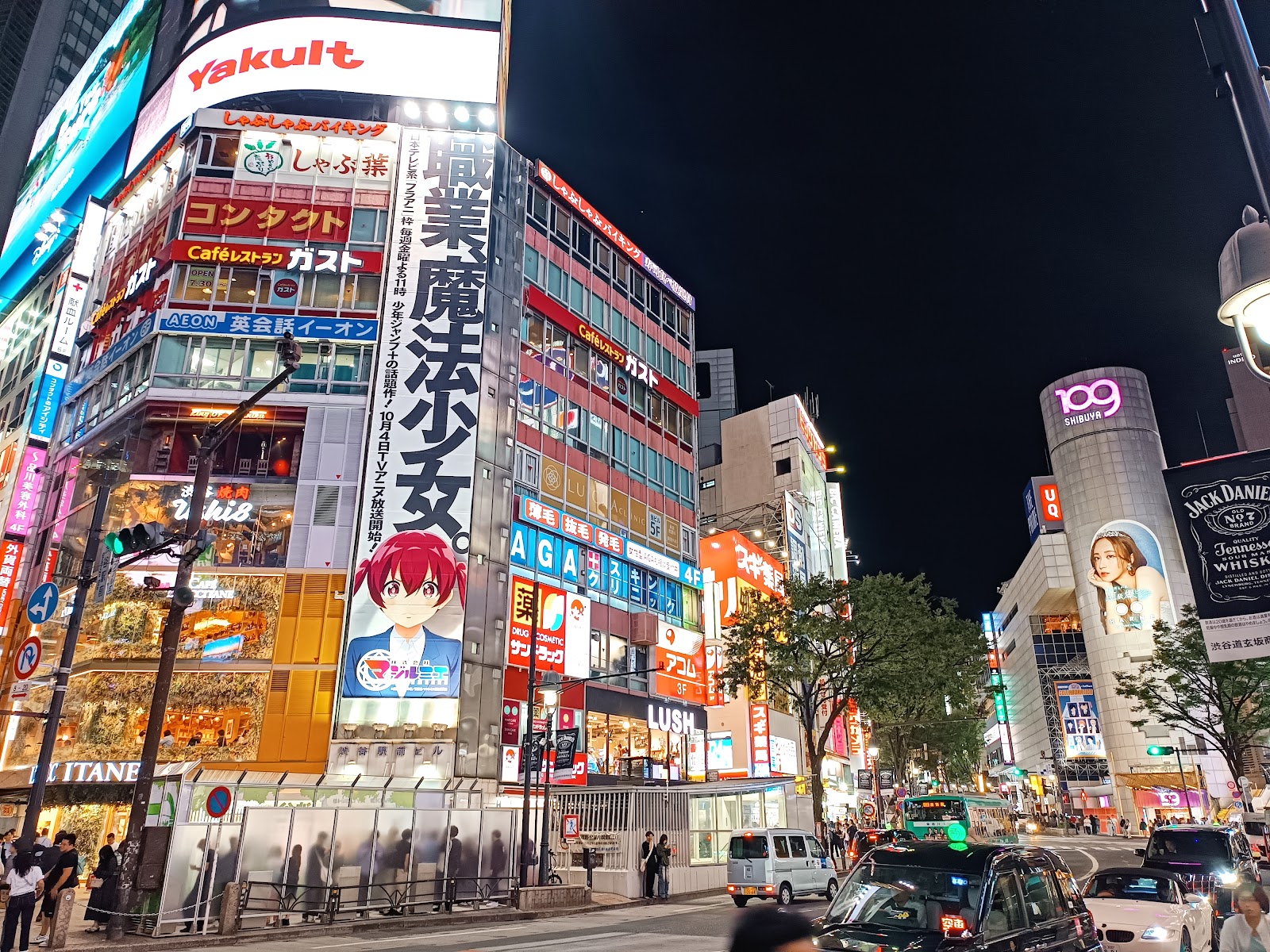
Every ninety seconds or so, the traffic lights around this five-point intersection in central Shibuya turn red in every direction at once, and somewhere between 2,500 and 3,000 people step off the kerbs simultaneously from all sides. For about 45 seconds the crossing belongs entirely to pedestrians, a slow-motion collision that somehow resolves itself without anyone breaking stride.
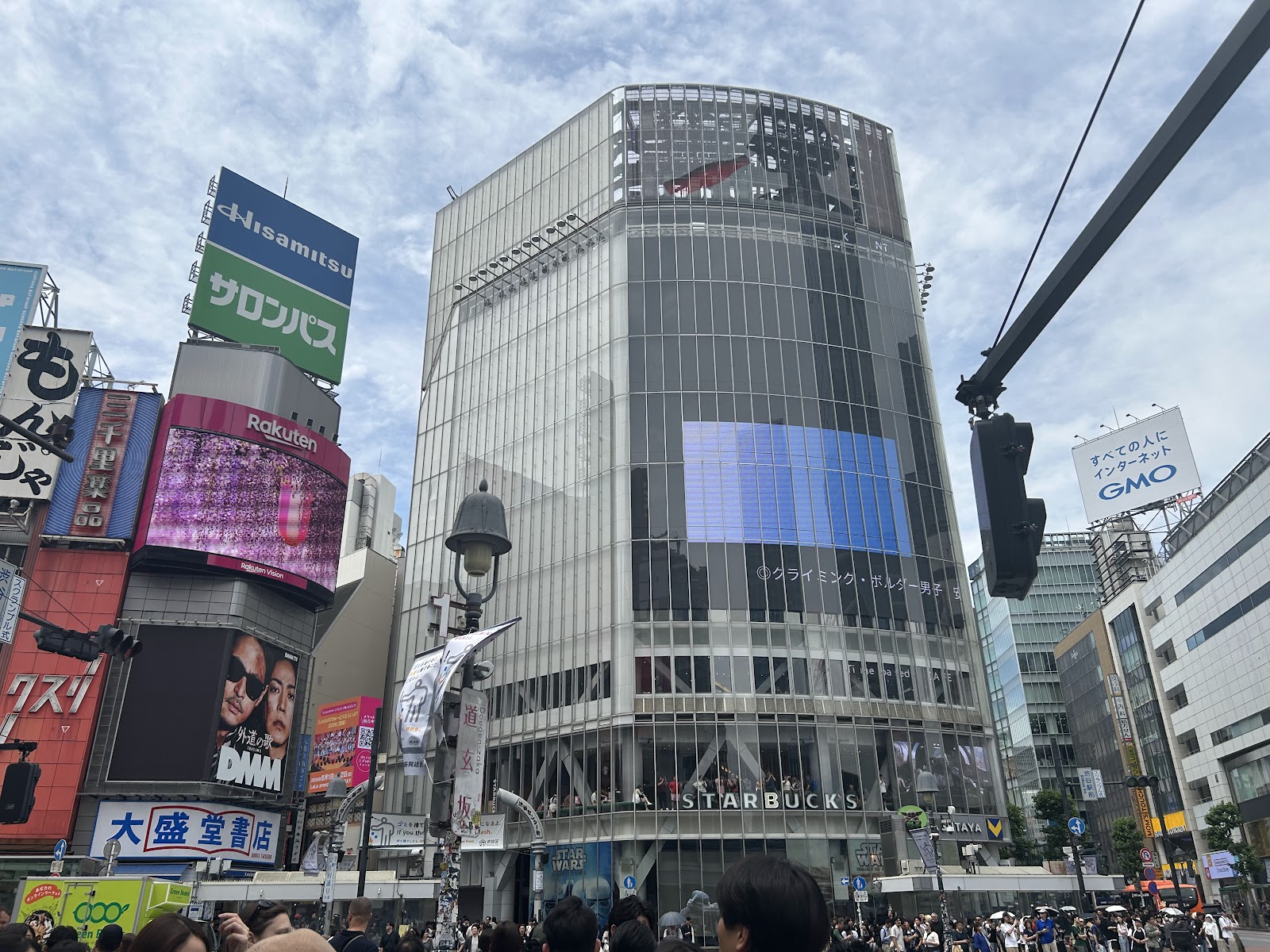
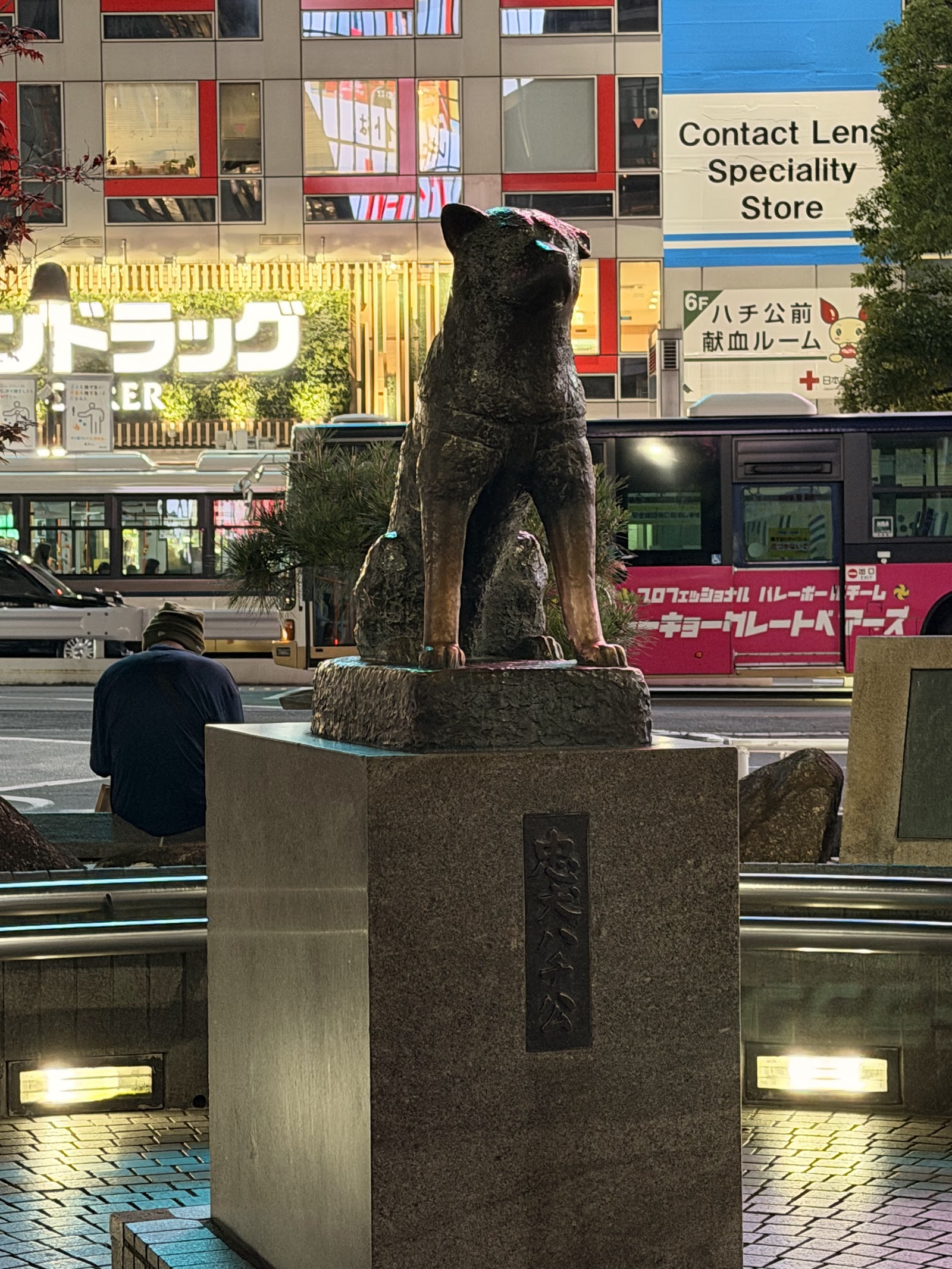
The crossing sits at the western exit of Shibuya Station, ringed by screens and storefronts that have made it one of the most photographed intersections on earth. The Hachiko statue — a bronze Akita dog waiting, as he did in life, just outside the station — marks the corner where most people orient themselves before stepping in.
💛 What travellers fall for
Regulars tend to agree: Friday evening between 19:00 and 21:00 is the spectacle at full volume, while Sunday before 10:00 gives you the crossing almost to yourself. The second-floor Starbucks in the QFRONT building offers a free, eye-level view; the MAG8 rooftop at Magnet by Shibuya 109 puts you directly overhead for ¥1,800 including a drink.
The story behind Shibuya Scramble Crossing
Shibuya Station opened in 1885, but the area around it remained relatively modest until rail lines began multiplying. The Tokyu Toyoko Line arrived in 1932, pulling more commuters through the west side of the station. By the early 1970s the foot traffic had grown dense enough to require a new solution, and in 1973 the scramble-crossing format — all signals red simultaneously, pedestrians crossing in every direction at once — was introduced to manage the flow.
The retail landscape that now frames the crossing took shape gradually. Shibuya 109 opened in 1979 and anchored the district's identity as a fashion destination. Shibuya Scramble Square, completed in 2019, added the Shibuya Sky observation deck on the 47th floor, placing the crossing far below in the frame.
Good to know
Take the Hachiko Exit (Exit 8) from Shibuya Station — the crossing is one minute on foot. Access is free, 24/7. Avoid October 31 and New Year's Eve, when the ward restricts public drinking and the mayor has formally asked tourists to stay away.
Spring (March–May) and autumn are the most comfortable seasons to stand and linger here — mild temperatures, manageable humidity. Summer pushes above 30°C with heavy humidity and frequent July rain, so crossing quickly and ducking into air conditioning becomes a rhythm of its own. Winter is cool and often clear, and the neon reads well against a dark sky.
Where is Shibuya Scramble Crossing?
More tickets & tours for Shibuya Scramble Crossing
Book directly at the provider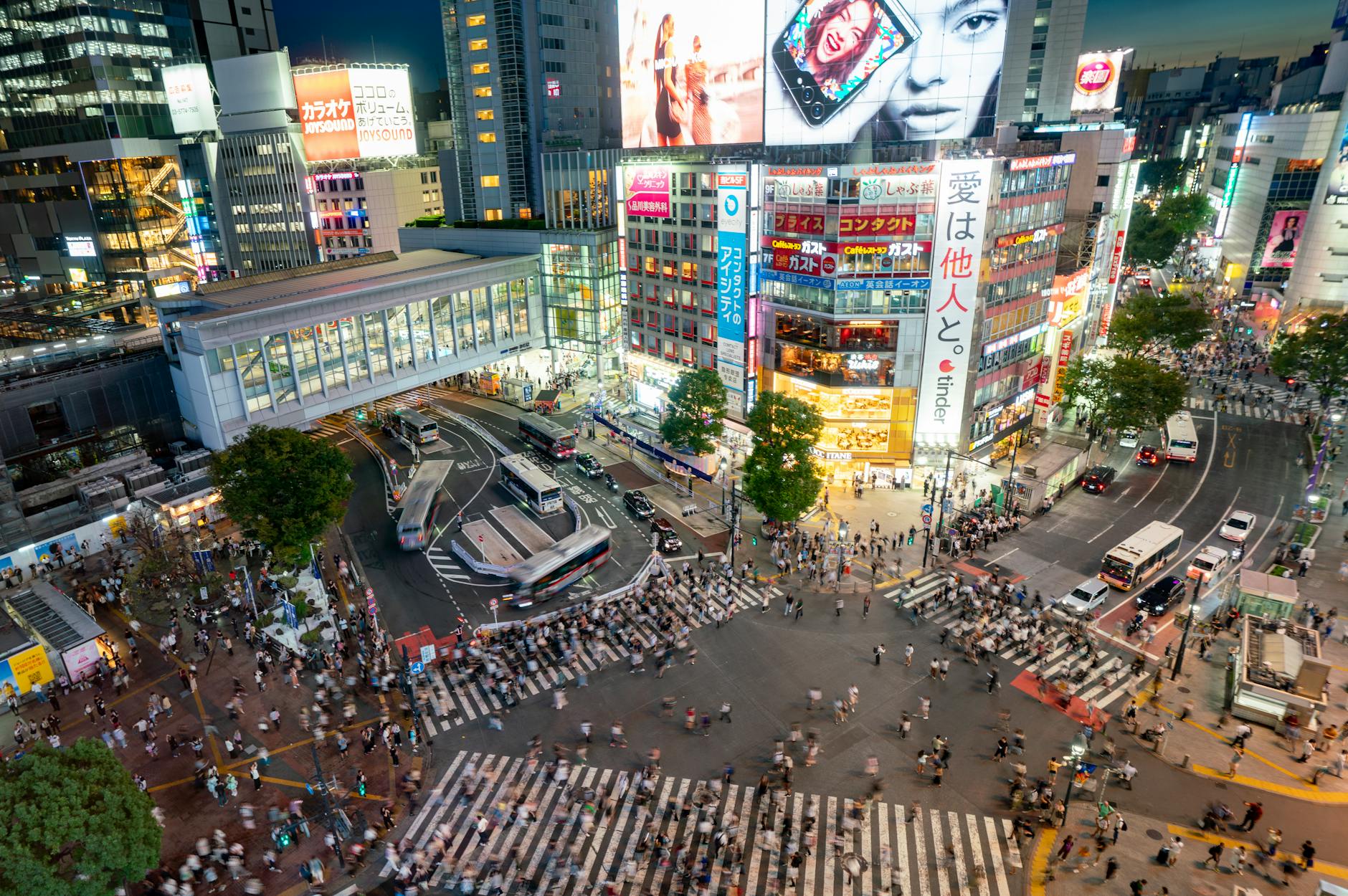
What travellers say about Shibuya Scramble Crossing
As an Indian, I arrived at Shibuya Crossing with two expectations: 1. I’d cross the road. 2. I’d leave. Neither happened. Instead, I spent the next hour standing around like a confused tourist, crossing the same road multiple times for absolutely no reason, taking photos, taking videos, and then taking photos of the videos. There is something strangely satisfying about watching hundreds of people move in every direction with military precision while nobody crashes into anyone. If this happened at a busy Indian junction, there would probably be three horns, two arguments, and a tea stall discussion before everyone got across. The crossing itself is just a crossing. Yet somehow it becomes an event, a performance, and a people-watching masterclass all at once. My son loved the energy, I loved the organized chaos, and my phone storage definitely did not. Verdict: Came to cross a road. Ended up experiencing a world-famous attraction. 10/10. Would cross again.
Visiting Shibuya Crossing was interesting, but personally, I found it a bit overrated. Yes, it’s definitely very crowded and iconic as one of the busiest pedestrian crossings in the world. We passed through both during the day and at night since it was on our way, so we got to see both sides of it. One thing that is truly impressive, though, is the way people move in sync. When the lights change, hundreds of people start walking at the same time from all directions, yet everything flows surprisingly smoothly. That sense of order within the chaos is actually quite fascinating to watch. That said, while it’s worth seeing once, I don’t think it’s something to spend too much time on. Some people seem to stay for hours, but for us, it felt like a quick “see and move on” kind of place. Tip: Walk through it once for the experience, maybe take a quick photo, and continue exploring the city. An iconic spot, interesting for a short visit, especially for the synchronized crowd movement.
It's everything you think it will be. If you are anxious about crowds either have a plan in place or visit EARLY. Night life is very busy and the local restaurants fill up fast. The pop up shops are cool. We had a Night life photoshoot booked from Klook we did in Shibuya which was a highlight.
An iconic experience that absolutely lives up to the hype. Shibuya Crossing is one of those places you’ve probably seen countless times in photos and videos, but being there in person is something else entirely. The sheer scale of it—the waves of people moving in every direction at once—is both chaotic and perfectly organized at the same time. It’s fascinating to watch and even more fun to be part of. What really stood out to me was how smooth everything feels despite the crowds. Thousands of people cross at once, yet there’s no sense of disorder. It’s a unique kind of energy that captures the essence of Tokyo—fast-paced, efficient, and vibrant. Whether you’re crossing it yourself or just observing from above, it’s incredibly captivating. I also highly recommend checking it out at different times of the day. During the daytime, you get a clear sense of the scale and movement, while at night, the neon lights and surrounding screens create a completely different, almost cinematic atmosphere. It may seem like just an intersection, but Shibuya Crossing is truly an experience. It’s a must-see in Tokyo and easily one of the most memorable urban sights I’ve ever visited.
This is my second time here and it hits just as hard as the first. Maybe harder. I've seen this place in movies, anime, music videos, and travel guides more times than I can count. None of it captures what it actually feels like to stand there when that light turns red and the whole world starts moving at once. The energy is real and it gets you every single time. I visited both during the day and at night in the rain. The daytime version is overwhelming in scale — thousands of people from every corner of the world converging at one point. But the rainy night? That's when it becomes something else. Neon signs bleeding into wet asphalt, Shibuya 109 glowing through the rain, umbrellas as far as you can see. It looks exactly like an anime frame. Except you're inside it. And yes — I desperately wanted to stop in the middle of the crossing and take the classic tourist photo. Couldn't bring myself to do it with that many people around. Maybe next time. Or the time after that. Because I already know I'm coming back. Some places you visit once. This one you keep returning to and never quite feel done with.
More of Tokyo
Discover where to stay, what to do and the best deals for your trip.
Explore Tokyo →More attractions in Tokyo
All of Tokyo →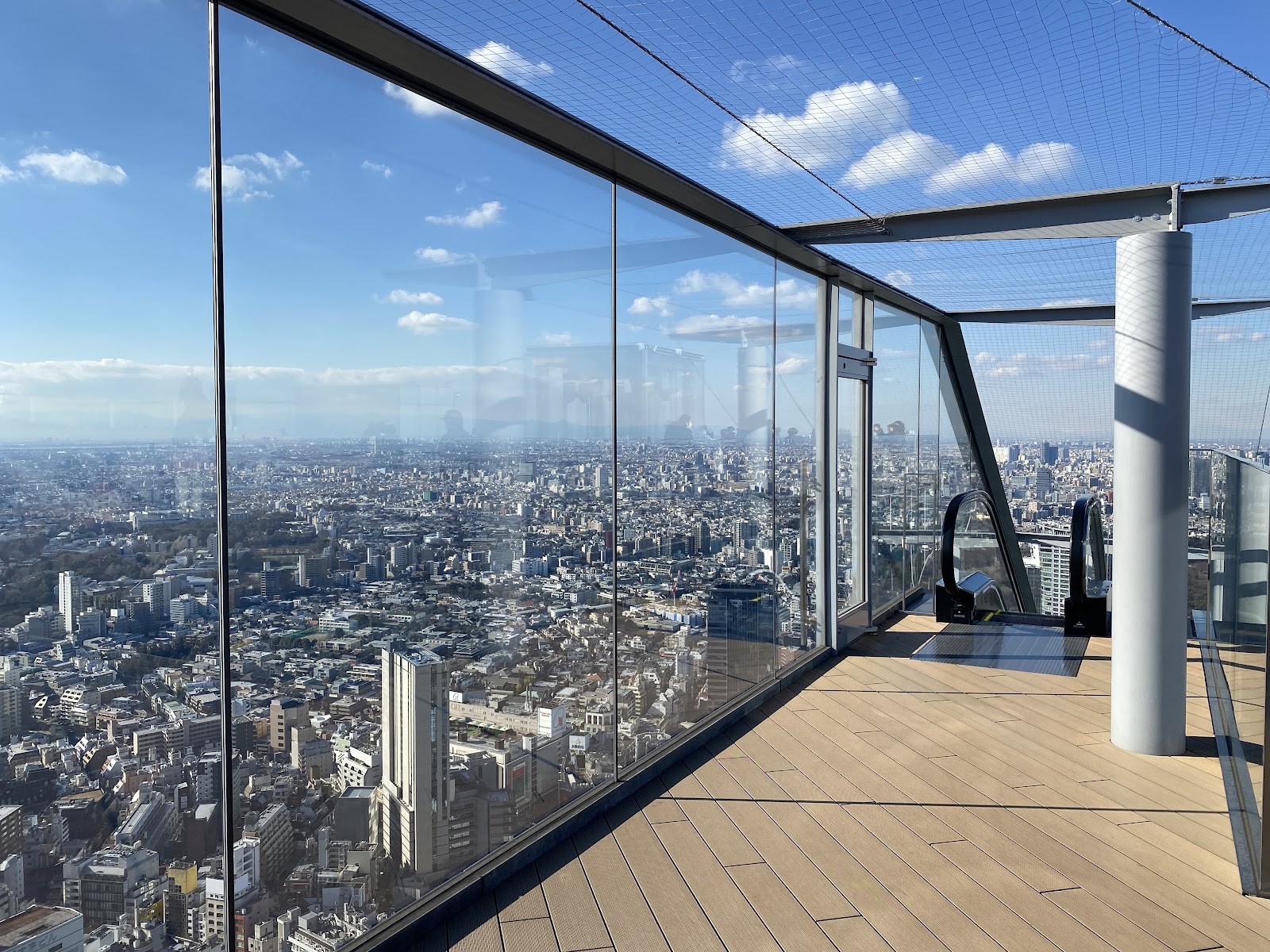

Background adapted from Wikipedia (CC BY-SA) · map data © OpenStreetMap contributors · ratings & place photos via Google · other photos with per-image credit. Ticket links may earn us a commission at no extra cost to you.