
Porta all'Arco (Etruscan Arch)

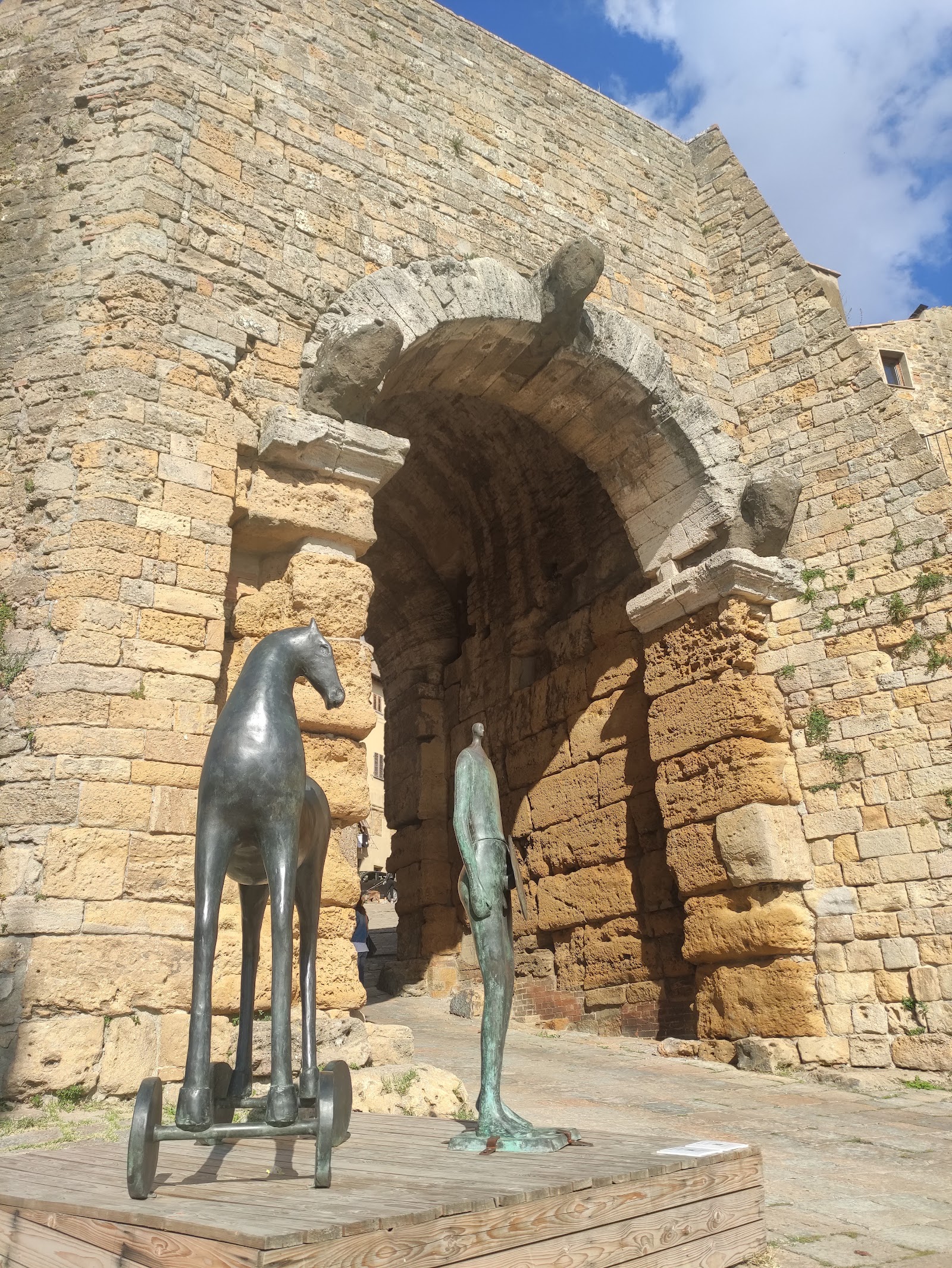
Three weathered stone faces look down from the arch as you pass beneath it — eroded past any readable expression, their identity still debated after two and a half millennia. This is Porta all'Arco, the south gate of Volterra, and its jambs were already old when Rome was still a republic. The sandstone blocks at the base, locally called *panchino*, were set in the 4th century B.C.; the arch itself came later, its voussoirs cut from a calcareous rock quarried just outside the city walls.
The street leading up to it, Via Porta all'Arco, is lined with alabaster workshops — the craft Volterra has traded on for centuries. Pass through the arch and glance left: a row of small windows set into the inner wall hold illustrated panels telling the gate's history in Italian and English, a low-key archive you can stand and read in a few quiet minutes.
💛 What travellers fall for
People who return tend to time their approach for early morning, when the light hits the three heads straight on and the street hasn't filled yet. The alabaster shops along Via Porta all'Arco open mid-morning — worth a look even if you're not buying, since the craftsmen often work in the front rooms.
The story behind Porta all'Arco (Etruscan Arch)
The jambs date to the 4th century B.C., making them among the oldest surviving Etruscan stonework in Tuscany. The arch was added later, probably around the turn of the 1st to 2nd century B.C., its blocks sourced from a quarry at Pignano and the three sculpted heads carved from selagite from the Montecatini Val di Cecina area. What the heads represent is unresolved — the most plausible reading is that they are protective deities. A 1st-century B.C. funeral urn now in the Museo Etrusco Guarnacci depicts a siege scene with the gate clearly visible, making it the earliest known image of the arch.
The gate survived the demolition of Volterra's original Etruscan walls in the early 12th century and a tower added above it in 1329 that was pulled down in 1540. Its closest call came on 30 June 1944, when Nazi forces threatened to destroy it. Volterra's residents built a defensive bulwark inside the arch within 24 hours, preserving it. The Italian government later awarded the town a silver medal for that act.
Good to know
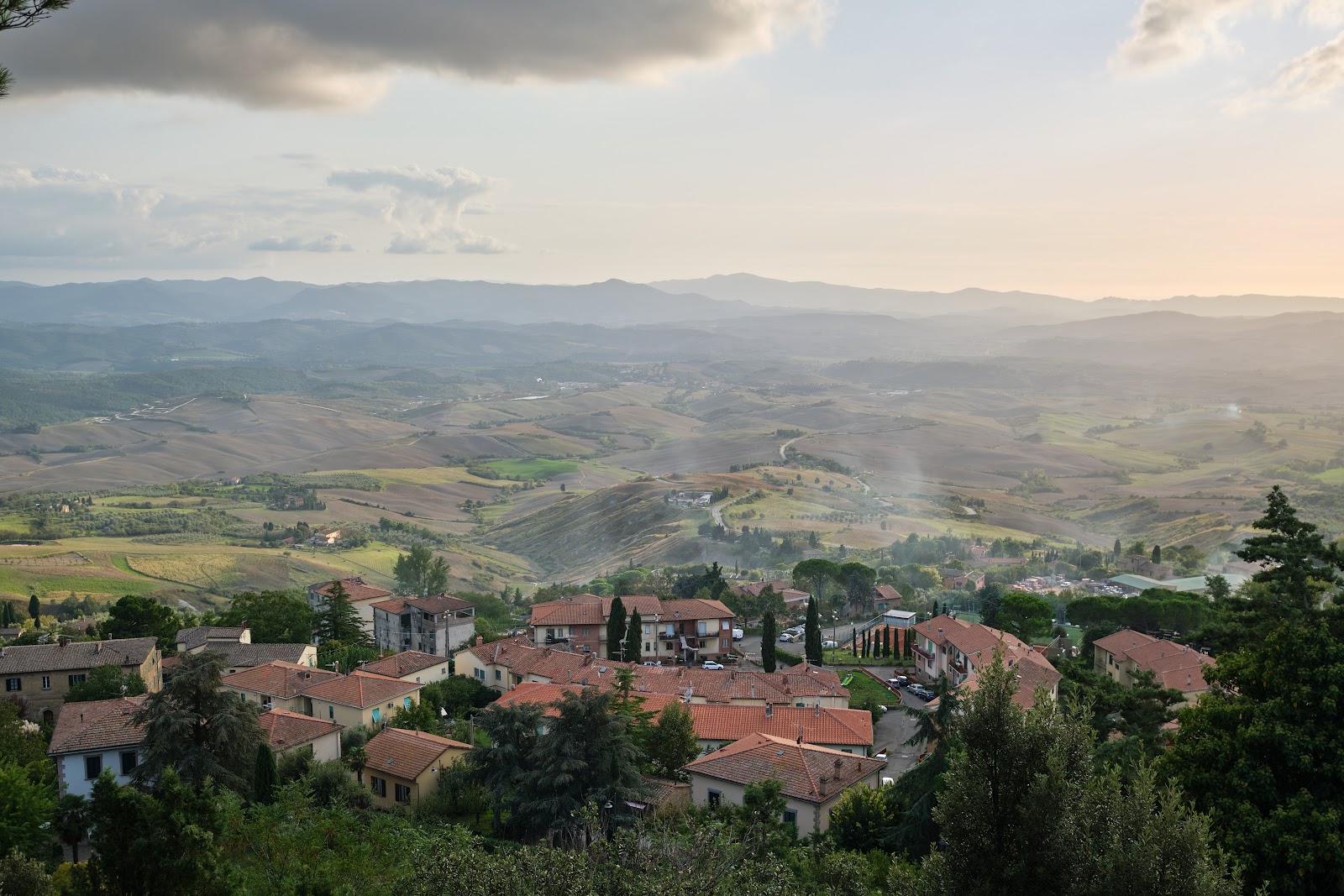
Access is free at any hour. From Volterra's centre, walk south downhill or take the bus to the bottom of Via Porta all'Arco and walk up. May, September and October offer the most comfortable temperatures for the climb. No ticket, no queue — just the gate.
Summer is dry and warm, with July averaging around 31 mm of rain across only six days and August highs reaching 30°C — comfortable for a short outdoor stop, though the walk uphill earns its shade. Winter brings the bulk of the year's rainfall, peaking in November at around 131 mm; the gate itself is always accessible, but the approach on wet cobblestones asks for decent footwear.
Where is Porta all'Arco (Etruscan Arch)?
More tickets & tours for Porta all'Arco (Etruscan Arch)
Book directly at the provider
What travellers say about Porta all'Arco (Etruscan Arch)
The Porta all’Arco is one of the most remarkable remnants of Volterra’s Etruscan heritage. Built in the 4th century BC, the gateway impresses with its massive stone blocks and the mysterious, weathered heads above the arch, whose meaning is still debated. Walking through it gives a real sense of stepping back in time. Its story is not only ancient: during World War II, the citizens of Volterra bravely protected the gate from destruction by filling it with stones, preserving it for future generations. A short stop is enough to admire the structure, but for anyone interested in history and architecture, it is an absolute must-see in Volterra.
A beautifully well preserved mediaeval city in Volterra. Walking these streets to experience the people living here is an educational pleasure.
In the presence of 2,500 years of history - incredible to even see this - the gate is a must see! Well kept, truly majestic, and utterly historic
Ancient Etruscan archway from around 300 to 400 BC. You get done lovely views of the narrow streets but also the surrounding countryside.
We went there with a very good guide. She explained the history and what the wall endured during thousands of years. Beatiful views also.
More of Volterra
Discover where to stay, what to do and the best deals for your trip.
Explore Volterra →More attractions in Volterra
All of Volterra →
Background adapted from Wikipedia (CC BY-SA) · map data © OpenStreetMap contributors · ratings & place photos via Google · other photos with per-image credit. Ticket links may earn us a commission at no extra cost to you.