
Parco Regionale del Matese (Caserta portion)

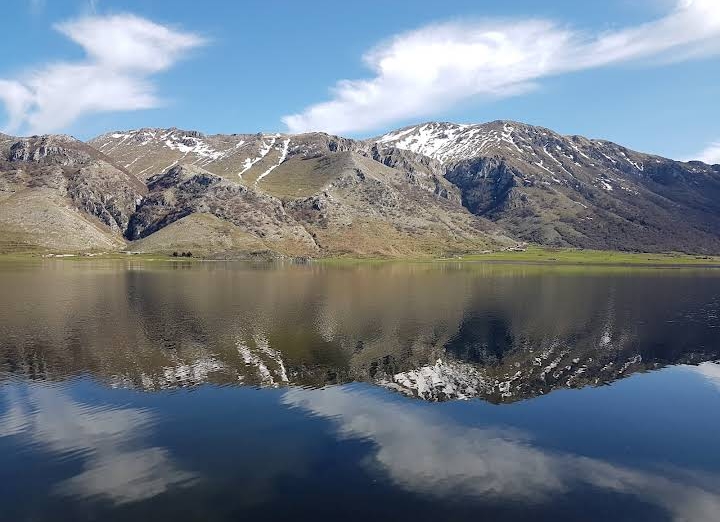
At 1,011 metres above sea level, Lago del Matese sits higher than any other karstic lake in Italy — a fact that lands differently once you're standing at its edge, the limestone massif rising behind you and the Campanian plain somewhere far below. This is the Caserta portion of the Matese, a landscape of beech forests, cave systems that drop more than a kilometre into the earth, and a Roman town at Alife whose opus incertum walls have stood largely intact since antiquity.
Under the park's territory lies the fossil of Scipionyx samniticus — nicknamed "Ciro" by the paleontologists who found it — a dinosaur 113 million years old, now housed in a small museum in Cusano Mutri. The cypress grove at Fontegreca holds trees half a millennium old. The mountain, Monte Miletto, tops out at 2,050 metres.
💛 What travellers fall for
People who come back tend to anchor a day around Alife — the Roman castrum gates still align with roads that once ran to Venafrum and Telesia — and save a morning for the Monte Mutria loop, which is only 4.8 kilometres and rewards you with a summit view that stretches well beyond the park. The Grotte di Lete, with their underground waterfalls, repay the detour.
The story behind Parco Regionale del Matese (Caserta portion)
Campania's regional law n. 33 of 1 September 1993 created the Parco Regionale del Matese on paper, but implementing regulations took nearly a decade to finalise, and the park only formally entered operation on 12 April 2002. Giuseppe Scialla, a university professor and environmentalist, served as its first president. The campaign to establish the park drew support from WWF, Italia Nostra, CAI, and twice-Environment Minister Alfonso Pecoraro Scanio. Park administration settled in San Potito Sannitico in 2006.
In 2018 the Italian budget law opened the path toward national park status, and on 22 April 2025 Environment Minister Gilberto Pichetto Fratin signed the decree formally establishing the Parco Nazionale del Matese — a transition more than three decades in the making.

Good to know
Mid-April to mid-June and September to early October offer the most reliable conditions for trails and cave visits. The park headquarters in San Potito Sannitico (Via Figulantina, tel. 0823/786942) is the practical first stop for maps and current access information. No entrance fee has been confirmed — verify locally.
Spring and early autumn are the most forgiving seasons: trails are clear, beech forests are at their fullest, and the high-altitude temperatures are walkable. Summer brings a genuine cool refuge in the forest canopy, while winter closes some trails under snow and ice but opens the park to a quieter, harder-edged version of itself.
Where is Parco Regionale del Matese (Caserta portion)?
More tickets & tours for Parco Regionale del Matese (Caserta portion)
Book directly at the provider
What travellers say about Parco Regionale del Matese (Caserta portion)
Never before seen landscape, a large lake grass in the top of the valley gives a splendid view of the entire range, fantastic, carry your tents and enjoy mother nature!!
Beautiful walks and views
Needs a lot more to convince any type of tourism. Very poor care.... A pity could be lovely. Financial aide disappears, reconstruction is abandoned to leave disorder. Country side is beautiful, could be cleaner.
During a very wet spring time the atmosphere is magical, otherworldly. Added bonus is the presence of shops selling local cheeses, salamis, wine, etc. Much appreciated by my American guests at my B&B.
The region of Campania has so much to iffer yet so little tourism. This park is absolutely gorgeous! The mountain peaks leave you breathless and the calm lake makes it such a relaxing scene. On the lake shore locals offer horse rides. A locally famous spring offers fresh mountain water and on the road many farmers sell their excellent cheeses and cured meats for yummy sandwiches. beautiful place to visit off the beaten track!
More of Caserta
Discover where to stay, what to do and the best deals for your trip.
Explore Caserta →More attractions in Caserta
All of Caserta →

Background adapted from Wikipedia (CC BY-SA) · map data © OpenStreetMap contributors · ratings & place photos via Google · other photos with per-image credit. Ticket links may earn us a commission at no extra cost to you.