
Palazzo Fruscione

Down in the oldest crease of Salerno's historic centre, between two narrow vicoli, a four-storey palazzo carries about nine hundred years of the city inside its walls. Walk through the south portal and you're standing on ground that was once a Roman thermal complex; the iron rings for tethering horses are still fixed to the ground floor walls.
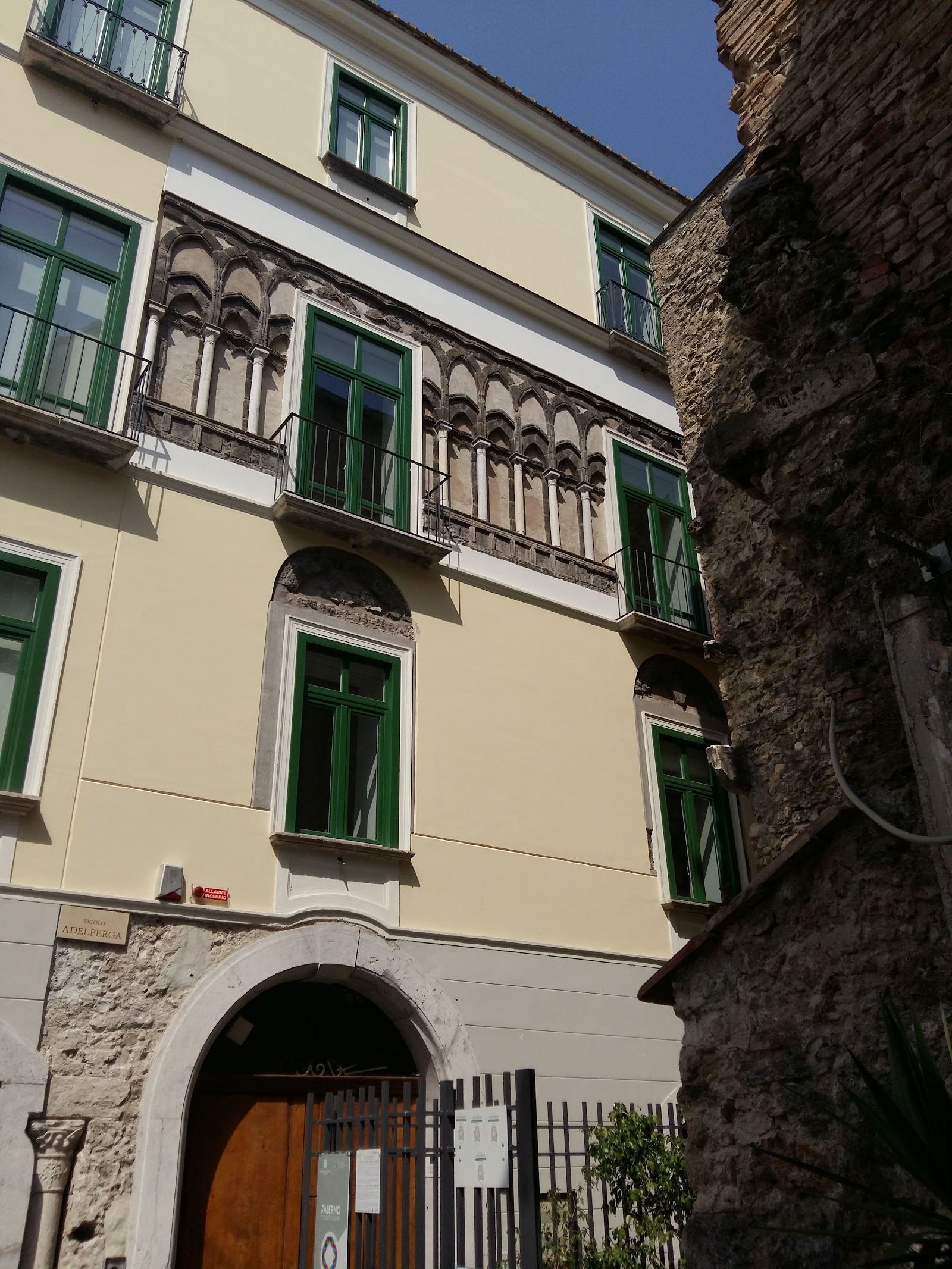
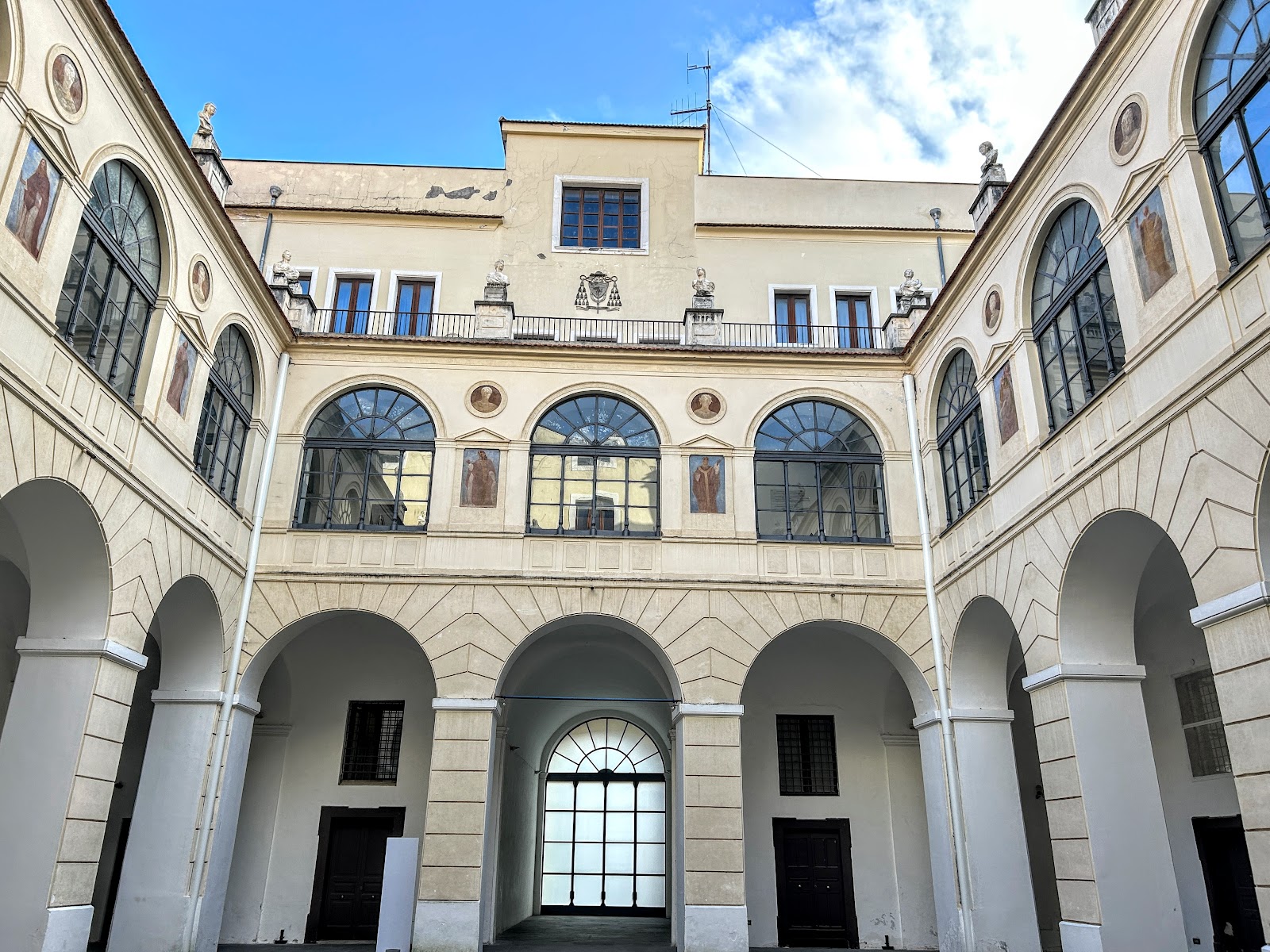
Palazzo Fruscione is one of those buildings that refuses to settle into a single era. Tufa blocks framed in brick, multi-pointed-arch windows on slender columns, fresco fragments, and a near-intact Roman mosaic from the first or second century — all of it surfaced during the restoration completed in 2013, turning what had been a crumbling lodging house into one of Salerno's most layered public spaces.
💛 What travellers fall for
People who come back tend to linger on the second floor, where the Norman monofore windows frame a very particular quality of light. The Roman mosaic — uncovered only during the 2009–2013 works — stops most visitors cold. Check what's showing before you go; the building hosts rotating exhibitions and the access and atmosphere shift considerably depending on what's on.
The story behind Palazzo Fruscione
The earliest stonework dates to the twelfth century, with bicolor inlays close in style to Salerno Cathedral and Castel Terracena. By the thirteenth century the building had grown to three portals on Vicolo dei Barbuti, and the second floor was completed by the early fourteenth. The probable medieval owner was Giovanni da Procida, a Salernitan physician of some standing.
By 1738 — when a notarial document records its transfer in perpetual lease to Bartolomeo Longo by the Cathedral Chapter — it had become a lodging house, the ground floor given over to stables. The Fruscione family held it until 1967, when the city expropriated it. A first restoration in the 1950s by Giorgio Rosi added decorative columns and stabilised the second level; the major campaign of 2009–2013, directed by architect Mario dell'Acqua with archaeological consultation from Professor Paolo Peduto, cost five million euros and reopened the building to the public in September 2013.
Good to know
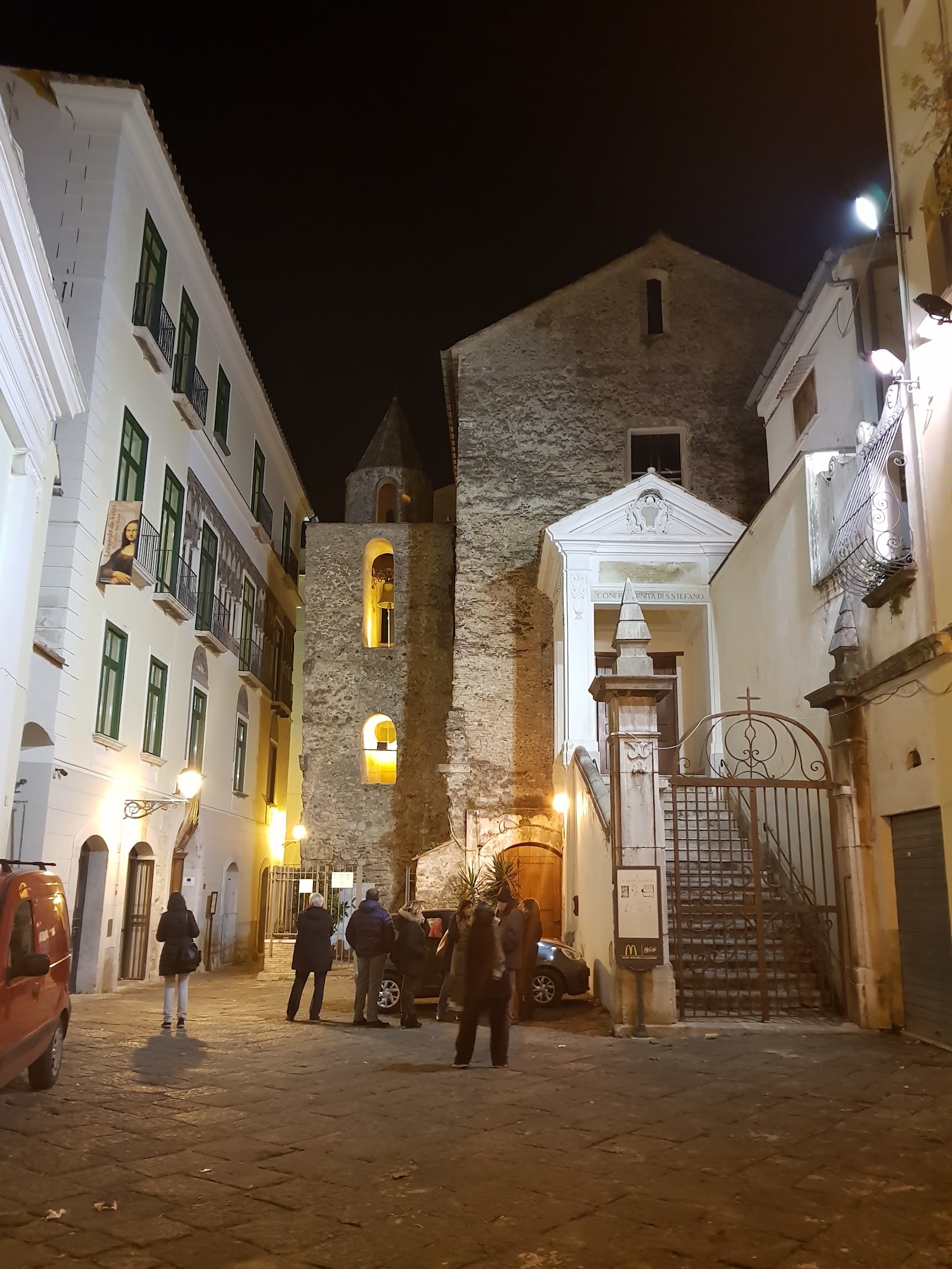
The address is Vicolo Adelberga 19, about a 15-minute walk from Salerno train station along Corso Vittorio Emanuele. Opening times follow exhibition schedules and vary, so confirm programming before visiting. A visit runs under an hour; pair it with the nearby Duomo or Giardino della Minerva.
Where is Palazzo Fruscione?
More tickets & tours for Palazzo Fruscione
Book directly at the provider
What travellers say about Palazzo Fruscione
The Palazzo Fruscione—a 13th-century Norman-Swabian palace partially built over the remains of a 1st–2nd century AD Roman thermal complex, featuring excavated mosaics, frescoed stucco walls, and two Lombard-era tombs containing adult male remains; restored in 2013 as a cultural venue that integrates medieval architecture with an on-site archaeological display.
We came to see it and discovered the secret church from the 1st century nearby. The palace itself is not really worth seeing, unless you are interested in this style of architecture.
The Palace is located in the oldest part of the historic center of Salerno. The construction, which began in the 13th century, is partly based on the ruins of a thermal complex from the imperial era. Its owner was probably the Salerno doctor Giovanni da Procida. During the restoration work of the years of 1910, traces of masonry were found that refer to a thermal complex of the imperial period, mosaics and frescoes of the II century. The room with the mosaic, whose walls are covered with relief decoration of stucco and paintings, belonged to the Roman baths built between the 1st and 2nd century AD. Inside the excavation, two tombs were found which returned the human remains of two adult males aged between 30 and 40. With the recent restoration work of Palazzo Fruscione new architectural remains have been discovered enriching the series of bichrome medieval tarsias known in Salerno; the results of a stratigraphic analysis allowed to isolate the parts forming the current building: some Norman structures in the West, the Angevin total renovation in the South and the part added at the end of 13th - beginning of the 14th century in the East. The remains of the 11th century confirm that the area, next to the ruins of the palace of Arechis II, was occupied by aristocratic palaces in the Norman era too. Then the building was modified several times as the vertical stratigraphy and the archaeological excavation show. This richness of archeological traces confirms that the area was considered very important in the medieval and modern city.
Interessting building with a 16th century church above a early christianity church above some roman baths - you can still see all this different layers of history
Beautiful place, with so many helpfull students.
More of Salerno
Discover where to stay, what to do and the best deals for your trip.
Explore Salerno →More attractions in Salerno
All of Salerno →
Background adapted from Wikipedia (CC BY-SA) · map data © OpenStreetMap contributors · ratings & place photos via Google · other photos with per-image credit. Ticket links may earn us a commission at no extra cost to you.