
Mura di Treviso (City Walls)

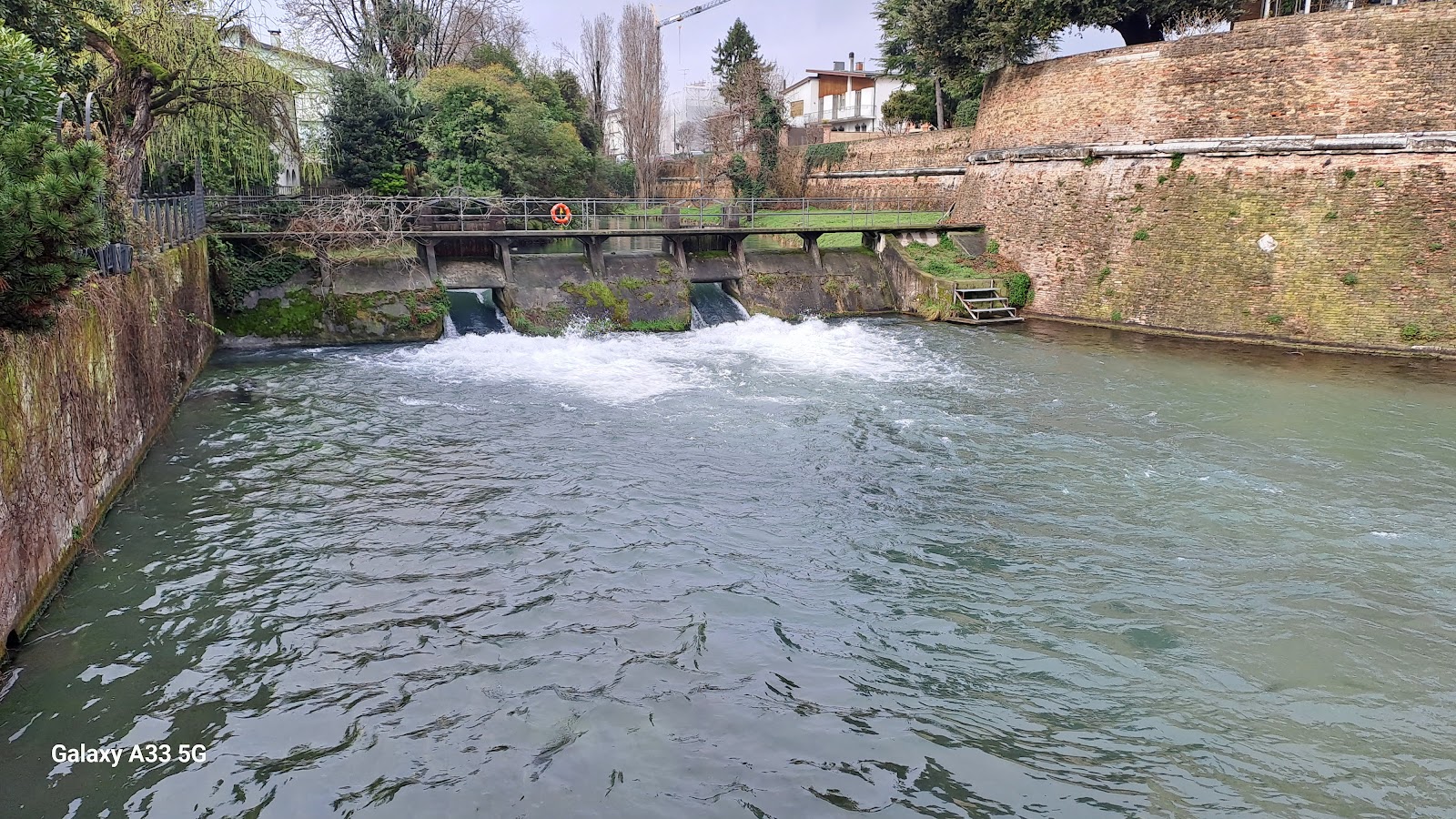
Walk the outer edge of Treviso's old city and you're tracing a line drawn in 1509 by a Franciscan friar-engineer named Fra' Giocondo, who pulled down the medieval walls and replaced them with a polygonal ring of earthen ramparts faced in brick — a design meant to absorb cannon fire rather than simply stop it. The moat is still full, fed by the same Sile and Cagnan rivers that have always run through this corner of the Veneto.
About five kilometres of wall survive, enough to walk a meaningful loop. From the ramparts, the cathedral dome and the tower of the Civic Museum clear the roofline. Locals jog here in the mornings, families walk here in the evenings, and in summer the stretch near Bastione San Paolo turns into an open-air terrace.
💛 What travellers fall for
People who come back tend to time a visit around the fourth Sunday of the month, when Porta Santi Quaranta opens for a proper look inside. Bistro Sulle Mura draws a crowd on summer evenings for the live music, and Bastione San Paolo is the spot to pause if you want the best read on the wall's scale from ground level.
The story behind Mura di Treviso (City Walls)
The walls Treviso had before 1509 were medieval — built between 1178 and 1230, with merlons and eleven gates. When the League of Cambrai threatened the Venetian Republic's mainland territories, the Serenissima commissioned Fra' Giocondo (Giovanni Monsignori) and military commander Bartolomeo d'Alviano to replace them entirely. The new design was polygonal, with angular bastions that deflected artillery rather than absorbing it head-on.
The investment proved its worth almost immediately: in 1511, the League of Cambrai laid siege to Treviso and was repelled. The two surviving gates that bookend this era — Porta Santi Quaranta (1516) to the west, dedicated to the Forty Martyrs of Sebaste, and Porta San Tomaso (1518) to the north, marked by a winged lion and a statue of the city's patron saint — were finished after the siege, as the Republic consolidated what it had defended.

Good to know
Treviso Centrale station is a five-minute walk from Porta Santi Quaranta — arrive by regional train from Venice (30 min) and you're at the walls almost immediately. No ticket is needed to walk the perimeter. Spring (mid-April to June) and September give the best conditions for a full circuit.
Spring and early autumn are the most comfortable seasons for walking the full circuit — temperatures sit between 10°C and 20°C and the light is good. Summer works if you go early or late in the day; afternoon heat in July and August regularly pushes past 30°C. Winter is cold and damp, but the walls are rarely crowded, and the moat has a particular stillness in low fog.
Where is Mura di Treviso (City Walls)?
More tickets & tours for Mura di Treviso (City Walls)
Book directly at the provider
What travellers say about Mura di Treviso (City Walls)
Beautiful place for a walk , if your lucky you'll see ducks swans rabbits herons etc. Bistro on the wall is excellent for a drink and foccacia
What a beautiful place from the moment you walk inside the walls
Great place to learn an aspect of the history of the city...
Lovely, enjoyed a little hike along the walls of treviso. Ancient, well built and beautiful just like Italia 🇮🇹 The walls go round the town and you can walk so far. There are lots of river, canal paths below and we spotted the biggest rat the world has ever seen! 🐀
Nice place for a walk. You can meet quite a few people exercising (walking or running) there, as well as families going for a nice walk by the river (or canals), on a Sunday afternoon. There are stairs every block or so, so you don't need to worry about going up at one point and going down at another. I didn't see stairs to the outer side of the city, though.
More of Treviso
Discover where to stay, what to do and the best deals for your trip.
Explore Treviso →More attractions in Treviso
All of Treviso →

Background adapted from Wikipedia (CC BY-SA) · map data © OpenStreetMap contributors · ratings & place photos via Google · other photos with per-image credit. Ticket links may earn us a commission at no extra cost to you.