
Cathedral of Vicenza (Duomo di Vicenza)

The Cathedral of Vicenza sits at the centre of the old city with the quiet authority of a building that has been destroyed and rebuilt more than once. Its Gothic façade — attributed to Domenico da Venezia and the only part to survive the Anglo-American bombing of May 1944 — faces you in four graduated tiers: five arched openings at street level, an oculus above, then a smooth band, then five statues and two pinnacles at the crown.
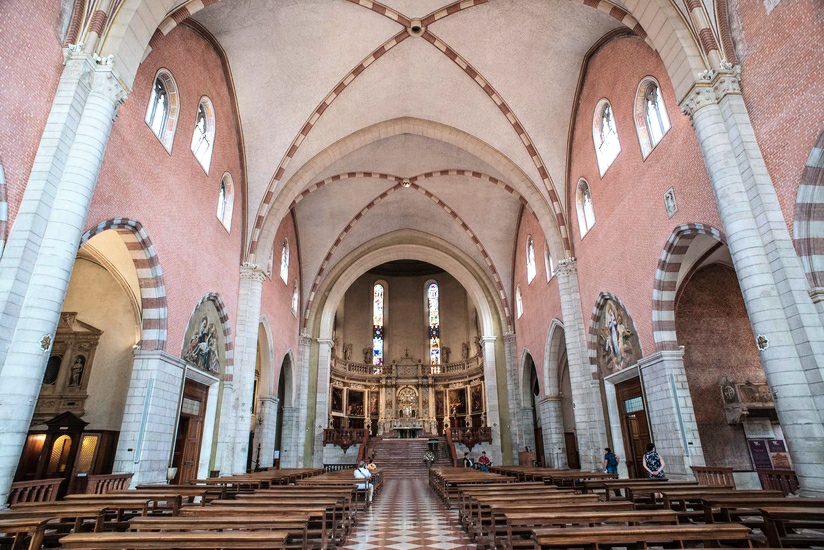
Step inside and the dome overhead is Palladio's work, its drum raised between 1558 and 1559, the dome itself completed in January 1566. The rest of the interior is largely post-war reconstruction, finished only in 2002.
💛 What travellers fall for
People who come back tend to head straight for the basement archaeological area, where you can trace the building's foundations through a Roman house, a Lombard church from the 8th century, and two medieval rebuilds layered one on top of another. The Chapel of St Jerome, founded in 1383, also rewards a second look — the busts by Alessandro Vittoria on the Gualdo monuments are quietly exceptional.
The story behind Cathedral of Vicenza (Duomo di Vicenza)
The site's documented Christian use stretches back to late antiquity, though the cathedral as a coherent structure began in 1482, to plans by Lorenzo of Bologna. Palladio entered the picture in the mid-16th century, designing the cupola — its cornice laid in 1558–1559, the dome raised by January 1566 — and probably the north doorway as well.
On 15 May 1944, Allied bombing destroyed the dome, most of the nave, and damaged the southern chapels. Only the Gothic façade remained standing. Reconstruction was a long undertaking, not declared complete until 2002. The archaeological area in the basement preserves the evidence of what came before: a Roman domus, an 8th-century Lombard church, and successive medieval rebuildings beneath the current floor.

Good to know
About a 15–20 minute walk from Vicenza train station, entry is free. The Mascioni organ (1955, three manuals) occasionally draws recitals worth timing your visit around. Check the Diocese website before you go for current opening hours.
Where is Cathedral of Vicenza (Duomo di Vicenza)?
More tickets & tours for Cathedral of Vicenza (Duomo di Vicenza)
Book directly at the provider
What travellers say about Cathedral of Vicenza (Duomo di Vicenza)
The Cathedral of Santa Maria Annunciata (Cattedrale di Santa Maria Annunciata) is a serene and dignified landmark in the heart of Vicenza, offering a quiet contrast to the city’s grand Palladian architecture. While its exterior is relatively restrained, stepping inside reveals a spacious and harmonious interior shaped by centuries of history and reconstruction. The cathedral blends Gothic origins with Renaissance and later influences, including contributions attributed to Andrea Palladio. High vaulted ceilings, soft light, and elegant chapels create a calm, contemplative atmosphere that invites visitors to slow down and reflect. Artworks and sacred details are presented with a sense of balance rather than excess, emphasizing spirituality over spectacle. As Vicenza’s main cathedral, Santa Maria Annunciata plays an important role in both religious life and the city’s historical identity. It may not be the most visually dramatic church at first glance, but its quiet beauty and layered past make it a rewarding stop—especially for those who appreciate understated elegance and a sense of living history.
The Cathedral of Vicenza is a Roman Catholic cathedral. It is the seat of the Bishop of Vicenza and is dedicated to the Annunciation of the Virgin Mary. You definitely can't miss it because it is very imposing and immediately arouses the visitor's interest in seeing the interior. There are many details that are definitely worth seeing.
Nice Cathedral in the middle of Vicenza, overshadowed by all of the other architectural beauty, and I am sure due to it being reconstructed after the WWII bombings. Beautiful marble floors, a wonderful altar and some frescoes adorn this rather sedate cathedral. Very quiet during the week when we visited. Not many people, and very, very quiet.
The Enduring Heart of Vicenza: Duomo di Santa Maria Annunciata Step into the Duomo di Vicenza, Santa Maria Annunciata, and feel time melt away. This isn't just a building; it's a profound narrative etched in stone, an imposing example of Venetian Gothic grace that has witnessed centuries unfold. Imagine its foundation laid in the late 1200s, upon the very soil where a 5th-century early Christian basilica once stood – a direct link to the whispers of ancient faith, visible beneath your very feet. As you gaze upwards at the triumphant figures of the Madonna and Child, flanked by saints, you feel a silent blessing. The cathedral has gracefully absorbed centuries, from its initial Gothic creation to the subtle alterations of the 1400s, holding its form steadfast against the tides of history. Inside, your eyes are drawn forward, down the central nave, to a grand staircase culminating in the magnificent presbytery. Here, the polypitch by Lorenzo Veneziano (1366), with its 29 vibrant panels depicting the Dormition of the Virgin and figures of saints, speaks volumes of devotion and artistic mastery. Every corner of this sacred space is a canvas, adorned with countless works of art spanning from the 14th to the 18th centuries, each whispering stories of faith and human creativity. The grand high altar, a dazzling creation by Giovanni di Giacomo da Porlezza and Girolamo Pittoni da Lumignano (1534-1536), gleams with precious stones and exquisite marbles. It's a testament to the generous spirit of Aurelio Dall’Acqua, and perhaps even an early touch of genius from a young Andrea Palladio, whose name echoes through these hallowed halls. His renowned hand is certainly found in the cathedral's majestic dome (1558-66) and the elegant northern side portal (1563), his architectural soul woven into the very fabric of this spiritual landmark. Beneath the main entrance, in the crypt, lie the silent tributes: the tomb slab of Archdeacon Alberto Fioccardo, a powerful piece attributed to Angelo di Giovanni da Verona, and that of Battista Fioccardo – poignant reminders of Vicenza's 15th-century sculptural heritage. In the seventh chapel on the left, the luxurious funerary monument of Girolamo and Giambattista Galdo (1566-1574) invites contemplation, with its busts, and allegorical figures of Faith, Hope, and Charity—a masterpiece by Alessandro Vittoria. And beneath it all, a newly opened archeological area of 750 square meters reveals layers of time stretching back to 1946, allowing us to walk paths unseen for centuries. The Duomo is more than a church; it's a living, breathing testament to the enduring human spirit, a place where art, history, and profound devotion intertwine, leaving an indelible mark on every soul who crosses its threshold.
A very big cathedral were you cand get some quiet time and admire the architecture. The place is enormous and you have a lot to see especially at the altar and on the sides. There is also some restored and preserved art around
More of Vicenza
Discover where to stay, what to do and the best deals for your trip.
Explore Vicenza →More attractions in Vicenza
All of Vicenza →

Background adapted from Wikipedia (CC BY-SA) · map data © OpenStreetMap contributors · ratings & place photos via Google · other photos with per-image credit. Ticket links may earn us a commission at no extra cost to you.