
Acquedotto Carolino (Carolino Aqueduct)

Stand beneath the Ponti della Valle at Maddaloni and count the tiers: three rows of tufa arches stacked 55 metres into the air, stretching more than half a kilometre across the valley. This is not a ruin — it carried water until the twentieth century, and it still holds. The Acquedotto Carolino runs 38 kilometres from the Fizzo springs on Monte Taburno down to the Royal Palace at Caserta, mostly underground, surfacing only where a valley forces it into the open.
Along the route, 67 square inspection towers with pyramidal roofs mark the buried conduit at regular intervals, like a procession of small sentinels crossing the Campanian plain. The whole system was calibrated to a slope of half a millimetre per metre — precise enough that gravity did all the work.

💛 What travellers fall for
People who come back tend to time it for late afternoon, when the low sun catches the tufa on the Ponti della Valle and the stone shifts from grey to amber. A few bring bikes and trace the overground sections between Maddaloni and Caserta. The inspection towers make good landmarks, and the route is flat enough to make the distance feel earned rather than punishing.
The story behind Acquedotto Carolino (Carolino Aqueduct)
King Carlo di Borbone broke ground in March 1753 with a specific problem to solve: the Royal Palace he was building at Caserta needed water — enough to feed a cascade, a network of fountains, silk mills at San Leucio and the royal estate at Carditello. He gave the commission to Luigi Vanvitelli, who designed a conduit 1.2 metres wide and 1.3 metres high, its iron pipes cast in state ironworks in Calabria from ore mined at Pazzano and Bivongi.
The work took seventeen years and cost 622,424 ducats. On 7 May 1762 the court gathered to watch the inaugural 'mostra dell'acqua' — water gushing from the hillside into cascading basins for the first time. The town of Airola had been granted city status in 1754 simply for allowing access to its springs. The aqueduct, along with the Reggia and San Leucio, became a UNESCO World Heritage Site in 1997.

Good to know
The aqueduct is free and accessible at any hour. The Ponti della Valle near Maddaloni is the most dramatic above-ground section; buses 46-CE, 48-CE and 49-CE stop within a ten-minute walk. Parking at the viewpoint is limited and informal. Spring (April–June) or early autumn (September–October) keep the heat manageable.
Summers here are hot and dry — August averages around 30°C — and the exposed sections of the route offer little shade. Spring and early autumn bring mild temperatures and lower crowds, making them the most comfortable seasons for walking or cycling any distance along the conduit.
Where is Acquedotto Carolino (Carolino Aqueduct)?
More tickets & tours for Acquedotto Carolino (Carolino Aqueduct)
Book directly at the provider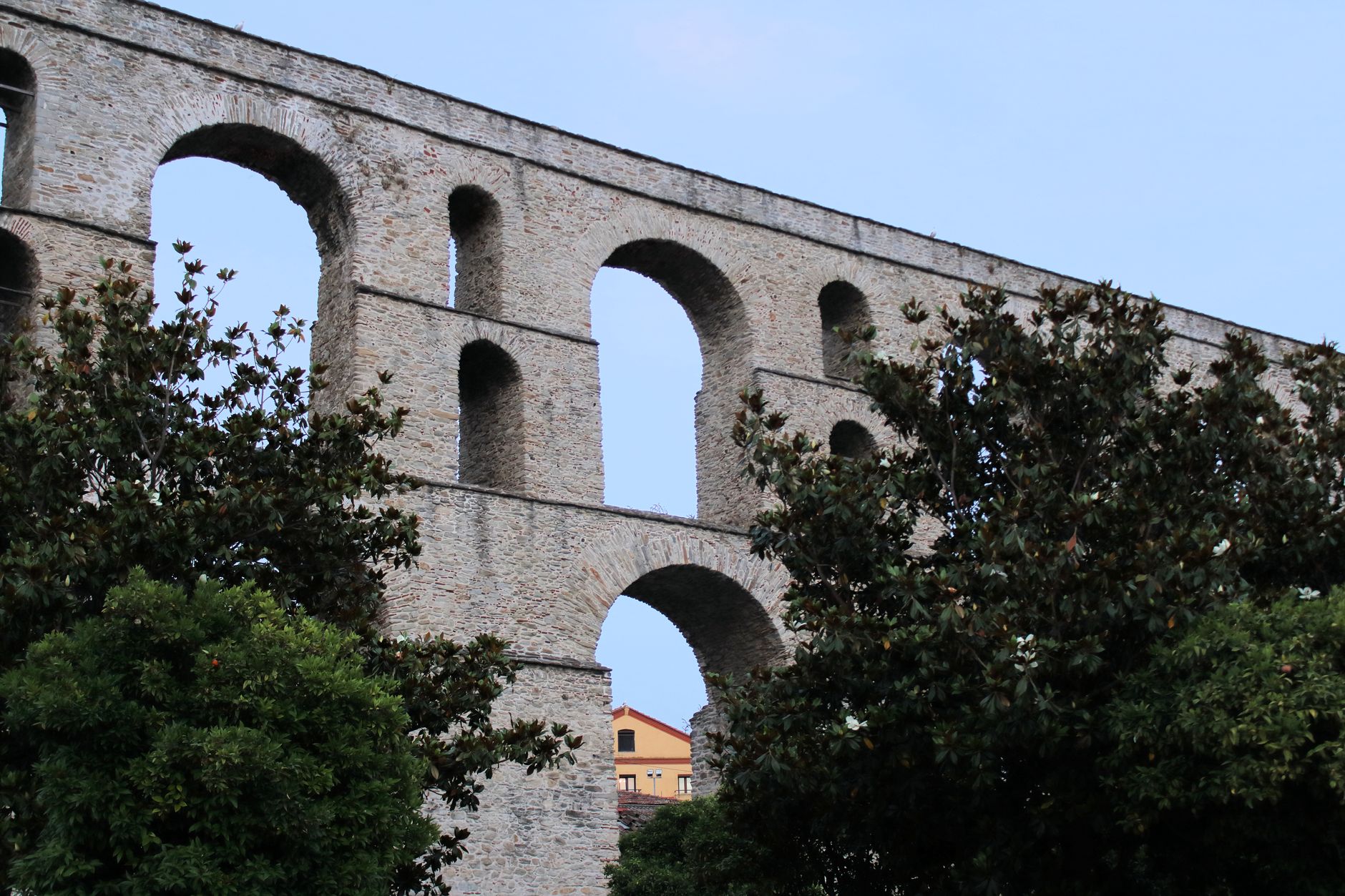
What travellers say about Acquedotto Carolino (Carolino Aqueduct)
Not far from Naples is the ruins of this amphitheater that sits besides what left of the amphitheater before it where Spartacus trained/fought. You can wall around the whole outside, parts of the inner rings, out onto the arena, and go to a large portion of the underground. The stairs to the underground are around on the left side and are poorly marked in Italian. There are free restrooms inside the area, a restaurant, and small gift shop. I was checked for my ticket no less than 3 times, twice by the same guy who needs to cut back on the weed cuz I about got a contact high from just his smell.
Impressive aqueduct that blends into the landscape. Nice place to visit/spot when driving by. Parking can be tricky but there is a lay-by after the aqueduct if coming from Caserta direction.
Definitely worth visiting it's just so much bigger than I imagined. It is in very nice condition. You cant walk on the top due to a gate. But you can follow a nice trail up to the top and see it.
While exploring the greater Naples area (Italy), had to make a quick stop to see this magnificent part of history! We drove by it a few times to soak it all in and ended up parking where I found the blue P sign for free parking (tiny side street where couldn't go too far in bc only open to residents). Massive, breath taking and unbelievable that our ancestors could engineer and build something so impressive. Only stated 10 minutes but worth the stop.
When you visit the Royal Palace of Caserta you don’t wanna miss this wonderful aqueduct just 10 km away from the palace. Mostly underground, the aqueduct is well known for its well-preserved and absolutely amazing, three-tier, 529-metre-long tufa-arched section bridging the Valle di Maddaloni between Monte Longano and Monte Garzano. This section was modelled after Roman arched aqueducts, is 55.8 metres high at its highest point, crosses what is now highway SP335 — and was designated a World Heritage Site in 1997. The Aqueduct of Vanvitelli or Caroline Aqueduct is a 38 km aqueduct that supplied water to the Reggia di Caserta and the San Leucio complex from the foot of the Taburno massif and springs of the Fizzo Contrada, in the territory of Bucciano. Commissioned by Charles of Bourbon, the aqueduct was designed by and named after Luigi Vanvitelli. Construction began in March 1753 and it opened on 7 May 1762. It is located in SS265, 81020 Valle di Maddaloni CE, Italy.
More of Caserta
Discover where to stay, what to do and the best deals for your trip.
Explore Caserta →More attractions in Caserta
All of Caserta →

Background adapted from Wikipedia (CC BY-SA) · map data © OpenStreetMap contributors · ratings & place photos via Google · other photos with per-image credit. Ticket links may earn us a commission at no extra cost to you.