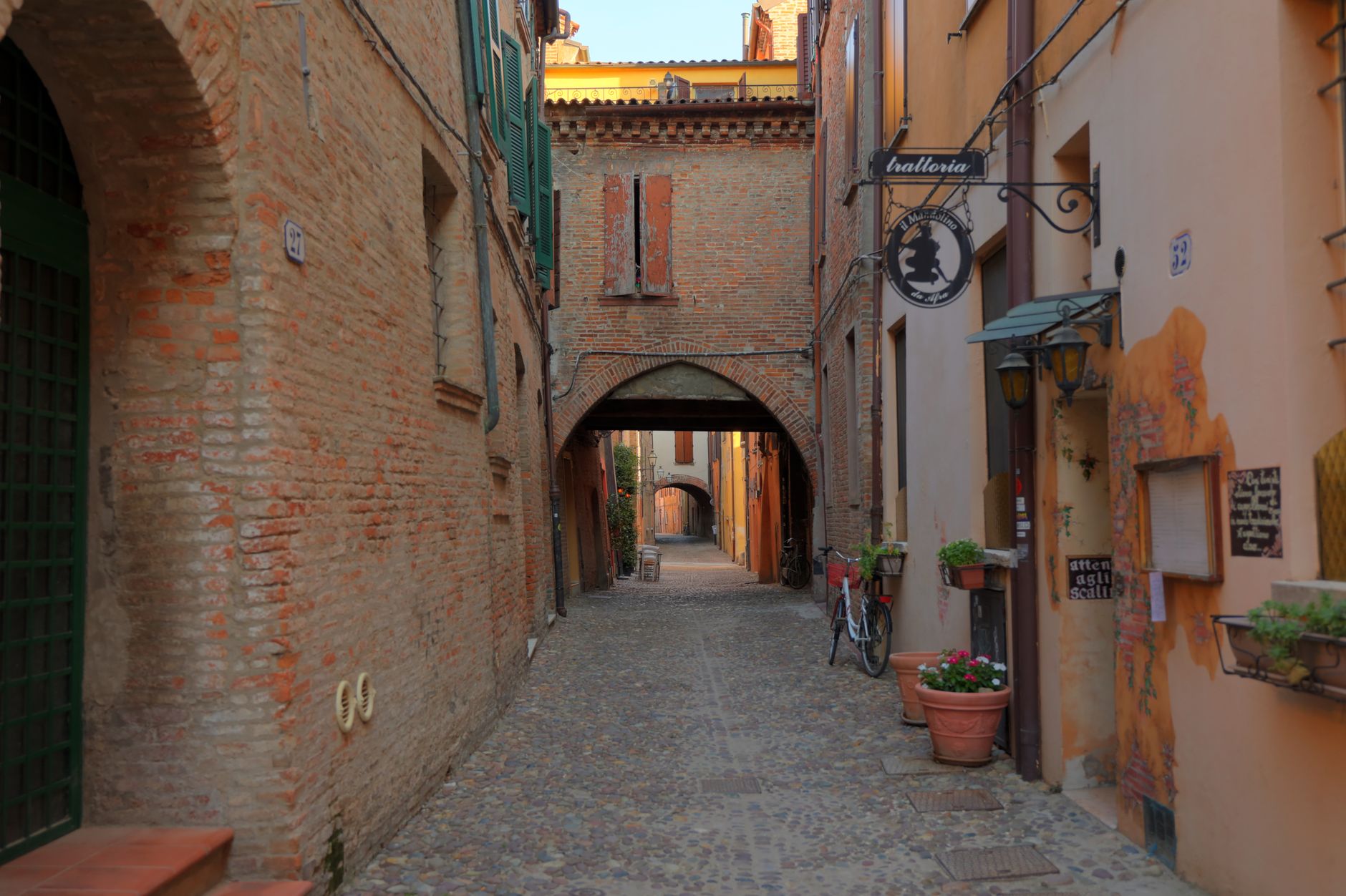
Addizione Erculea
When Duke Ercole I d'Este commissioned Biagio Rossetti to expand Ferrara northward in 1492, the result became the world's first planned Renaissance city — and UNESCO recognised it as such. Walking the Addizione Erculea today feels like stepping inside a 15th-century urban-planning blueprint that actually worked.

The grid that changed urban history
Rossetti's masterpiece is the Quadrivio degli Angeli, the intersection of Corso Ercole I d'Este and Corso Rossetti, where four landmark palazzi anchor the corners in a deliberate act of civic theatre. Palazzo dei Diamanti — its façade studded with 8,500 pointed marble blocks — is the showstopper, but take time to look at all four corners as a composition rather than rushing inside.
The wide, straight boulevards were revolutionary: designed for carriages, processions and perspective views rather than the tangle of medieval lanes. The scale still impresses. Corso Ercole I d'Este is long enough that on a clear day you can see the city walls at the far end, framing the view like a painting.
What to do inside the neighbourhood
Palazzo dei Diamanti houses the Pinacoteca Nazionale, with an excellent collection of Ferrarese Renaissance painting — Cosmè Tura, Francesco del Cossa and Ercole de' Roberti are all here. The building also hosts major temporary exhibitions that regularly draw national attention.
The neighbourhood is almost entirely residential away from the main corso, which keeps it quiet and authentic. Duck down Via Ariosto to find the modest house where poet Ludovico Ariosto lived and wrote Orlando Furioso — it is open as a small museum and is rarely crowded.
More of Ferrara
Discover where to stay, what to do and the best deals for your trip.
Explore Ferrara →