Vieux-Lyon (Old Lyon) and the Traboules
Vieux-Lyon is the largest Renaissance urban district in France, a UNESCO World Heritage Site of ochre and rose-coloured façades squeezed between the Saône river and the Fourvière hill. Its most addictive secret is the traboules — a network of covered passageways that cut through apartment blocks, spiral up medieval staircases and emerge unexpectedly in sun-dappled courtyards.

Navigating the Traboules
The word traboule derives from the Latin transambulare, to pass through, and Lyon has over 300 of them, with around 40 open to the public in Vieux-Lyon alone. The most celebrated run between Rue Saint-Jean and Rue du Boeuf, threading through Renaissance courtyards with carved loggias and stone wellheads that feel completely untouched by the 21st century.
The silk weavers of the Croix-Rousse district used a separate network of traboules on the opposite bank to transport bolts of fabric under cover, protecting the delicate cloth from rain. A free map from the Lyon tourist office marks the key entrances, though half the fun is finding unmarked doors that push open.
Beyond the Passageways
The Cathédrale Saint-Jean-Baptiste anchors the southern end of the district, its astronomical clock striking at noon, 2 pm, 3 pm and 4 pm with a mechanical angel show that draws small, delighted crowds. The nearby Musée Gadagne houses both the city history museum and an international puppet museum — Lyon is the birthplace of the Guignol puppet tradition.
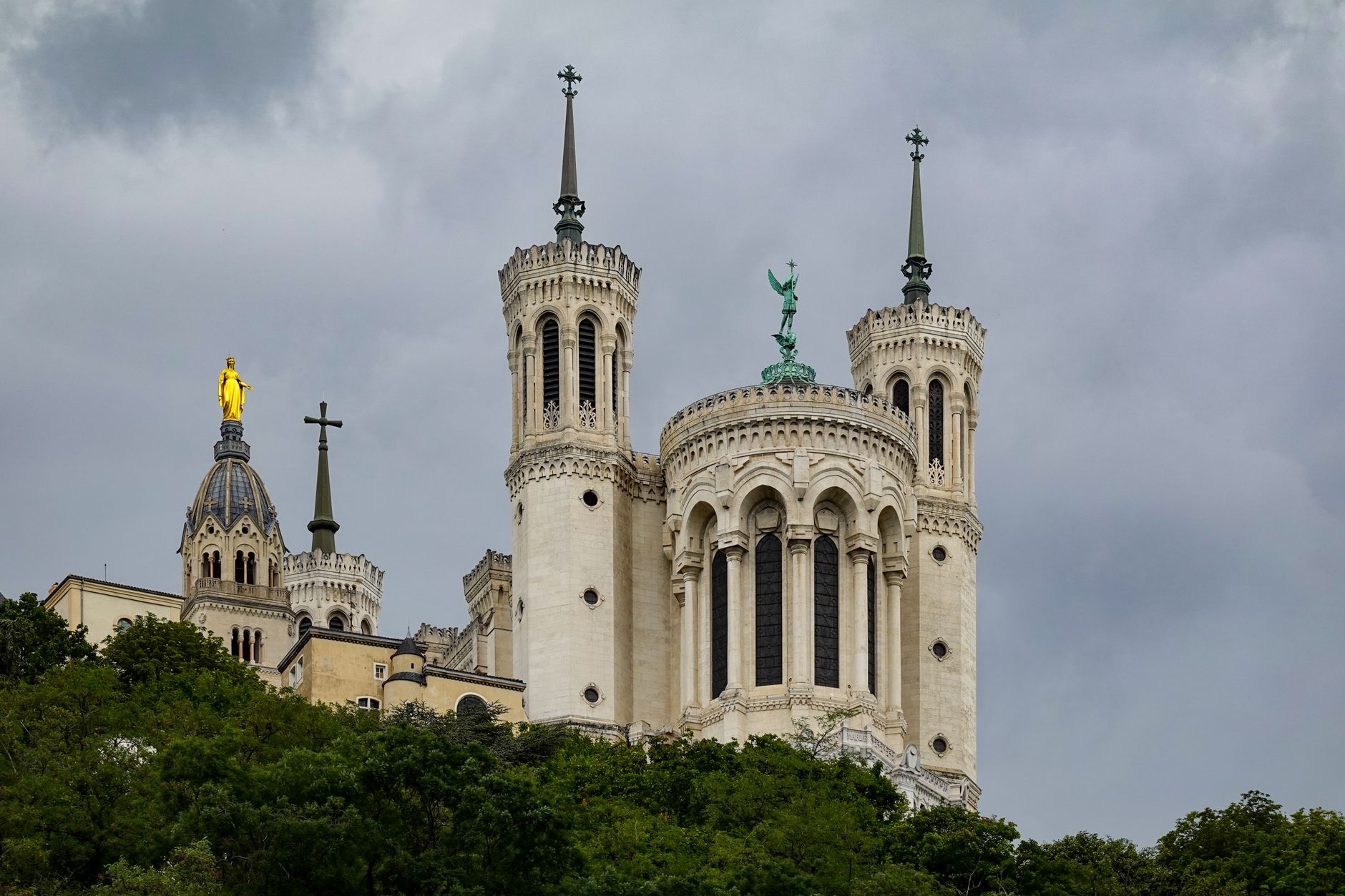
For the full panoramic payoff, take the short funicular from the Vieux-Lyon metro station up to the Basilique Notre-Dame de Fourvière, whose white marble towers loom theatrically over the city. The esplanade below the basilica offers one of the great urban viewpoints in France, with the Presqu'île, the Alps and on exceptional days Mont Blanc all visible.

More of Auvergne-Rhône-Alpes
Discover where to stay, what to do and the best deals for your trip.
Explore Auvergne-Rhône-Alpes →