
Santa Maria delle Grazie (The Last Supper)
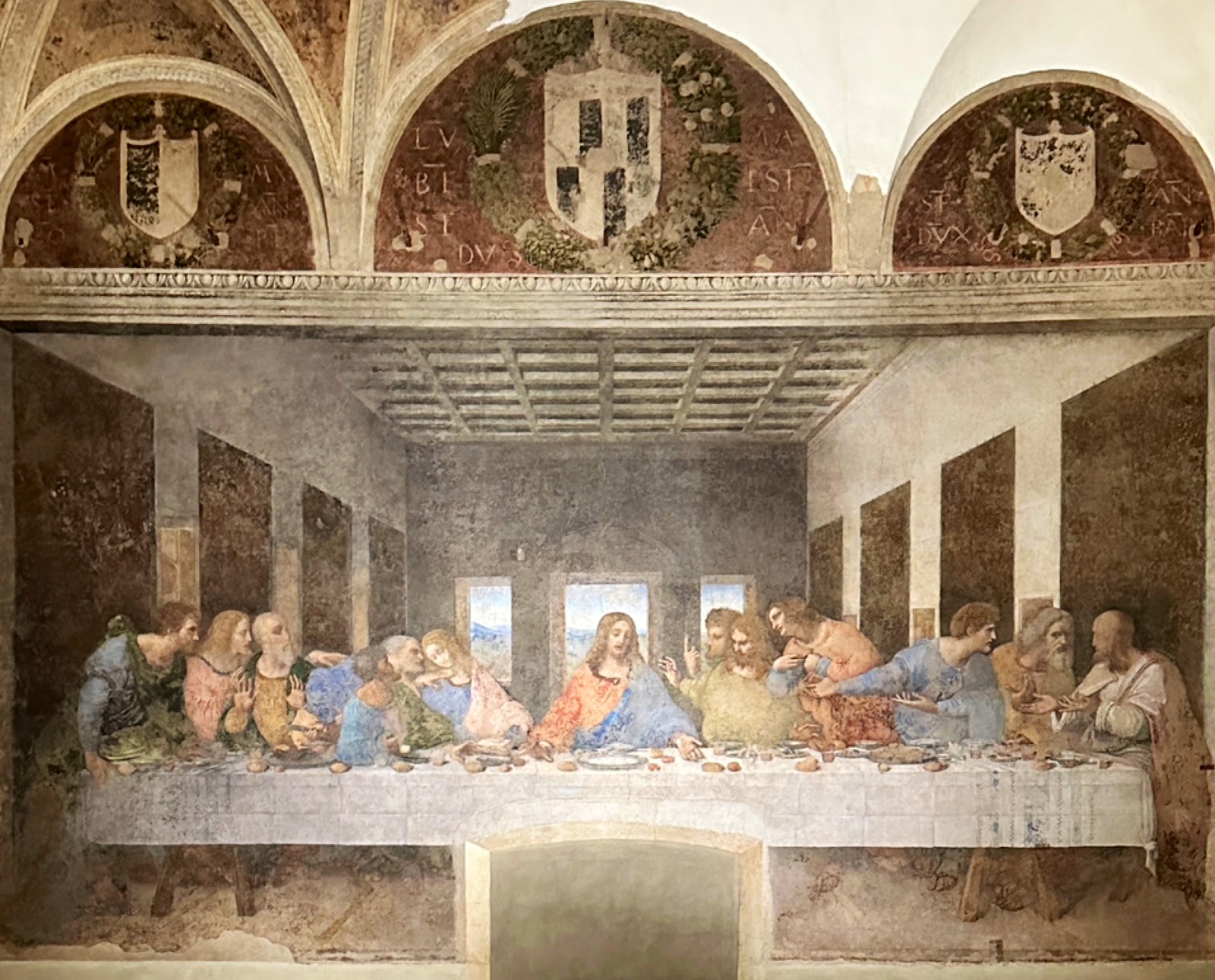
The refectory wall is 460 centimetres tall and 880 centimetres wide, and Leonardo da Vinci covered it between 1495 and 1497 with tempera and oil on dry plaster — a technically risky choice that began deteriorating within decades. What you stand before today is the result of a twenty-one-year restoration completed in 1999, and of a remarkable accident of war: when Allied bombs destroyed much of the refectory in August 1943, the north wall held.
The church itself, Santa Maria delle Grazie, earns its own attention. Guiniforte Solari's Gothic nave gives way to Donato Bramante's Renaissance tribune — a sixteen-sided drum and hemispherical dome added from 1492, commissioned by Duke Ludovico Sforza when he decided this would be the Sforza family burial church. Beatrice d'Este, his wife, was interred here in 1497, the same year Leonardo finished painting.

💛 What travellers fall for
People who come back tend to say the same thing: book the refectory the moment your travel dates are fixed, not a week before. The 15-minute slot with a maximum of 35 people moves quickly, and popular months sell out far in advance. Walk the church first — Bramante's cloister and the Chiostro delle Rane, with its bronze frog fountain, give you time to settle before the main event.
The story behind Santa Maria delle Grazie (The Last Supper)
Construction began in 1463 when Duke Francesco I Sforza commissioned a Dominican convent and church. Guiniforte Solari completed the Gothic nave by 1469. After Francesco's death, his son Ludovico — known as il Moro — took the project further, deciding the complex should serve as the Sforza dynastic burial site. He brought in Bramante, whose redesigned apse and drum-topped dome transformed the eastern end of the building into something distinctly Renaissance. Work on the tribune began 29 March 1492.
Ludovico also commissioned Leonardo da Vinci in 1495 to paint the north wall of the refectory. On the opposite wall, Giovanni Donato da Montorfano painted a Crucifixion the same year — it still faces Leonardo's work today. The complex received UNESCO World Heritage status in 1980.

Good to know
Take M1 to Conciliazione or M2 to Cadorna, then walk eight minutes. The church is free and needs no booking. The refectory (€15, reduced €2 for ages 18–25, free under 18) requires advance reservation via the official site or by phone. Closed Mondays and during the midday break.
Where is Santa Maria delle Grazie (The Last Supper)?
More tickets & tours for Santa Maria delle Grazie (The Last Supper)
Book directly at the provider
What travellers say about Santa Maria delle Grazie (The Last Supper)
Visiting Leonardo da Vinci's The Last Supper was one of the highlights of my trip to Milan and an experience I will never forget. Getting tickets was actually one of the most challenging parts of the visit. I checked availability almost every day for several weeks before finally getting lucky and securing an 8:30 AM entry slot. In fact, our Milan itinerary was planned around this visit because seeing The Last Supper was one of our top priorities. If you are planning a trip, I highly recommend booking as early as possible and monitoring availability regularly if tickets are sold out. My reservation was for 8:30 AM, and we arrived around 8:15 AM. The entire process was very well organized. After completing security screening, visitors are guided through a series of controlled access areas designed to protect the artwork. We waited approximately 10 minutes in an intermediate climate-controlled room before being admitted to the viewing hall. The preservation efforts are impressive and demonstrate the care taken to protect this priceless masterpiece. Although viewing time is limited, it is more than enough to appreciate the scale, detail, and historical significance of the painting. Seeing The Last Supper in person is far more powerful and emotional than viewing photographs or reproductions. The staff were professional and efficient, and the timed-entry system worked smoothly. Standing before one of the world's most famous works of art and experiencing Leonardo da Vinci's genius firsthand was truly inspiring. A helpful tip for visitors: do not forget to bring the passport or identification document used during the booking process, as it may be required for ticket verification. Creating an online user account in advance can also make the booking and entry process much smoother. If you are visiting Milan, this is an absolute must-see attraction and well worth the planning and effort required to secure a ticket. For us, it was the highlight of our Milan trip and a memory that will last a lifetime
We were in Italy for a month and visited many great museums and art gallaries and duomos. This was, for us, one of the apex moments. I loved seeing it in the very place it was painted and that made it transcendent. Also, the transient quality of the work adds to the sense of deep gratitude to be so blessed as to see it. This was our first stop in Milan and my favorite. Hard to compare with being on the roof of the Duomo which is utterly spectacular but... that quiet time standing in the rectory was unforgettable.
It’s hard to put into words how amazing this experience was. We were fortunate to be able to go on Holy Thursday. Our guide was amazing - she really drew us into the moment and gave historical and spiritual context that allowed us to really engage more and understand the context daVinci was painting in. It’s worth rerouting to go and certainly a must see if you’re in Milan. You must plan ahead to get your tickets. And don’t rush yourself arriving — you need to check into the registration area, wait for your guide, and enter the space together. You’ll be with a group of around 40 people and will spend 15 minutes viewing the Last Supper and 15 minutes entering and exiting the space. Beautiful and meaningful experience.
Maybe I’m not the right person for it, but seeing it in person did not give me the magical epiphany everybody else seems to have felt, or one that would support why the bookings for it are so hard to get, and the level of security and convoluted entry to actually get to the main hall. That said, it does look good and feel important enough, the dim lighting and the scale of the space creates enough of an interesting atmosphere. There’s also more than just The Last Supper itself there, and I especially like the miniature relief version of it as well. Then again, it is a cultural and historical landmark of Milan, and if you have the opportunity to see it in person, by all means do. I just think the level of importance and hype it’s getting is not entirely justified PS: None of this applies to the adjacent Santa Maria delle Grazie, which is very beautiful and definitely worth its recognition
Seeing it in person is genuinely special. The full setting gives far more context than the cropped images you usually see - the scale of the hall, the opposite wall fresco by a different painter, and even the visible damage (including the doorway cut through the lower section centuries ago) all add to the experience. It feels less like “just a painting” and more like stepping into a preserved historical space. Entry is tightly controlled: groups of about 35 people at a time, with roughly 15 minutes inside. It sounds short, but it’s actually enough time to take it in and read the few signs without feeling rushed. Pricy bookshop and single toilet available after viewing the painting. Note: Small allowed as long as no food or drinks; lockers available in the ticket area for those not meeting the standards. However, it’s easily one of the most difficult tickets I’ve ever tried to secure. Timed entry is mandatory, tickets sell out quickly, and the whole booking process is far more stressful than it feels like it should be. Tickets were released roughly a month before each quarter, and on release day the website repeatedly crashed and threw errors - across 100+ attempts on multiple devices and browsers (no exaggeration). After that, I resorted to checking the calendar obsessively - first several times a week, then several times a day in the final couple of weeks - until a time slot finally appeared and, thankfully, the transaction actually went through. Frustrating logistics, but absolutely worth seeing in person at least once.
More of Milan
Discover where to stay, what to do and the best deals for your trip.
Explore Milan →More attractions in Milan
All of Milan →

Background adapted from Wikipedia (CC BY-SA) · map data © OpenStreetMap contributors · ratings & place photos via Google · other photos with per-image credit. Ticket links may earn us a commission at no extra cost to you.