
Cimitero Militare Tedesco di Cassino
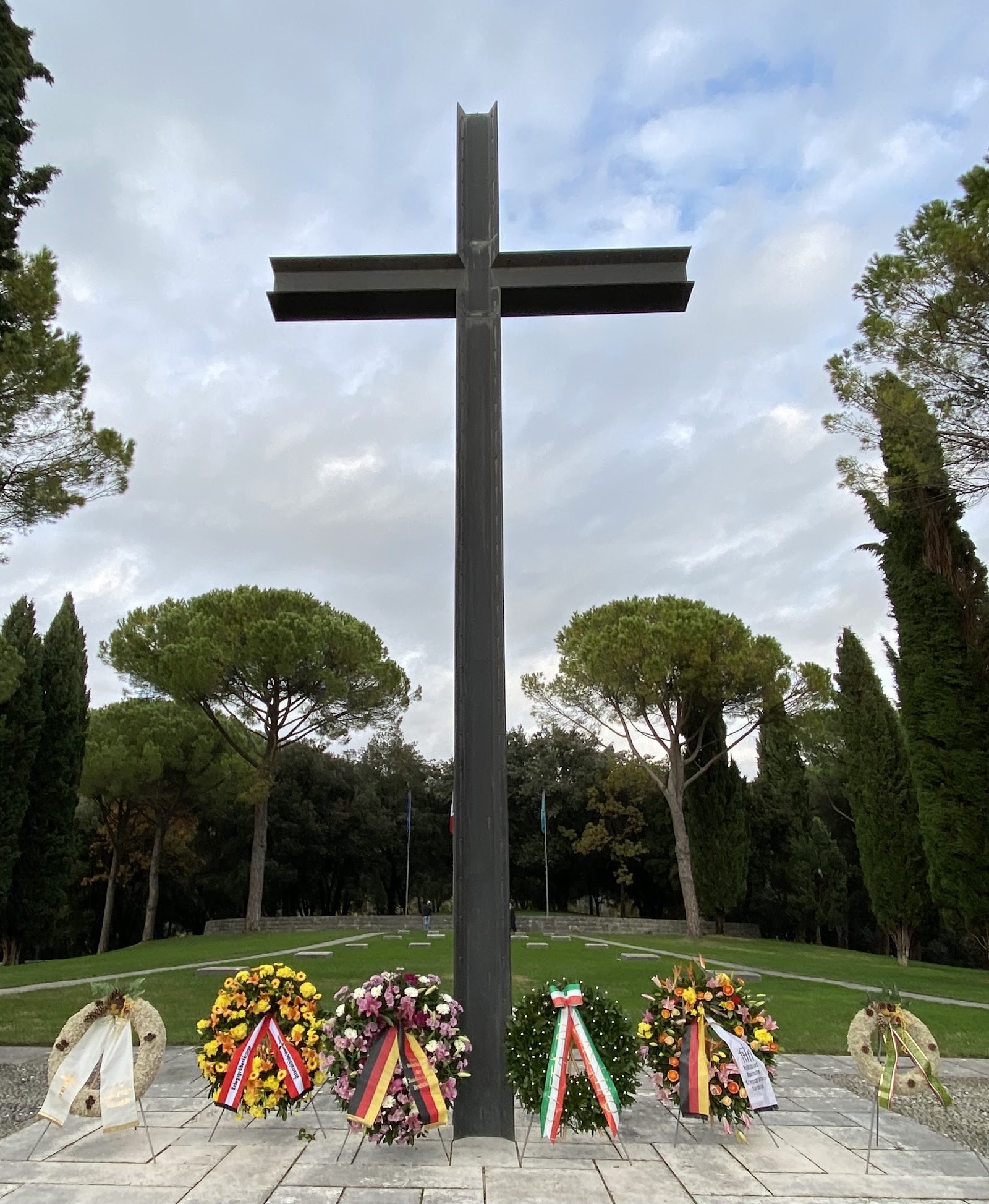
At the entrance to the German Military Cemetery at Cassino, a cube-shaped building open to the sky frames Suse Müller-Diefenbach's bronze sculpture — daylight falling on "Mourning and Consolation" before you've taken a single step among the graves. Beyond it, 34 burial fields spread across seven semicircular terraces on Colle Marino, each grave marked by a flat stone cross shared by three names.
More than 20,000 German soldiers lie here, many of them reburied from 602 temporary graves scattered across 21 Italian provinces — fields, hillsides, roadsides — after a five-year recovery effort that began in 1959. From the hilltop, the valley and town of Cassino open wide below you. The Abbey of Montecassino is nowhere in sight from where you stand.

💛 What travellers fall for
People who've been before tend to arrive early, before the light gets harsh and before tour groups from the abbey make their way down. The steep climb to the upper terraces is worth it for the panoramic view of the valley — and for the quiet. The stone crosses, each carrying three names on two faces, reward slow reading.
The story behind Cimitero Militare Tedesco di Cassino
The cemetery exists because of a bilateral agreement signed in December 1955 between the German and Italian governments, authorizing two German military cemeteries on Italian soil. Construction ran from 1959 to 1964 under the Volksbund Deutsche Kriegsgräberfürsorge — the German war graves organization founded in 1919 — with design by chief architect Robert Tischler and completed by Professor Offenberg. The site was inaugurated on 4 May 1965.
The ground it occupies sits on the southern foothills of Colle Marino in Caira, directly beneath the Gustav Line, where German forces held their position for four months in 1944. Italian reluctance to grant land meant the dead were buried up to six deep per plot — a compression of loss that the orderly rows of shared crosses only partly reveal.

Good to know
Park at Piazza Marino Fardelli — there's no parking at the entrance itself. The climb through the terraces is steep; contact the information office at the entrance if you need vehicle assistance. Admission appears to be free. Confirm current opening hours via the Volksbund Deutsche Kriegsgräberfürsorge website before visiting.
May through October offers the most comfortable conditions, with temperatures between roughly 21°C and 29°C and the driest months falling in July and August. Winter visits are cool and often grey, with short days and higher rainfall — November is the wettest month — though the terraces are rarely crowded.
Where is Cimitero Militare Tedesco di Cassino?
More tickets & tours for Cimitero Militare Tedesco di Cassino
Book directly at the provider
What travellers say about Cimitero Militare Tedesco di Cassino
Next to entrance there is museum and public toilets. Cementry is kept clean and tidy. So many polish surnames. They fought against polish brothers
A German cemetery that is very well maintained. The gate was open even on a Sunday and we were the only ones to visit.
Beautifully maintained place of remembrance. If you're driving a car, there's no evident parking near cemetery. I was looking for a parking lot, there was none, and ended up on a tiny private road doing a U-turn to the scowl of a homeowner. I parked in a small space in front of cemetery main building which seems like it is for utility vehicles. I'd suggest park in an easy spot 200 meters away and do NOT drive across the little bridge to get near cemetery. Park safely then walk the last bit.
Established in 1959, this location in Caira became the centralised area for German military personnel from other cemeteries, It now contains the graves of over 20,000 fallen in battle. It's seven burial terraces served by two main paths steeply dominate and engulf an entire hill. Interspersed by trees which contribute to a certain dignified ambience, it requires a degree of physical stamina to absorb the site in its entirety. The poignant sculpture of two figures posed in grief and a tall serene bronze cross symbolise grief and loss.
My Father served with the US 1st Armoured Division. Upon entering Cisterna he noticed three fallen German Soldiers opposite a small fence. Near one of the soldiers layed his helmet. My Father told me he was a stout husky guy with bright red hair but very black from decay. He often referred to him as "Big Red " He said he only took his helmet of which there is a hand painted number in black 166 and cut his Eagle patch off and sent these items home. He looked at a picture Big Red had of himself and wife and Family but put it back so that it may help to identify him. My Father said he appeared to have been killed by concussion from artillery burst. This is all that I know but Big Red is still a part of my life and now my Grandson knows of him as well. You are not forgotten although you are unknown to me. Rest In Peace and I hope that my eyes have seen your eternal resting place through these beautiful photos.
More of Cassino
Discover where to stay, what to do and the best deals for your trip.
Explore Cassino →More attractions in Cassino
All of Cassino →


Background adapted from Wikipedia (CC BY-SA) · map data © OpenStreetMap contributors · ratings & place photos via Google · other photos with per-image credit. Ticket links may earn us a commission at no extra cost to you.