
Church of Sant'Ilario a Port'Aurea

A wooden walkway runs between two entrances of this small church, suspended above an unpaved floor that exposes the layers underneath — Roman corridors from the second century AD, Benedictine monastery walls, medieval ground tombs. The building itself is spare: a rectangular plan, a semicircular apse, two towers of unequal height.
The name comes from the Arch of Trajan, visible just south. In the Middle Ages the arch was folded into the city walls and called the Porta Aurea — the Golden Gate — and the church that stood beside it took its address from that gate. Today, the same arch is the subject of a film projected onto the church's interior walls after dark.

💛 What travellers fall for
People who come back tend to mention the guardian specifically — someone who actually knows the excavation history and talks you through it without a script. The combined ticket that links this site to the Museo del Sannio and the cloister of Santa Sofia is worth picking up here rather than at the larger venues.
The story behind Church of Sant'Ilario a Port'Aurea
The church dates to the late seventh or early eighth century, almost certainly Lombard in origin, built over an earlier Roman complex whose three communication corridors are still visible below the current floor. Its dedication to Saint Hilary of Poitiers — the theologian who argued against the Arian heresy — is thought to reference Bishop Barbato and Duke Romualdo I, who together brought Benevento's Lombard population into Roman Catholicism around that same period.
The first written record of the church and its attached monastery appears in December 1148. Pope Julius II annexed it to the Metropolitan Chapter in 1504. The 1688 earthquake left it unusable; it spent centuries as a farmhouse. Systematic restoration began in 1952 under Professor Mario Rotili, who later became mayor of Benevento. The Province purchased the complex in 1974, and in December 2004 the interior reopened as the Museo dell'Arco di Traiano.

Good to know
The Benevento Arco Traiano railway halt is 160 metres south on Via San Pasquale. The combined ticket (€4 reduced, free for several categories) covers multiple sites across the city — buy it here. Spring and early autumn are the most comfortable seasons; July and August can push past 37°C.
Benevento runs hot in summer — highs above 37°C are common in July and August, with very little rain to break the heat. Mid-April through early June and September through early October give you warm, mostly dry days without the full weight of summer.
Where is Church of Sant'Ilario a Port'Aurea?
More tickets & tours for Church of Sant'Ilario a Port'Aurea
Book directly at the provider
What travellers say about Church of Sant'Ilario a Port'Aurea
This site is or can be part of a combination ticket that would get you into other museums. The historical site still has some ruins. There are two presentations one audio and one video explaining the story behind the birth of the Arch. Worthy visit.
Grazie Livia, very nice welcome when entering the museum of s. ilaro. The site is well preserved with information in English within the site. There is a short film which provides good information on the importance of the site and Arco Traiano. Cash was required for the tickets and it’s very well priced for what is on offer.
The Monumental Complex of Sant'Ilario a Port' Aurea in Benevento is located a few steps from the Arch of Trajan and is used as a museum of the Arch (a film is shown explaining the history of the Arch of Trajan). Originally built in the 6th-7th century AD, it was presumably a Lombard church, built on ancient ruins. Over the centuries, it underwent transformations until it became a museum. From the outside, it is very beautiful, and the remains of the ancient ruins are still visible. It is definitely worth the ticket.
The Sant'Ilario Multimedia Museum accurately describes the story of Emperor Trajan, beautifully carved in the marble of the nearby Arch of Trajan. Using modern technology, a film is projected that evocatively describes all the episodes depicted on the monument, with particular attention to the small frieze that runs along the four sides of the Arch. The frieze is illustrated through virtual reality, offering a personal interpretation of the monument; the arch itself speaks and explains the symbols, engaging in a sort of live commentary of the events narrated on the arch. The opposing panels of the monument dedicated to Trajan are illustrated. The purpose of the film is to allow the visitor to better understand the entire descriptive apparatus of the Arch, rightly called "a book of stone," with references to the history of Benevento and with insights for a greater understanding of the Roman world. The archaeological excavation conducted in the Church of San Ilario revealed that the church was built in the Lombard period, resting on three sides on masonry structures belonging to an Imperial-era building. The monumentality of the spaces identified led to a modification of the original design, which envisioned a classical layout with panels and display cases. To leave the ancient structures visible, a walkway was constructed, spanning the church from the main door to the apse, which features a door dating back to the Middle Ages. Consequently, the layout was modified, telling the story of Trajan, described by his sculptor, through the projection of a film based on the development of architectural reliefs. To allow for the projection of the film, a double iron track suspended from the ceiling by steel cables was constructed above the walkway, carrying five projectors. One of these, located in front of the entrance door, projects images of three figures, including Trajan, onto a screen in the apse. The figures alternate, describing what is projected by the other four projectors on the opposite side walls. Before the projection, visitors are greeted at the entrance to the church by an operator who briefly explains the history of the church and the archaeological structures highlighted.
I'll start by saying that I only glimpsed it from the outside due to lack of time, but it made a strong impression on me. It's a church, probably of Lombard origin and now deconsecrated, that owes its name in part to the nearby Arch of Trajan, which in the Middle Ages was known as the Porta Aurea. Around it are ruins, possibly related to the monastery that was annexed to the church.
More of Benevento
Discover where to stay, what to do and the best deals for your trip.
Explore Benevento →More attractions in Benevento
All of Benevento →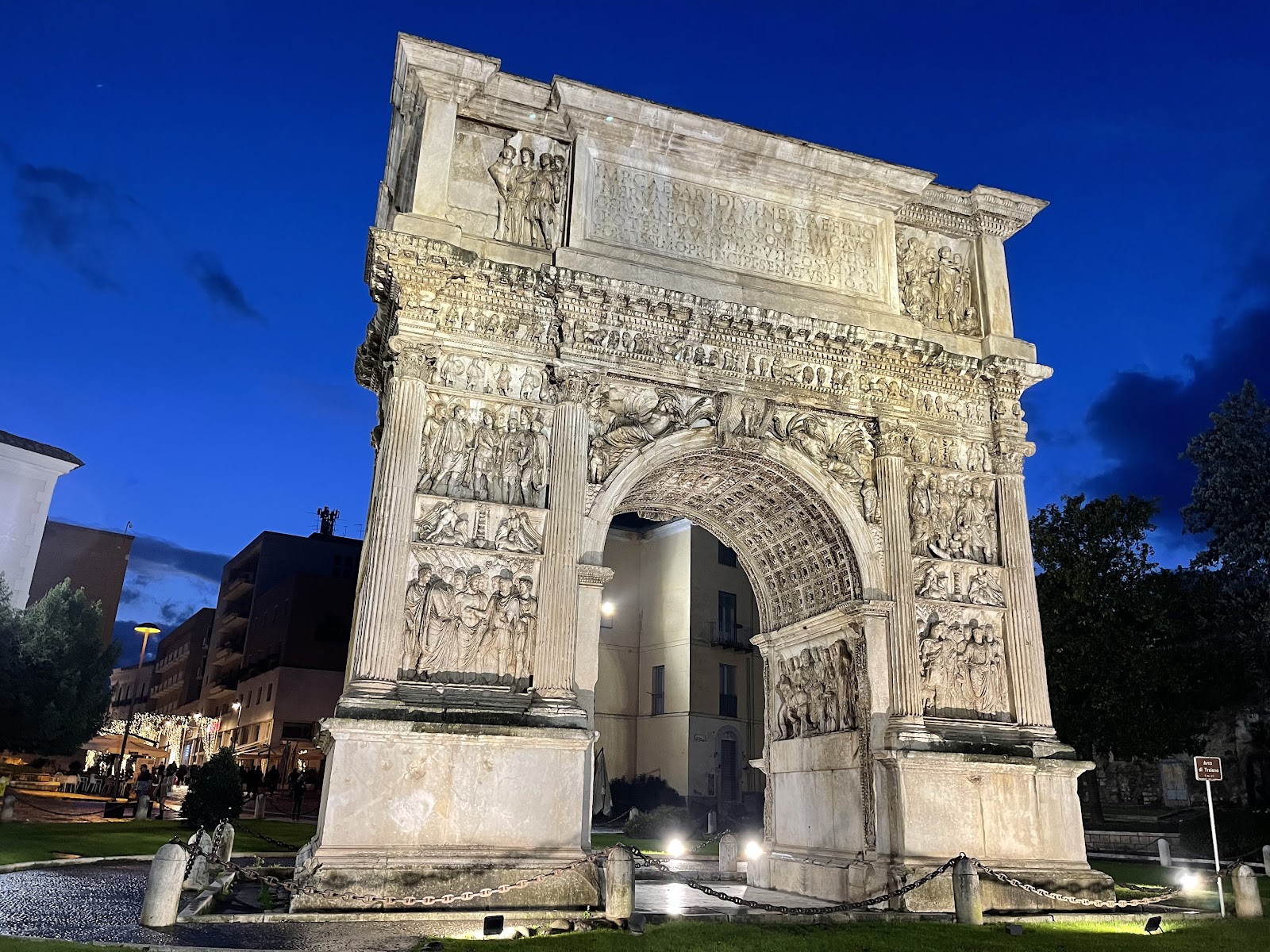
Background adapted from Wikipedia (CC BY-SA) · map data © OpenStreetMap contributors · ratings & place photos via Google · other photos with per-image credit. Ticket links may earn us a commission at no extra cost to you.