
Baptistery of Cremona
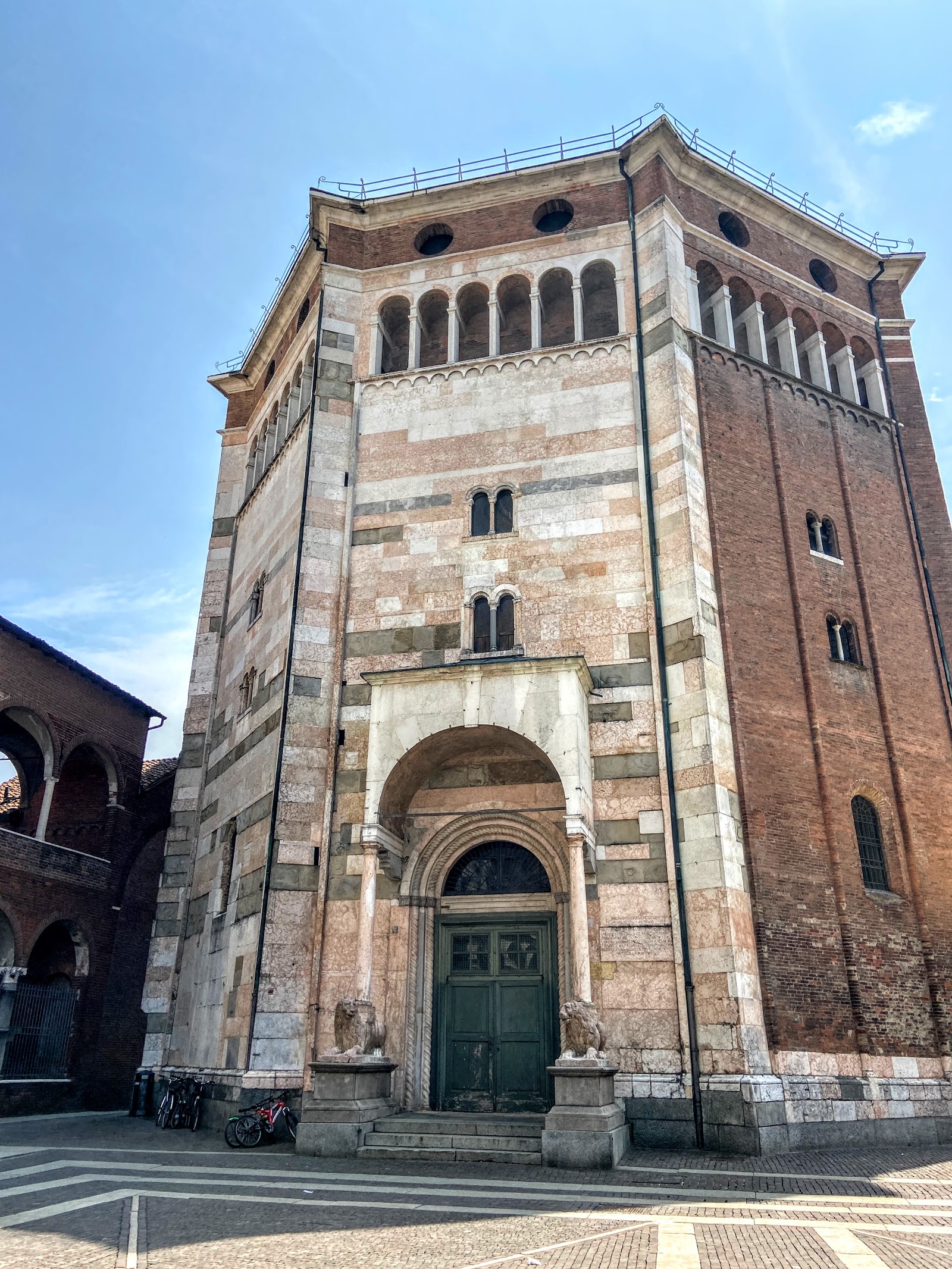
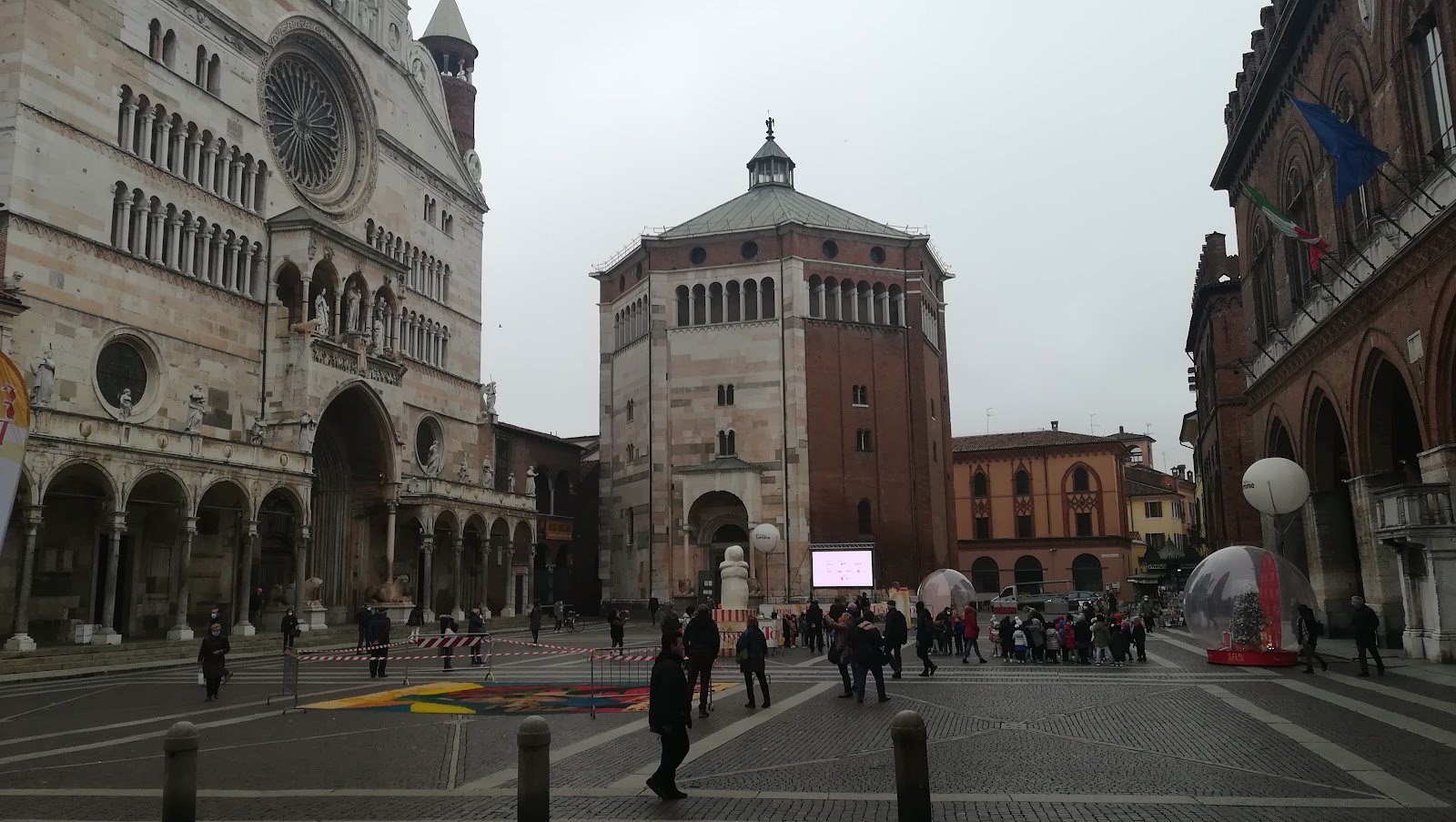
Stand at the door of Cremona's Baptistery and notice the asymmetry right away: six of its eight sides are plain bare brick, and only two are faced in marble. That is not neglect — it is the building's honest biography, a terracotta octagon that was always more civic statement than finished jewel.
Built from 1167, it stands beside the Cathedral as a matter of early Christian doctrine: the unbaptized could not enter a consecrated church, so they needed their own threshold. The Baptistery was that threshold, and it still reads that way — smaller than what's next door, but carrying its own specific gravity.
💛 What travellers fall for
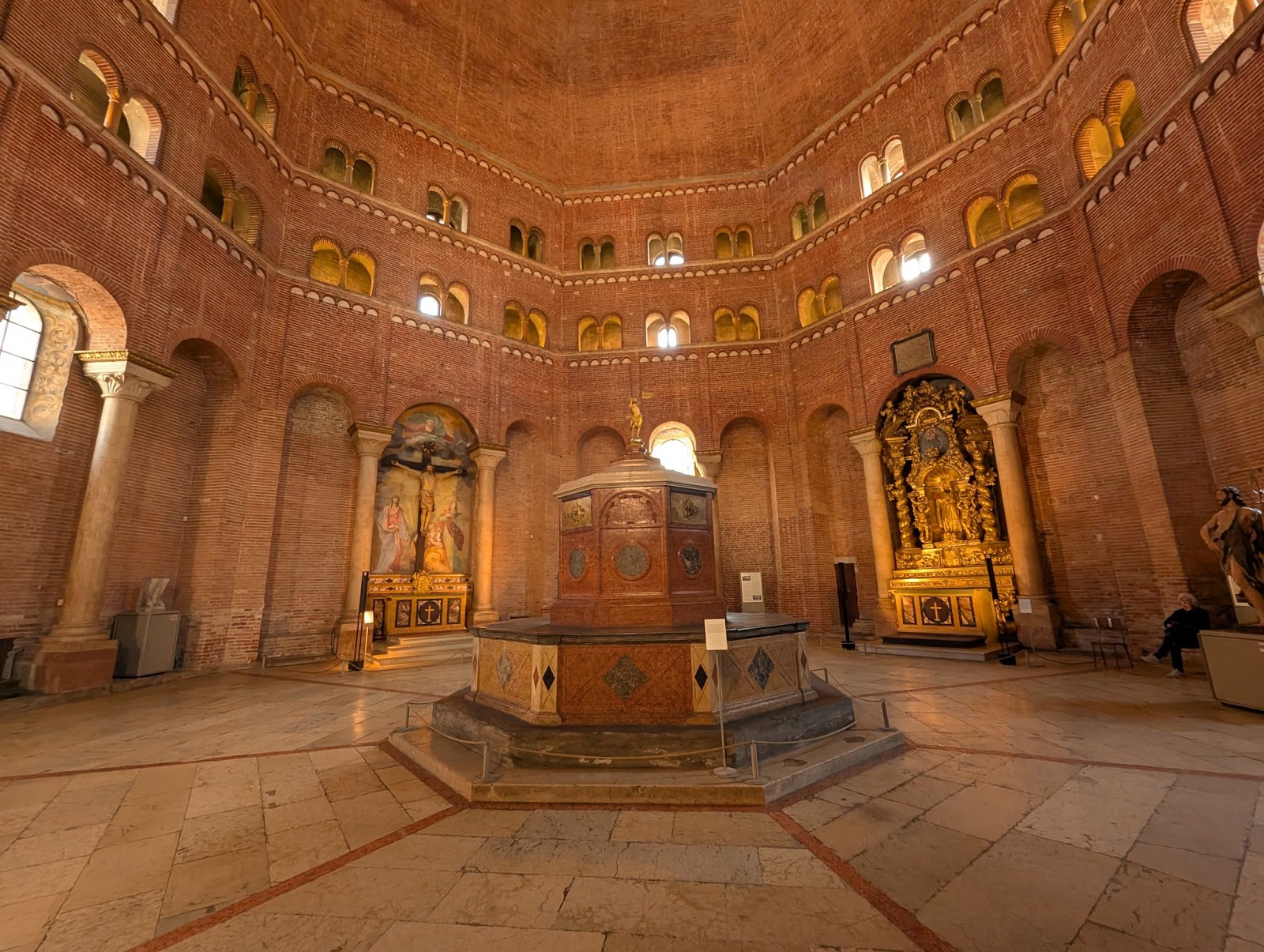
People who come back tend to slow down inside once they find the great red marble basin Lorenzo Trotti carved between 1520 and 1531 — it sits in the centre of the space and rewards a long look. The Romanesque Stone Museum arranged around the perimeter is easy to miss if you're moving quickly; give it a few unhurried minutes.
The story behind Baptistery of Cremona
Construction began in March 1167. The architect's identity is unconfirmed — a certain Teodosio Orlandino is sometimes mentioned, but no documentation settles the question. The building mixes Romanesque structure with Lombard-Gothic bare brickwork, and it was added to and altered across several centuries.
The marble cladding on two of the eight exterior faces was applied between 1553 and 1558. In 1531 Lorenzo Trotti completed the large red marble holy-water basin inside. Janello Torriani was commissioned to fit gilded bronze doors in 1534. Angelo Nani designed the entrance narthex in 1588, complete with a small loggia resting on lions. The dome was rebuilt entirely in 1655. A more recent restoration installed the Romanesque Stone Museum around the interior perimeter, gathering carved fragments and statuary tied to the building's own history.
Good to know
The €10 cumulative ticket covers the Baptistery, the Torrazzo and the Diocesan Museum and is valid for 24 hours — worth it if you plan to climb the tower the same day. Hours vary and have been listed inconsistently across sources, so confirm on arrival. Budget 15–30 minutes inside.
Where is Baptistery of Cremona?
More tickets & tours for Baptistery of Cremona
Book directly at the provider
What travellers say about Baptistery of Cremona
10 euro admission fee covers the baptistery bell tower and diocesan museum. Very elegant octagonal structure and roof was exquisite. Explanation are in italian so i have no idea what it is about, But all baptistery basically detector namesake purpose
Cremona is situated in Lombardy region and it's the capital of the province of Cremona. The city of Cremona is especially noted for its musical history and traditions, including some of the earliest and most renowned luthiers (as violin makers are called), such as Giuseppe Guarneri, Antonio Stradivari, Francesco Rugeri, Vincenzo Rugeri, and several members of the Amati family. The Baptistery of Cremona is a building that originated in 1167. A previous baptismal structure probably stood in the area of the present presbytery of the Cathedral, in the center of two buildings, perhaps co-cathedrals. Built in a Romanesque (and Lombard-Gothic) style with the height of 34 meters, it's 20,5 meters in diameter with an octagonal design, as is often the case with baptismal buildings, signifying a particular symbolic reference to both “on the eighth day”, day of the Resurrection, day without a sunset, and to an ancient reference to the cross which can be perfectly inscribed in an octagon: a form, therefore, which alludes both to the Passion and to the Resurrection and in this way a connection is made between the Easter of the Lord and the life of the Christian through the sacramental sign of Baptism. The edifice mixes Romanesque and Lombard-Gothic styles, the latter evident in the preference for bare brickwork walls. To the 16th century restorations belong the marble cover of some walls, the pavement and the baptismal font (1531) and the narthex (1588) of the entrance, in Romanesque style, work by Angelo Nani. The interior has a 14th-century Crucifix, over the St. John altar, and two wooden statues portraying "St. Philip Neri" and "St. John the Baptist" by Giovanni Bertesi. Over the ceiling is a 12th-century statue of the Archangel Gabriel. More than 150 luthiers still live and work in Cremona. This town of 73,000 inhabitants is also the home to the Violin Museum and the School of Violin & Viola Makers. * Photos courtesy of Internet and Facebook. Thanks!
Very impressive place. With 10€ you can visit: Tower, Battistero and Museo. It’s a must see if you visit Cremona.
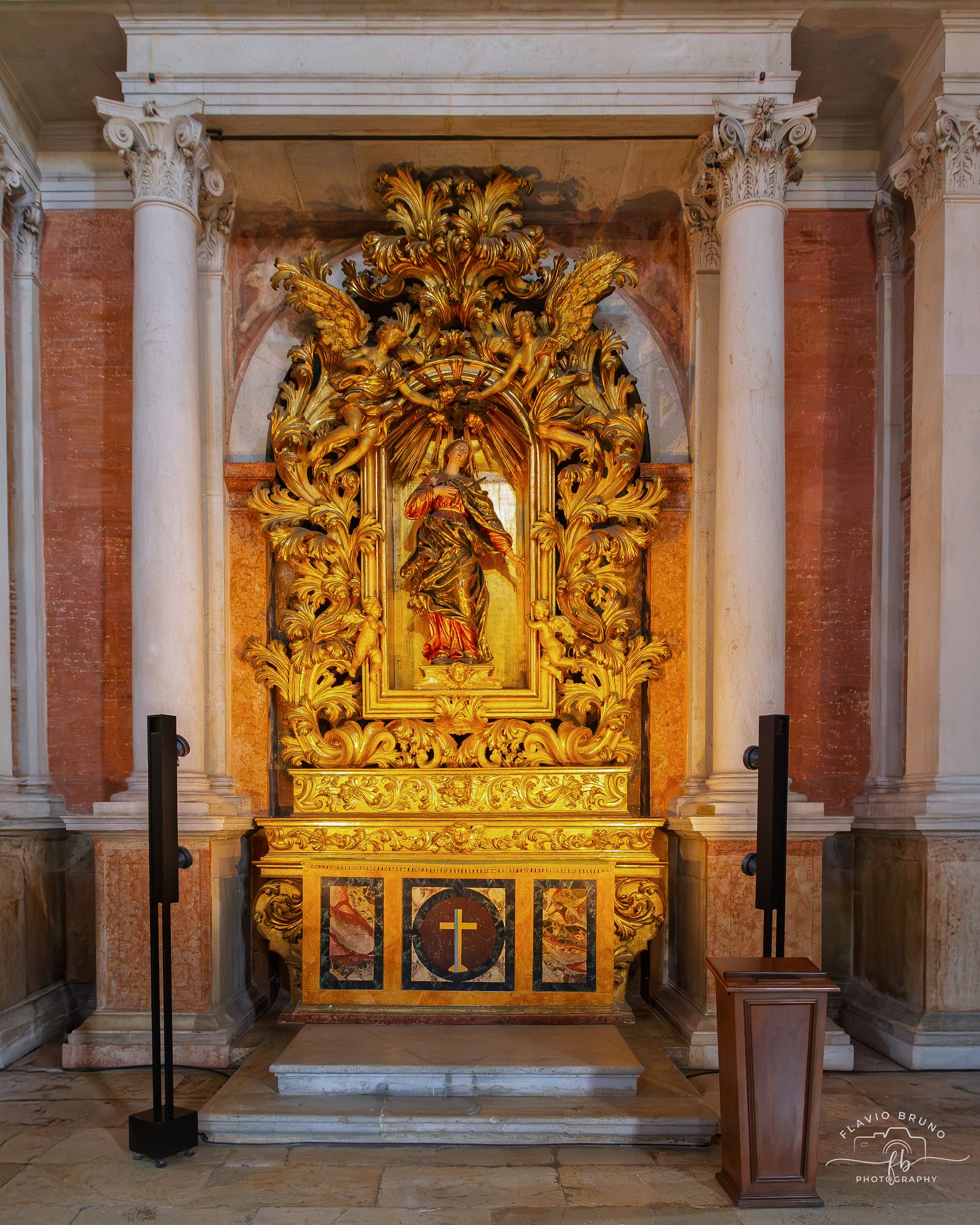
The Cremona Baptistery is a religious edifice in Cremona, northern Italy. It is annexed to the city's Cathedral. Built in 1167, it is characterized by an octagonal plan, a reference to the cult of St. Ambrose of Milan, symbolizing the Eight Day of Resurrection and, thenceforth, the Baptism. The edifice mixes Romanesque and Lombard-Gothic styles, the latter evident in the preference for bare brickwork walls. To the 16th century restorations belong the marble cover of some walls, the pavement and the baptismal font (1531) and the narthex (1588) of the entrance, in Romanesque style, work by Angelo Nani. The interior has a 14th-century Crucifix, over the St. John altar, and two wooden statues portraying "St. Philip Neri" and "St. John the Baptist" by Giovanni Bertesi. Over the ceiling is a 12th-century statue of the Archangel Gabriel. The exterior originally had three doors, but the south and east were closed in 1592 ; today only the northern one remains, overlooking the square, composed of a portico with two column-bearing lions, similar to the porch of the Cathedral. The roof is in marble, which incorporates the facade of the cathedral, but only on some sides, while on the others it is in exposed brick . In the upper section runs a gallery with small Roman arches, which always takes elements from the nearby cathedral. On the southern side are the city units fixed in 1388 . The light penetrates inside from a double series of overlapping mullioned windows and from the lamp at the top of the dome. On each wall are supported two columns, as a sober decoration on the brick background. Finally, a series of balconies all around open up. The baptistery houses a sixteenth-century baptismal font, which dominates the center of the interior with its large, octagonal cistern like the building's plan: it is a monolithic block of red marble from Sant'Ambrogio di Valpolicella near Verona , work of Lorenzo Trotti ( 1527 ). The source is crowned by a gilded wooden statue of the risen Christ . The interior is also adorned with a fourteenth-century crucifix, placed on the altar opposite the entrance by a confraternity in 1697 . On the sides there are two other altars, on the left with a Madonna Addolorata , attributed to Giacomo Bertesi , and the right one, dedicated to San Biagio , built by the town brotherhood of the wool carders between 1592 and 1599 . There are also two wooden statues depicting St. Philip Blacks and St. John the Baptist , works by Giovanni Bertesi , and other statues and fragments dating back to medieval times.
From the outside looks quite good
More of Cremona
Discover where to stay, what to do and the best deals for your trip.
Explore Cremona →More attractions in Cremona
All of Cremona →

Background adapted from Wikipedia (CC BY-SA) · map data © OpenStreetMap contributors · ratings & place photos via Google · other photos with per-image credit. Ticket links may earn us a commission at no extra cost to you.