
Astronomical Clock of Messina
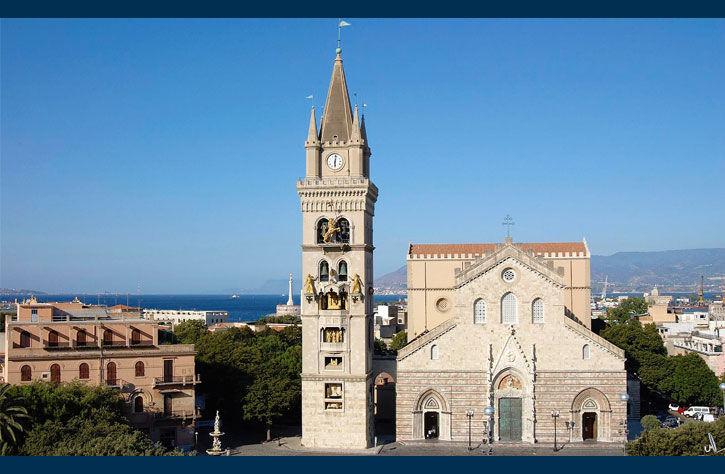
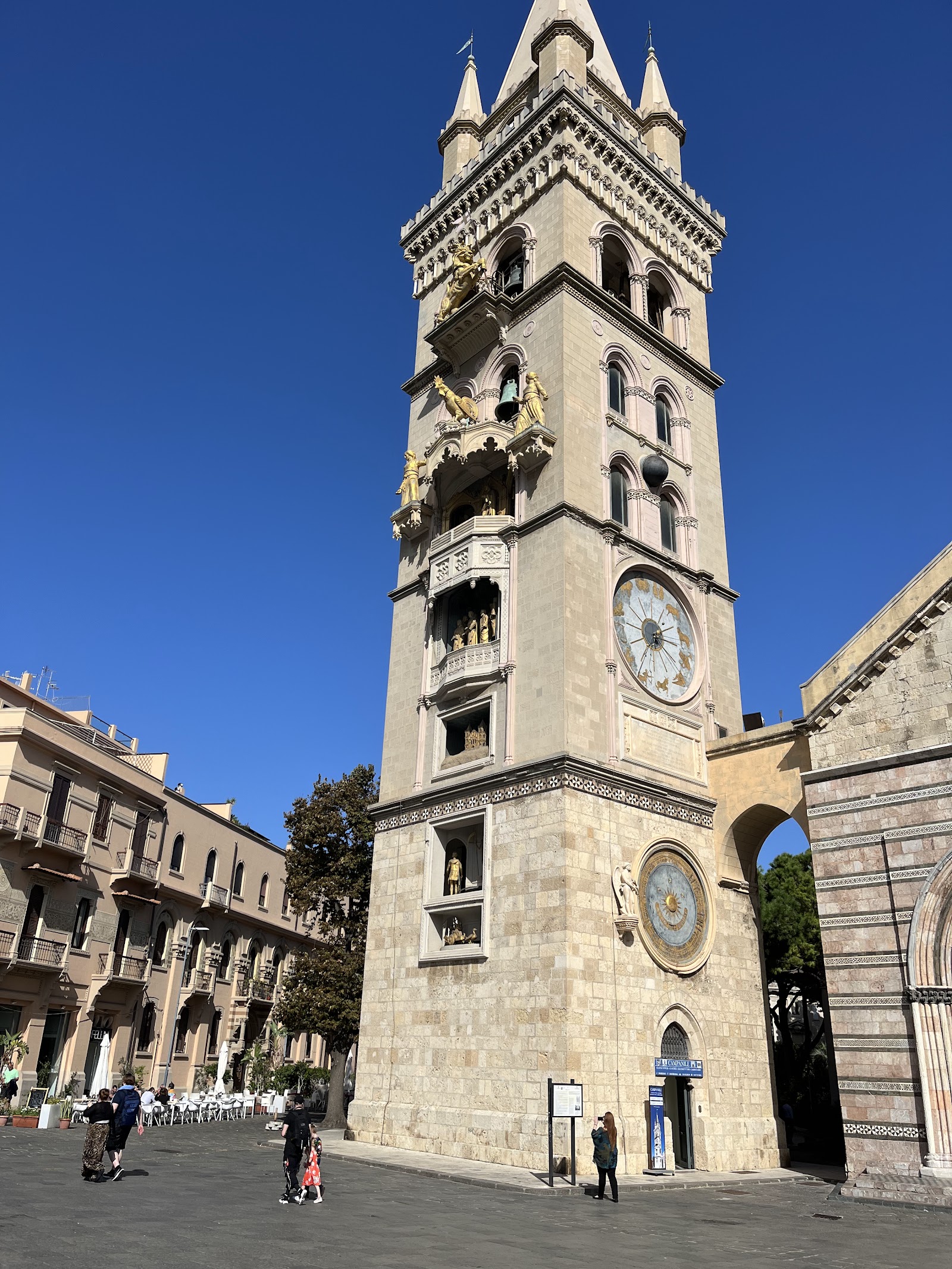
At noon every day, Piazza del Duomo goes quiet in the way that crowds do when something mechanical and enormous starts to move. The 60-metre campanile beside Messina Cathedral comes alive for twelve minutes: a rooster flaps its wings and crows three times, a lion raises a flag and roars, a dove circles above a miniature sanctuary, and four bronze figures — childhood, youth, warrior, old man — pass one by one before a figure of Death, who lifts her scythe.
The clock was built in 1933 by the Ungerer Company of Strasbourg, and it does not perform quietly. Schubert's Ave Maria plays underneath everything, and the 54 bronze figures move with the slightly uncanny deliberateness of things that have been doing this for decades.
💛 What travellers fall for
People who come back tend to do the same thing: arrive at 11:40, claim a spot near the centre of the piazza rather than the sides, and stay for the full twelve minutes. The quarter-hour chimes — Dina and Clarenza striking the bells — are worth catching outside of noon too, if you're already in the square.
The story behind Astronomical Clock of Messina
The 1908 earthquake that levelled Messina took the old medieval bell tower with it. When Archbishop Angelo Paino commissioned a replacement campanile in the early 1930s, Pope Pius XI gave him a working model of the famous Strasbourg astronomical clock — an apparent nudge toward ambition. Paino engaged the Ungerer Company of Strasbourg, whose mechanism was designed by Frédéric Klinghammer and whose artistic program was shaped by Théodore Ungerer. Architect Valenti designed the tower itself, completed between 1930 and 1933.
The clock was inaugurated on 15 August 1933, reviving a tradition that stretched back to Messina's medieval cathedral. The eight bells inside were cast earlier, by the Colbachini foundry of Padua in 1929, and the figures of Dina and Clarenza — two women said to have defended the city during the Sicilian Vespers of 1282 — were woven into the mechanism as local memory made bronze.
Good to know
The noon show is free and runs every day from the piazza — no ticket needed. Climbing the campanile costs €5 (€7.50 combined with the Treasury); there's no elevator and the tower closes without warning in rain or strong wind. From the cruise terminal it's a five-minute walk.
Where is Astronomical Clock of Messina?
More tickets & tours for Astronomical Clock of Messina
Book directly at the provider
What travellers say about Astronomical Clock of Messina
The clock is absolutely captivating! Make sure you go at noon so that you can witness all the statues in motion. If you like architecture, do not miss this site! We did not go inside the tower, however the outside was magnificent enough.
I recommend to go inside and go up the tower. Each floor is interesting to see, how all the mechanisms work, and on the top you have a nice panoramic view on all Messina.
The great clock of Messina:The bell tower of the Cathedral of Messina is 60 m high and contains the biggest and the most complex mechanical and astronomical clock in the world. Designed by the firm Ungerer of Strasbourg for the Archbishop at the time, Mons. Angelo Paino, the clock was inaugurated on August 13th, 1933. At noon a complex system of counterweights, leverages and gears, determines the movements of the 54 gilded bronze statues located in the façade overlooking the square. One can climb the tower (5€) for an wonderful view of Messina
Lovely both inside and out, day and night. Very close to the cruise ship pier.
Beautiful old building with moving parts and sounds. 12 o'clock sharp for start.
More of Messina
Discover where to stay, what to do and the best deals for your trip.
Explore Messina →More attractions in Messina
All of Messina →


Background adapted from Wikipedia (CC BY-SA) · map data © OpenStreetMap contributors · ratings & place photos via Google · other photos with per-image credit. Ticket links may earn us a commission at no extra cost to you.