
Wooden Mashrabiya Screens

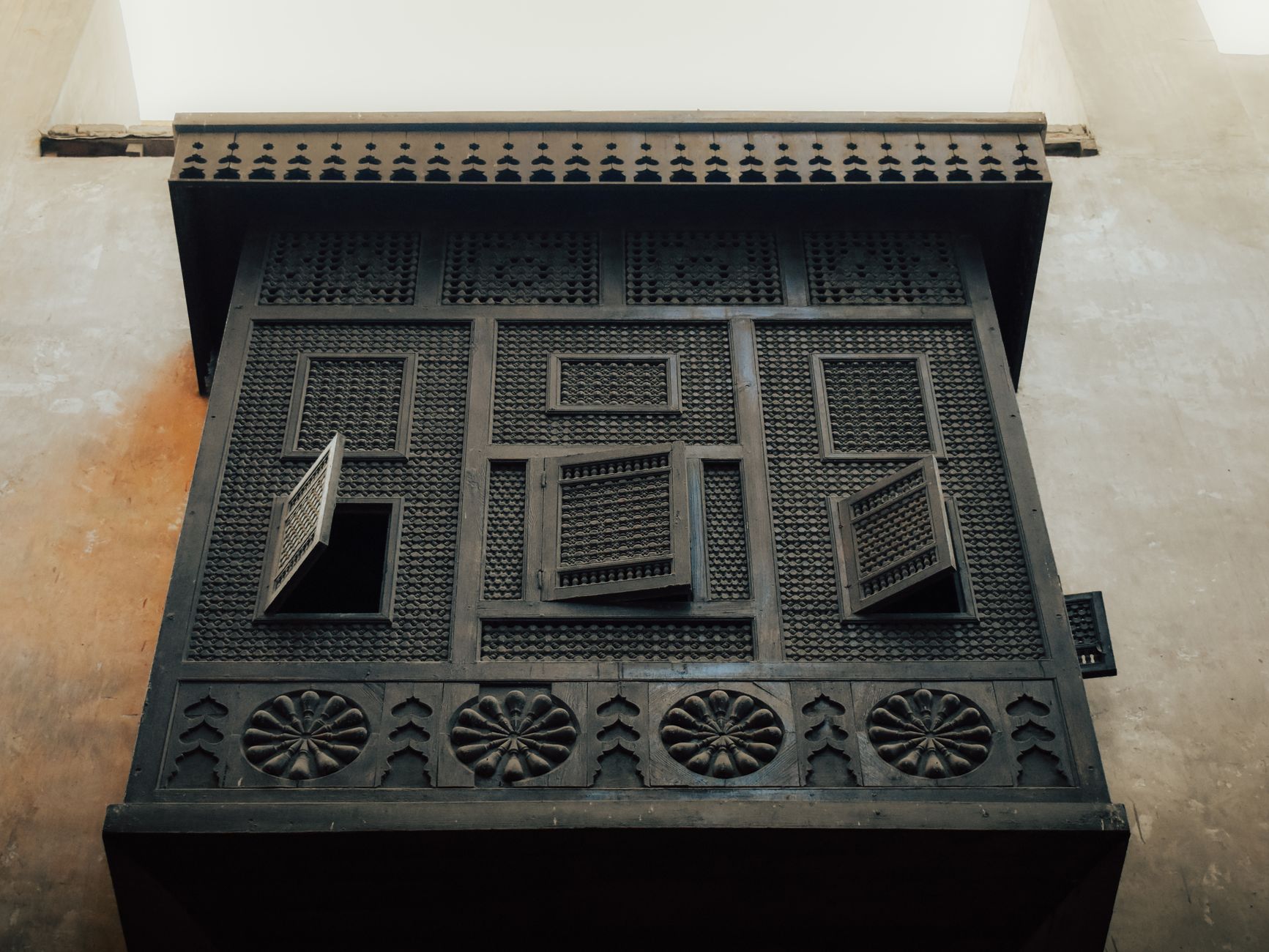


Stand at the threshold of the central courtyard and look up before you look around. The cedar mashrabiya screens framing the archway — their lattice cut in repeating geometric and floral patterns — are doing two things at once: filtering the light into something cooler and more considered, and marking a clear boundary between the world outside and the one within. Cedar was chosen for a reason. It resists warping in heat, holds carving well, and over centuries develops that particular warm grain.
Across the courtyard, the same logic repeats itself: wooden lintels, latticed window screens on the student rooms above, carved cedar doors. The screens aren't decoration applied to a structure — they are part of how the building breathes.
💛 What travellers fall for
People who've been through more than once tend to spend longer at the screens than anywhere else. The trick is to crouch to eye level with the lowest carved panels near the courtyard entrance — the detail there is finer than it looks from standing height. Go on a weekday, just after opening, when the light through the lattice falls at its sharpest.
How Wooden Mashrabiya Screens came to be
The madrasa takes its name from Almoravid Sultan Ali ibn Yusuf, who ruled from 1106 to 1142 CE and founded the adjacent Ben Youssef Mosque — though the building standing today has no direct connection to him. A Marinid madrasa occupied the site first, commissioned under Sultan Abu al-Hasan in the fourteenth century. That structure was eventually torn down and replaced entirely.
The current building — including its cedar screens and carved courtyard — dates to 1564–65 CE, commissioned by Saadian sultan Abdallah al-Ghalib (r. 1557–1574). At completion it was the largest madrasa in the Maghreb, housing up to 900 students in 130 cells. It closed in 1960, reopened as a historical site in 1982, and completed a full restoration in April 2022.
Who and what shaped it
People who shaped it
Landmark buildings
Plan your visit
On the map
When to go
Spring (March–May) and autumn (late September to mid-November) are the most comfortable seasons — temperatures sit between roughly 20°C and 28°C in spring, cooling gradually through autumn. Summer pushes 35–40°C, which makes the shade of the cedar screens welcome but the medina lanes tiring; winter days are mild but evenings can drop close to freezing.
Right now
Background & history adapted from Wikipedia (CC BY-SA) · specs from Wikidata (CC0) · weather from Open-Meteo · map data © OpenStreetMap contributors · photos from Wikimedia Commons / Unsplash with per-image credit. No third-party reviews or social posts reproduced.