
Torre Guinigi
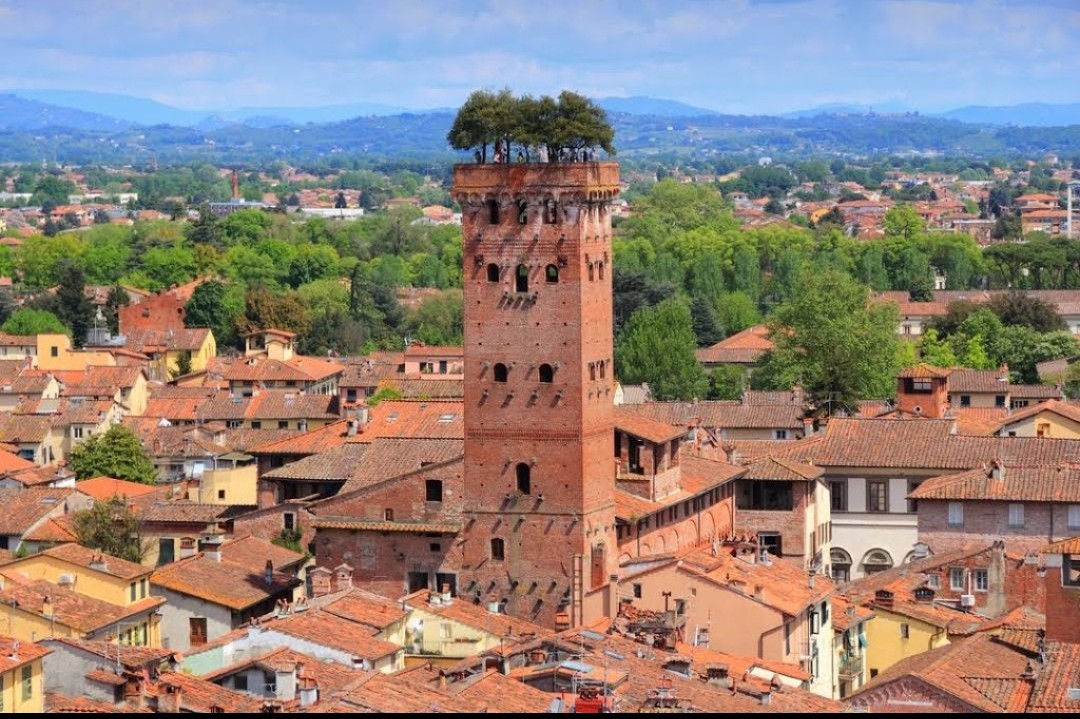
At the corner of Via Sant'Andrea and Via delle Chiavi d'Oro, a medieval brick tower rises forty-five metres above the rooftops of Lucca — and at the very top, seven holm oaks grow from three stone flowerbeds, their roots somewhere inside the seventh storey. It is a genuinely strange sight from the street below: a grove in the sky, swaying slightly in the wind.
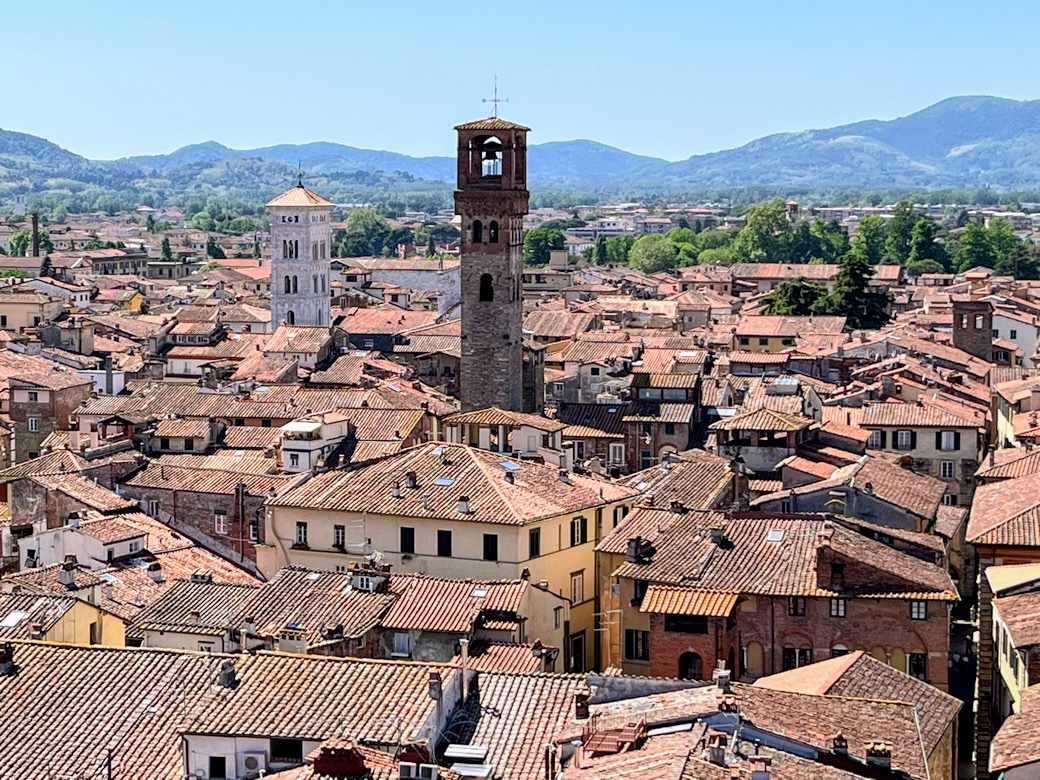
You reach it via 230 steps and 28 flights of increasingly narrow staircase. The climb takes the better part of an hour. What waits at the top is a small, quiet garden with an unobstructed view north to the Apennine foothills and south across the soft Tuscan plain.
💛 What travellers fall for
People who come back tend to time it for early morning — the tower opens at 9am (9:30 in winter) and the first hour is genuinely calm. Late afternoon also works well: the light from the west catches the brick across Lucca's skyline, and the oaks cast actual shade. The combined ticket with the Torre delle Ore is worth it if you plan to climb both in a day.
The story behind Torre Guinigi
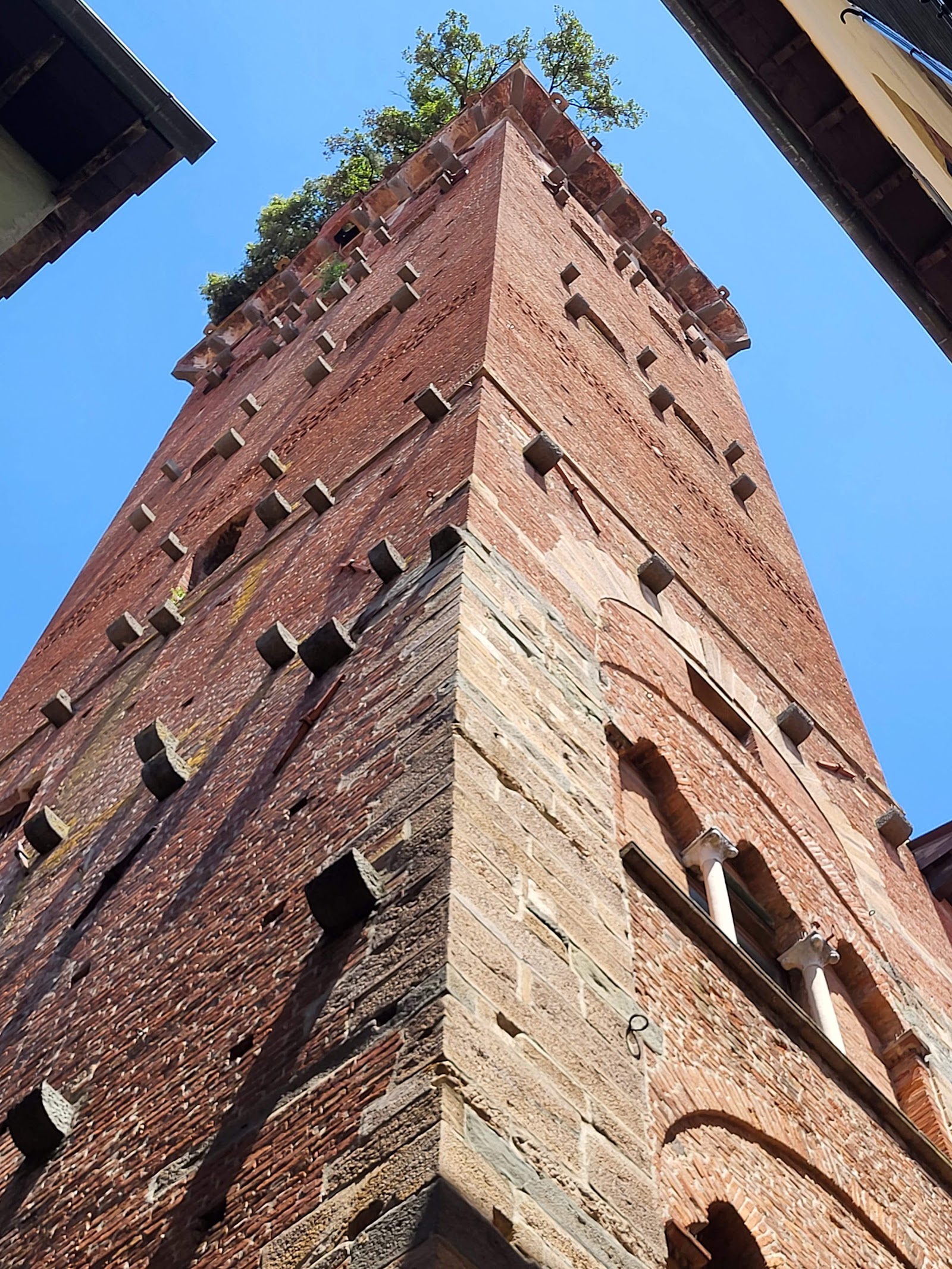
Lucca's merchant families built towers in the latter half of the 14th century the way others built country houses — as declarations of standing. The Guinigi family, silk traders and bankers, raised their tower around 1384, seven stories of fired brick and stone with decorative cornices and narrow windows in the local Romanesque-Gothic manner.
Paolo Guinigi, who became Lord of Lucca in 1400, refined the adjoining residence and is credited with planting the original tree at the tower's summit. He ruled until 1430, then fell from power, was imprisoned, and was executed by Francesco Sforza. A drawing from around 1600 already shows the rooftop garden in place; the current holm oaks date to a 19th-century restoration. Descendants of the Guinigi family donated the tower to the city in 1968.
Good to know
Reservations are recommended on weekdays and required on weekends. There is no lift — the tower is not accessible to visitors with mobility disabilities. Admission runs €4 for adults, less for children and seniors. Avoid the midday summer slot; the stairwell holds heat.
Spring and autumn keep the climb manageable — mild temperatures and thinner crowds. Summer mornings before 11am are tolerable; summer midday is not. In winter the tower closes earlier and the oaks are bare, but the view north to the hills is clear.
Where is Torre Guinigi?
More tickets & tours for Torre Guinigi
Book directly at the provider
What travellers say about Torre Guinigi
Spent the day in Lucca. This was one of our highlights! As a warning, there are 200 some stairs to get to the top, you will feel it. After getting to the top the view is absolutely beautiful. You can walk around all four sides and take photos of Lucca and the surrounding area. It's less than $10 per person. And well worth spending an hour here if the weather is clear.
This was a really cool tower. Very unique to have the trees on the top. Like a little garden in the sky. The initial climb up is pretty tame. The last part is metal staircase along the edges of the wall with the drop in the middle. It’s not too scary, just take your time. If you come during the weekday, don’t worry about a reservation.
Trees on top of a tower. Shade, wonderful views, relaxation. Only possible to go up there if you are smaller than 190 cm and 120 kilo - otherwise you might get stuck on the last few meters, they are TIGHT!
I consider it one of the "must see" attractions in Lucca! See the city from the top! I paid 8 euros and it was worth it. I went on April, it was during sunset, amazing! In the exit there is a small shop to buy souvenirs. Just be prepared to climb several stair steps.
This tower is a must-visit in Lucca. Lucca is a tiny medieval town. It is super cute. We stopped by this place after visiting the Leaning Tower of Pisa. We used Apple Maps or Google Maps. It is a very small place and hard to find. I found the tower by looking it up. Otherwise, we almost missed it. There is a small fee to enter the tower. I am afraid of heights, but I managed to climb the stairs. The view from the tower is impressive. We get to see a panoramic view of Lucca.
More of Lucca
Discover where to stay, what to do and the best deals for your trip.
Explore Lucca →More attractions in Lucca
All of Lucca →


Background adapted from Wikipedia (CC BY-SA) · map data © OpenStreetMap contributors · ratings & place photos via Google · other photos with per-image credit. Ticket links may earn us a commission at no extra cost to you.