
Stupa of Benalmádena (Buddhist Stupa)

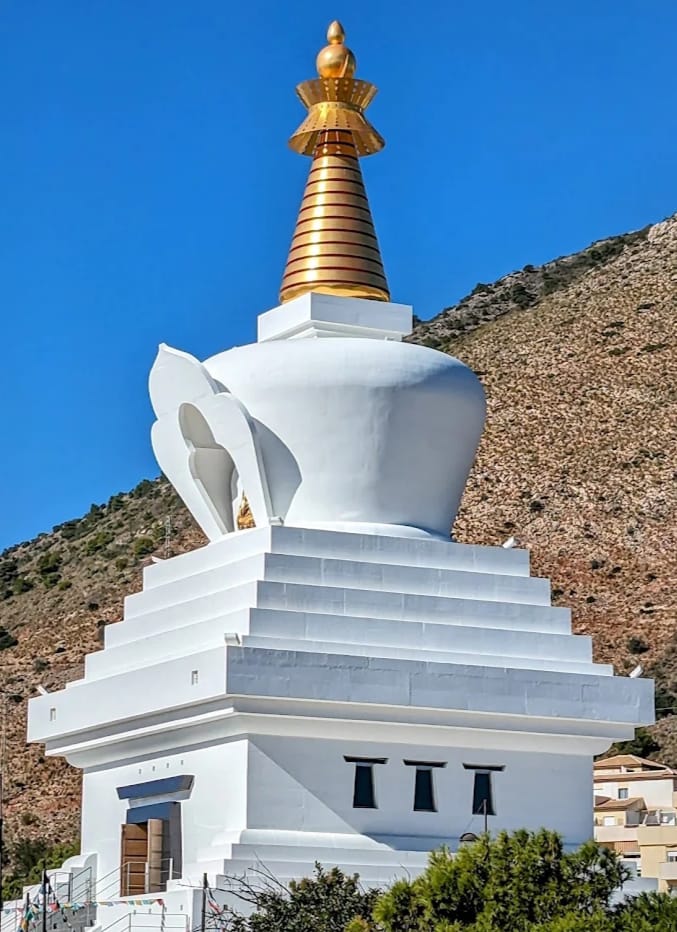
At 33 metres tall, the stupa rises above the whitewashed rooftops of Benalmádena Pueblo in a way that takes a moment to process — Tibetan in form, Andalusian in light, with the Mediterranean glinting somewhere beyond the hills. It is the tallest stupa in Europe, and unlike most stupas, which are sealed solid, you can walk inside it.
The interior holds a 100-square-metre meditation room whose walls trace the life of the historical Buddha Shakyamuni in paint, and above that chamber, sealed within the structure, sit half a ton of Buddhist prayers printed on cotton paper, the complete Kanjur teachings, and 6,000 hand-formed clay Buddha reliefs.
💛 What travellers fall for
People who come back tend to time it for the Sunday evening guided meditation at 18:00 — the room is small, the occasion unhurried, and it costs nothing. The shop near the entrance is worth a slow look: ceramics and texts brought from the Himalayas, nothing mass-produced. The basement exhibition, at two euros, adds context that the structure alone doesn't give you.
The story behind Stupa of Benalmádena (Buddhist Stupa)
The stupa's origins trace to 1990, when Bhutanese lama Lopon Tsechu Rinpoche first visited Spain, giving teachings at Karma Guen near Vélez-Málaga. A decade later, his disciples in Benalmádena formed the Asociación Cultural Karma Kagyu de Benalmádena with the specific aim of building a Buddhist monument in the pueblo. Construction began in 2002, overseen by Polish architect Woitek Kossowski, who worked from Lopon Tsechu's ritual guidance.
Lopon Tsechu died four months before the stupa was completed. It was inaugurated on 5 October 2003 by H.H. Kunzig Shamar Rinpoche, second-most senior teacher in the Karma Kagyu lineage of Tibetan Buddhism, with a Bhutanese government minister and the Mayor of Benalmádena among those present. The association continues to run it today under the spiritual guidance of the 17th Karmapa Trinley Thaye Dorje.

Good to know
Entry to the stupa is free; the basement exhibition costs €2. The bus stop outside is literally called 'Estupa Tibetana' on lines L2, M112 and M121. Opening hours shift by season and the site is closed Mondays — check the official website before you go. Free parking is available on site.
Spring and autumn are the easiest seasons to visit — warm enough to sit outside on the grounds without the full weight of a Costa del Sol summer. In July and August the heat can reach 31°C by midday, so an early-morning visit makes sense; the shaded interior offers some relief. Winters are mild and rarely cold enough to deter an outdoor visit.
Where is Stupa of Benalmádena (Buddhist Stupa)?
More tickets & tours for Stupa of Benalmádena (Buddhist Stupa)
Book directly at the provider
What travellers say about Stupa of Benalmádena (Buddhist Stupa)
This Buddhist shrine is really a nice peaceful place. It looks huge however it’s only one floor the main floor. The entry to enter is free but donation is recommended so we indeed did our part. We arrived one hour before closing and highly recommend to come early or later as parking is limited here. Once you park be careful the drivers seem to drive rather fast in a parking lot which is unacceptable especially as there is children in this area. The shrine is located in a beautiful hill top with excellent views of the city. There’s also a gift shop outside of the building. I wanted to ask the person inside questions about the temple but felt it wasn’t an appropriate place for ask questions. It seemed like it was a place only for silence. Either way it was a good experience!
A place where Andalusia unexpectedly meets the Himalayas. Rising above the Costa del Sol, this white stupa feels less like a monument and more like a quiet lighthouse - not guiding ships, but thoughts. At 33 meters tall, it’s the largest Buddhist stupa in Europe, visible from miles along the coastline. Built between 2002 and 2003 under the guidance of Lopon Tsechu Rinpoche, it became his final gift to the Western world. But what makes it truly unusual is hidden inside. Unlike most stupas, you can actually enter this one. Inside lies a meditation hall, surrounded by thousands of sacred relics, statues, and symbolic elements representing the Buddhist view of the universe. Every year, thousands of visitors come here - some for the panoramic sea views, others for silence. Meditation sessions, teachings, and Buddhist ceremonies are regularly held, while visitors walk clockwise around the structure, following an ancient ritual believed to bring clarity and intention. The strangest part? You’re standing in southern Spain, looking at the Mediterranean… yet somehow, you feel miles closer to Tibet.
A truly beautiful and peaceful spot. The vantage point alone is worth the visit, you can see why they chose this exact location for a Buddhist temple. The view opens up over the coast in a truly magnificent way.
Peaceful and beautiful. Great views along the coast too. Very interesting interior explained superbly by one of the staff. Walk around and make a wish. Free entry.
The Buddhist Temple in Benalmádena is located in a truly breathtaking place, with stunning views that create a sense of peace and harmony from the moment you arrive. The energy here feels incredibly uplifting and calming. I especially love meditating with Margaret on Sundays, just after sunset — the meditation is held in both Spanish and English, which makes it even more welcoming. It’s a deeply moving and beautiful experience that stays with you long after. A truly special place for reflection, mindfulness, and inner peace.
More of Benalmádena
Discover where to stay, what to do and the best deals for your trip.
Explore Benalmádena →More attractions in Benalmádena
All of Benalmádena →

Background adapted from Wikipedia (CC BY-SA) · map data © OpenStreetMap contributors · ratings & place photos via Google · other photos with per-image credit. Ticket links may earn us a commission at no extra cost to you.