
Pont Neuf
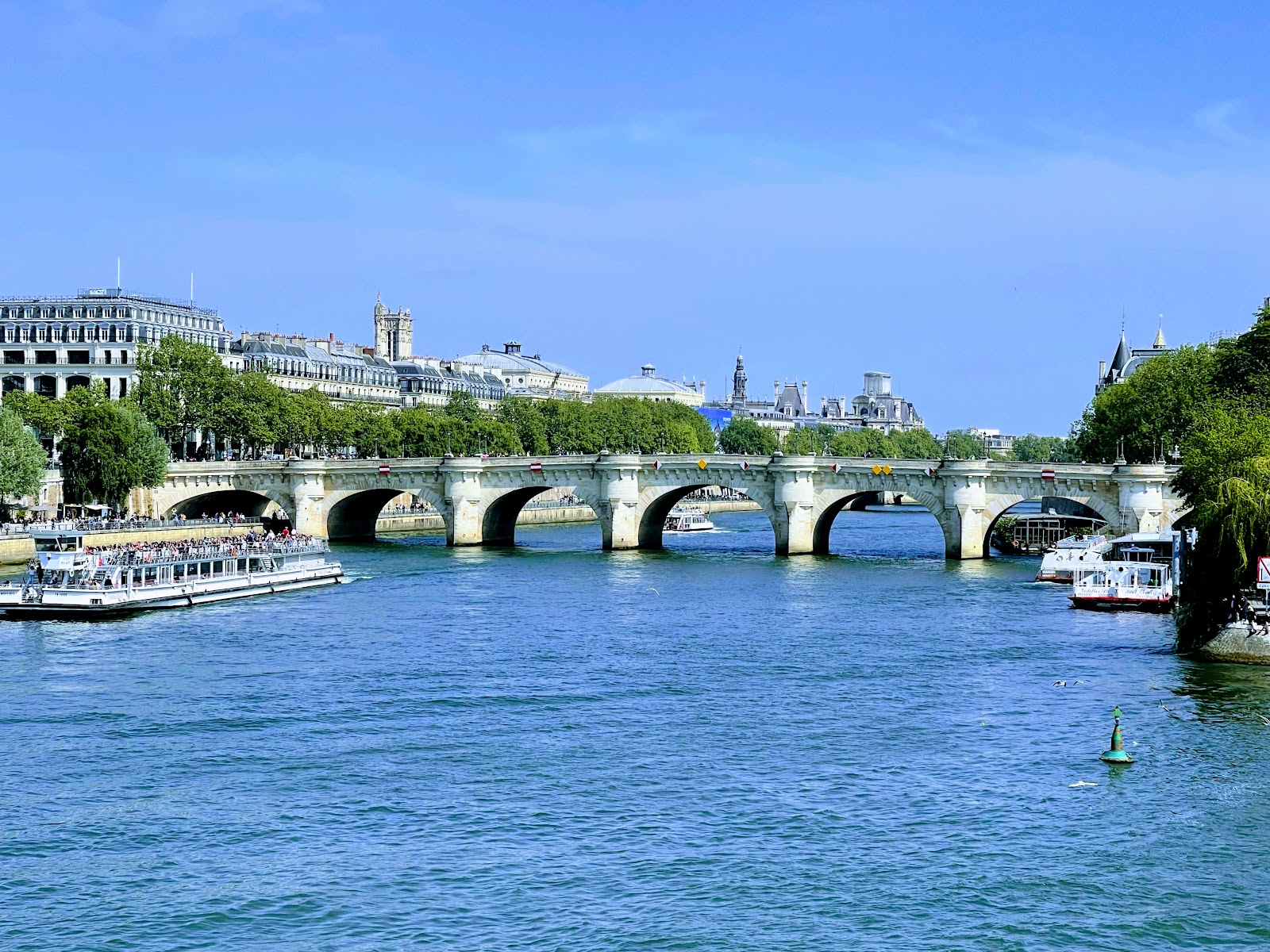
Despite its name, Pont Neuf is Paris's oldest standing bridge — and the contradiction suits it. It opened in 1607 without a single house on it, which was radical: every other bridge in the city was lined with buildings. What you get instead are unobstructed views of the Seine in both directions, twelve stone arches, and 381 grotesque masks — mascarons of satyrs and forest spirits — carved into every bracket along the balustrades.
At the midpoint, Henri IV sits on horseback in bronze, stern and permanent, watching the river traffic below. Drop down the stairs to Square du Vert-Galant and you're at the pointed tip of Île de la Cité, a wedge of park that puts you level with the water.
💛 What travellers fall for
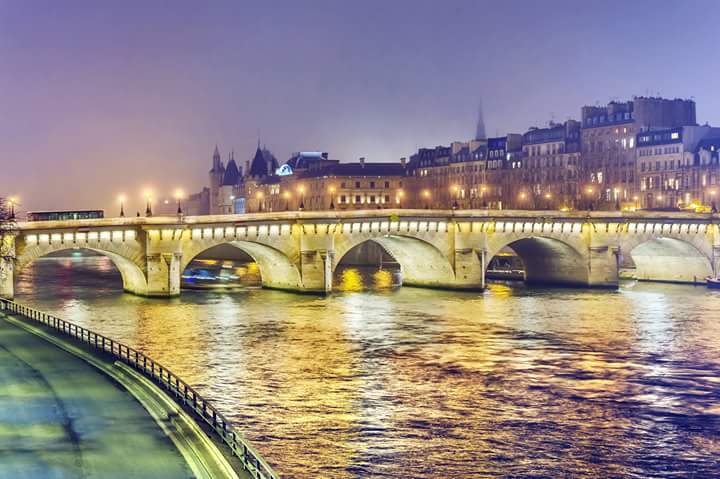
People who know the bridge well tend to cross it around dusk, then double back along Quai du Louvre for the full-length view — it photographs completely differently from the bank. The triangular Place Dauphine, just off the bridge's right-bank end, is where you'll find pétanque players and a quiet café table if the afternoon is cooperating.
The story behind Pont Neuf
Henri III laid the first stone on 31 May 1578, with Catherine de Medici and Queen Louise of Lorraine present — but Paris then revolted against the king, and construction stalled for a decade. Work resumed and the bridge was finally completed in 1607 under Henri IV, designed by Baptiste du Cerceau and Pierre des Illes, possibly drawing on an earlier plan by Guillaume Marchand. It was the first bridge in the city with pavements, and the semi-circular bays above each pier quickly filled with merchants, acrobats, and street quacks.
The bridge was listed as a Monument Historique in 1889 and underwent a full restoration completed in 2007, its 400th year. The equestrian statue of Henri IV — the first of its kind in Paris — was erected in 1614, destroyed during the Revolution in 1792, and replaced in 1818 with a new casting by François-Frédéric Lemot.
Good to know
Metro line 7 to Pont Neuf is the straightforward option. The bridge is free and open around the clock, but note closures in May–June and late June–July 2026 for a temporary art installation. Late afternoon, between 5 and 7 PM, gives you the best light.
Spring and autumn are the most comfortable seasons for lingering on the bridge, with mild temperatures and lower crowds. Summer brings warm evenings ideal for the dusk crossing, though the exposed stonework offers no shade in afternoon heat; winter light on the Seine has its own quality, but the wind off the water cuts hard.
Where is Pont Neuf?
Location
- In Paris 1st Arrondissement
- 48.8573, 2.3412
- Open in Google Maps
Rating
4.6 ★ · 22,689 Google reviews
More tickets & tours for Pont Neuf
Book directly at the provider
What travellers say about Pont Neuf
Wonderful bridge to walk across in the heart of Paris. Recommended to do it whilst it’s night time/getting dark when the bridge lights turn on. You can see the top of the Eiffel Tower when stood on the furthest most point of the bridge. Benches and other seating areas available. Can be very romantic for couples! 10/10
A stunning expanse over the river Seine. The art exhibit on display this June, Le Caverne du Pont Neuf by French artist JR, is epic to behold. A massive inflatable cave covers the bridge, glowing with light at night. Even better viewed by boat!
The oldest bridge crossing the Seine in Paris, Pont Neuf is open only to pedestrians. My companion and I have used it many times, but traveled there specifically today to visit LA CAVERNE DU PONT NEUF. This is an exhibit of cloth and hidden structure conceived by artist JR. They have created an immersive exhibit replicating a passage through a worn cavern.
I was lucky to catch Pont Neuf with the JR installation "La Caverne du Pont Neuf". Installed more than 40 years since Christo wrapped Pont Neuf, this new installation is distinguished by a walkable "cave" on top. The effect is like going into a mountain. Catch it before it closes after June 28. You can access the cave from the side of Ile de la Cité.
The covered bridge Pont Neuf offers a spectacular sight of the modern work of Christo and Jeanne Claude and their fashion to pack up buildings. There are assistants everywhere to help you find your way (or the trash cans! 😜). The area is very pleasant to walk, especially if you descended by the river Seine.
More of Paris 1st Arrondissement
Discover where to stay, what to do and the best deals for your trip.
Explore Paris 1st Arrondissement →More attractions in Paris 1st Arrondissement
All of Paris 1st Arrondissement →
Background adapted from Wikipedia (CC BY-SA) · map data © OpenStreetMap contributors · ratings & place photos via Google · other photos with per-image credit. Ticket links may earn us a commission at no extra cost to you.