
Piazza Grande
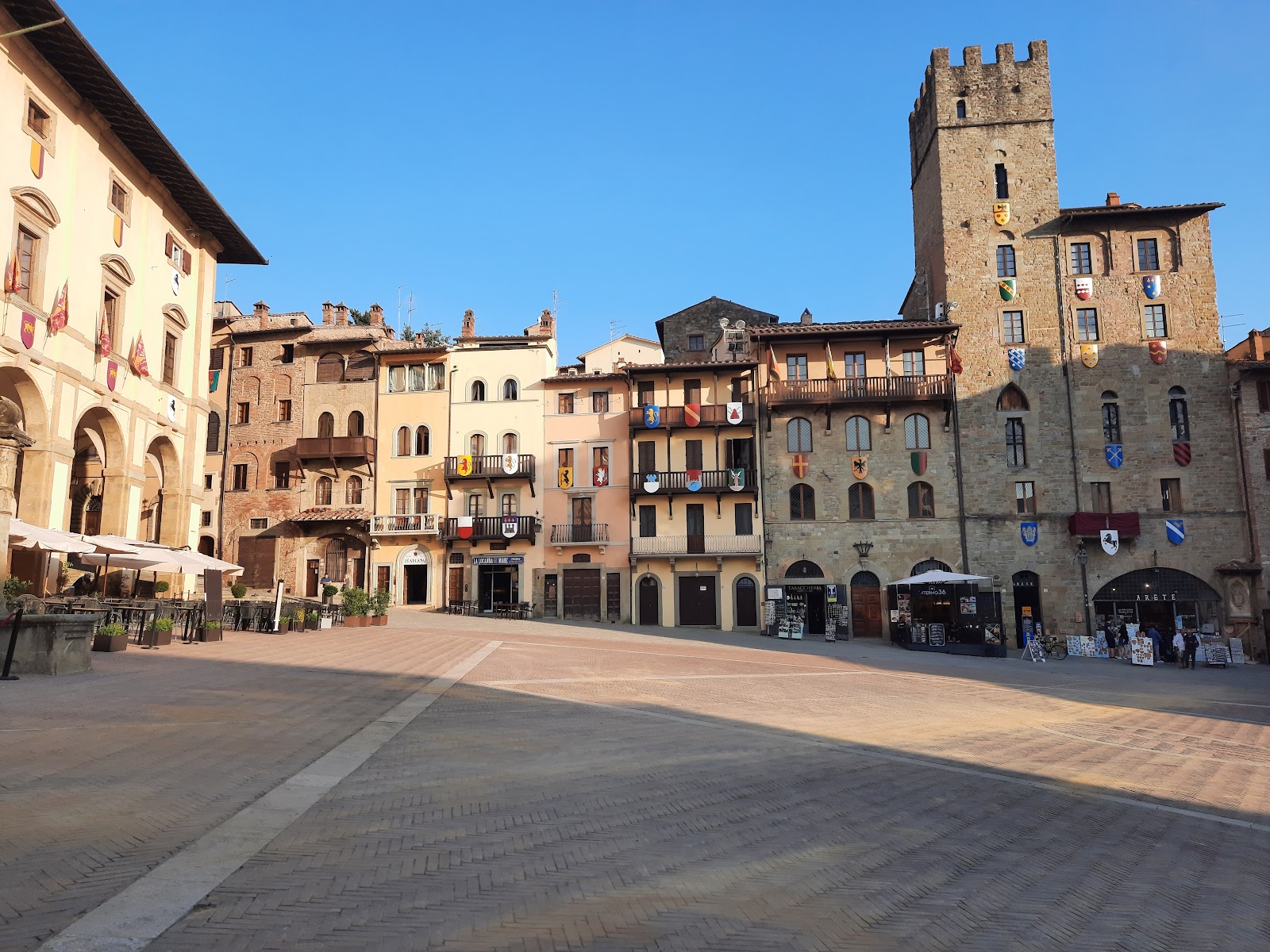
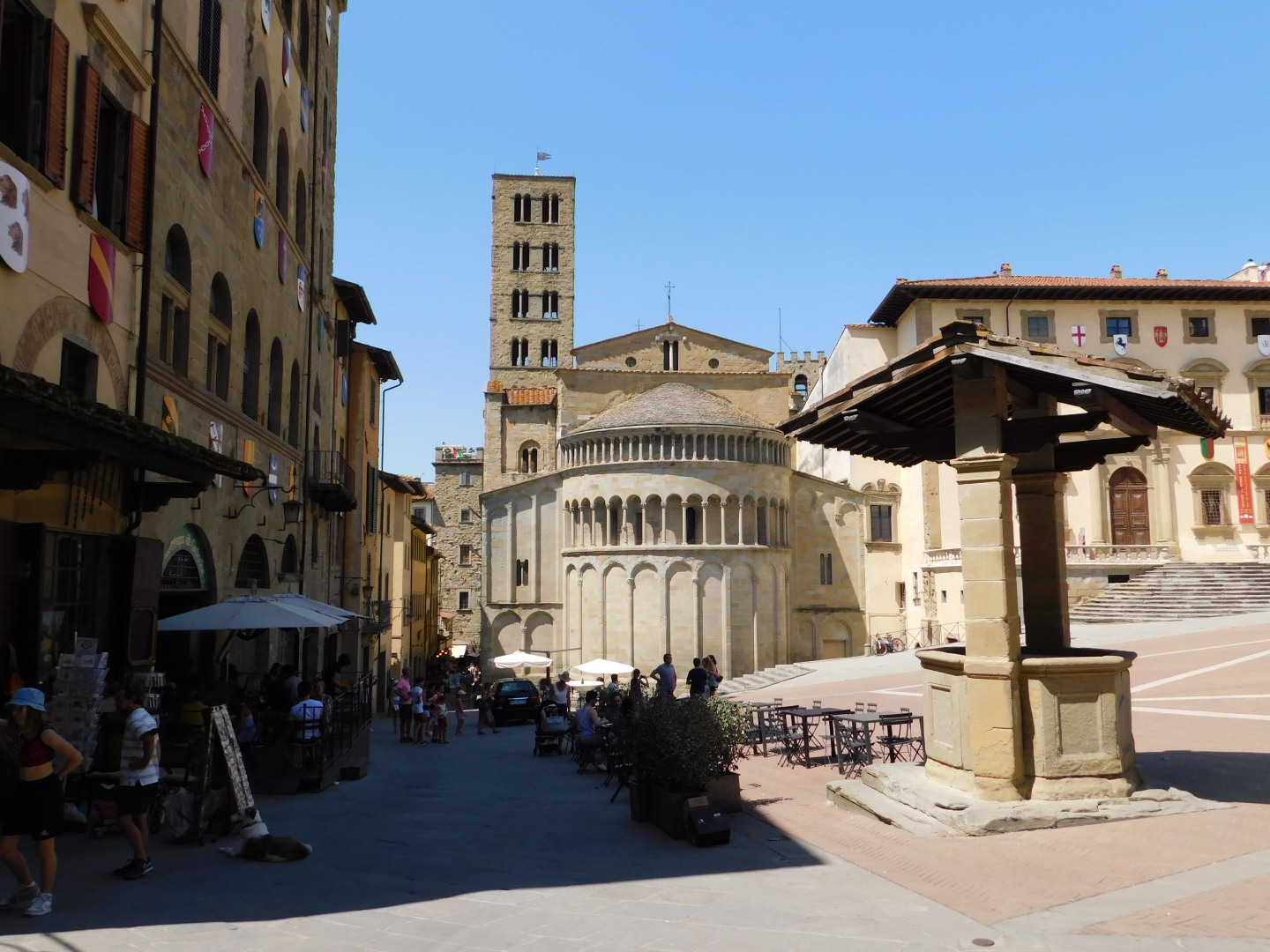
Piazza Grande sits at an odd, satisfying tilt — a trapezoid of stone that drops nearly ten metres from one end to the other, so that standing at its lower edge you look up at the Romanesque apse of the Pieve di Santa Maria Assunta like a stage set. The slope is not incidental; it is the piazza's whole character.
Along one side, Vasari's long loggia runs in clean Renaissance arches, its ground-floor shops still occupied. Across from it, the Palazzo della Fraternita dei Laici shows you Gothic and Renaissance stonework on the same façade, topped by an astronomical clock from 1552 that still marks the lunar calendar.
💛 What travellers fall for
People who return tend to arrive early, when the loggia throws long shadows across the paving and the square is quiet enough to read the Petrone — the reproduction column once used to publicly shame insolvent debtors — without a crowd around it. The escalators from the Via Pietri car park are free and drop you close.
The story behind Piazza Grande
The ground beneath Piazza Grande has been in use since Etruscan times, and the Roman forum stood here before the medieval market replaced it. By the thirteenth century it functioned as a livestock market — the platea porcorum — and the Torre Faggiolana, named for the condottiere Uguccione della Faggiola, already anchored one corner.
The square took its present form in the sixteenth century, when Cosimo I de' Medici commissioned Giorgio Vasari to design the Palazzo delle Logge in 1573. Vasari died the following year; Alfonso Parigi finished the work in 1595. The Palazzo della Fraternita dei Laici had been accumulating its layered façade since 1375 — Baldino di Cino and Niccolò di Francesco began it, Spinello Aretino frescoed the lunette between 1395 and 1396, and Bernardo Rossellino added the Renaissance upper floor in 1433. Gherardo Mechini's fountain arrived in 1603 to mark the completion of the city's new aqueduct.
Good to know
The square is always open and free. Parking inside is impossible; use the Via Pietri garage to the north and take the free escalators up. Allow thirty to sixty minutes for the square itself — more if the antique market or Giostra del Saracino is on.
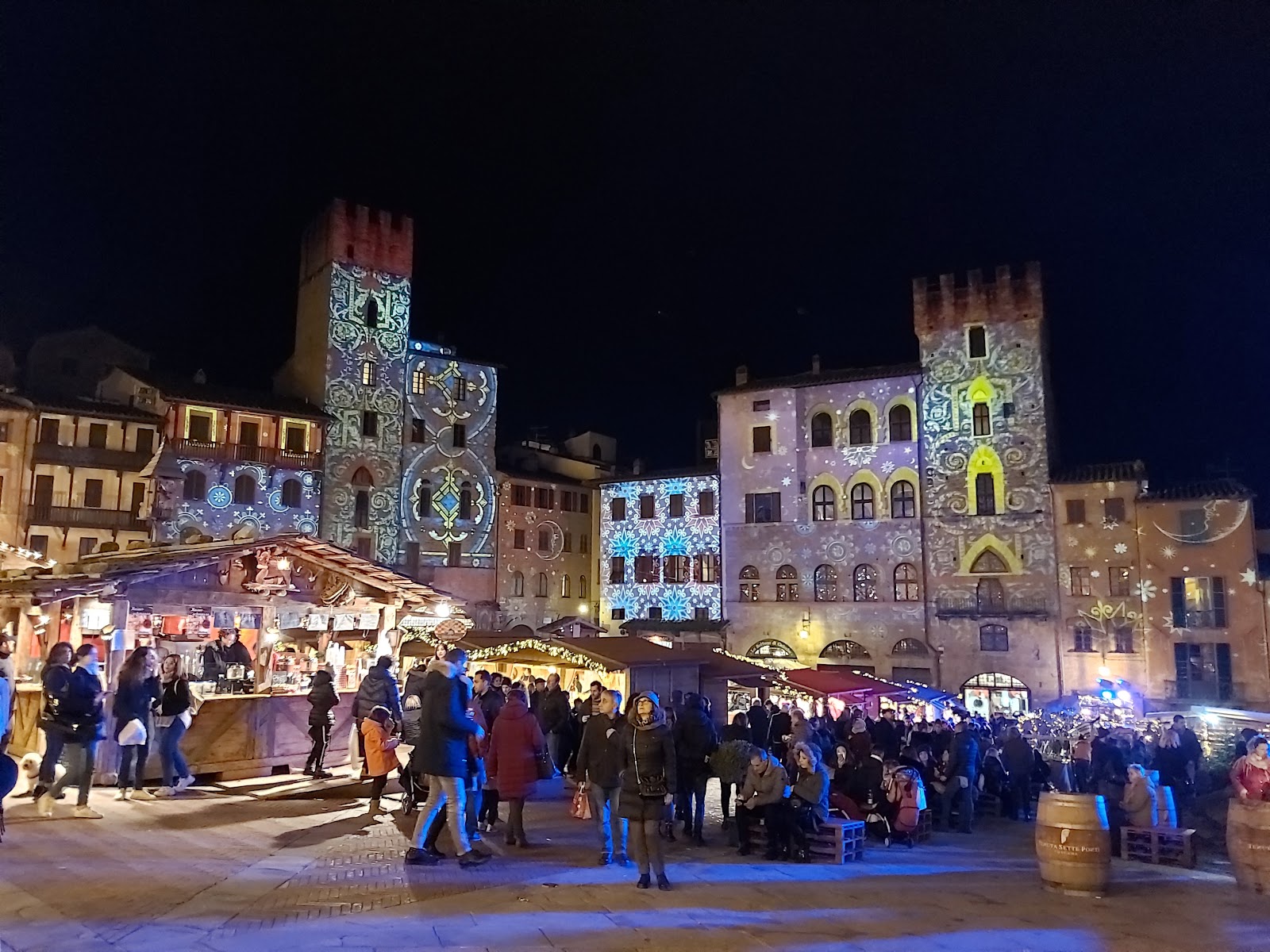
Spring and early autumn keep the square comfortable and the light low enough to show the stone at its best. Summer afternoons can be sharp on the exposed slope with little shade away from the loggia; the Giostra del Saracino jousting event, held in June and September, fills the piazza and the surrounding streets entirely.
Where is Piazza Grande?
Location
- In Arezzo
- 43.4647, 11.8827
- Open in Google Maps
More tickets & tours for Piazza Grande
Book directly at the provider
More of Arezzo
Discover where to stay, what to do and the best deals for your trip.
Explore Arezzo →More attractions in Arezzo
All of Arezzo →
Background adapted from Wikipedia (CC BY-SA) · map data © OpenStreetMap contributors · ratings & place photos via Google · other photos with per-image credit. Ticket links may earn us a commission at no extra cost to you.