
Iglesia de El Salvador

A tall araucaria pine stands in front of Iglesia de El Salvador, brought from Chile in the early twentieth century by a local emigrant who came home. The tree has become as much a landmark as the church itself, and together they mark the narrow strip of ground between Plaza Cavana and the Paseo del Balcón de Europa, where the bells toll every half hour whether anyone is listening or not.
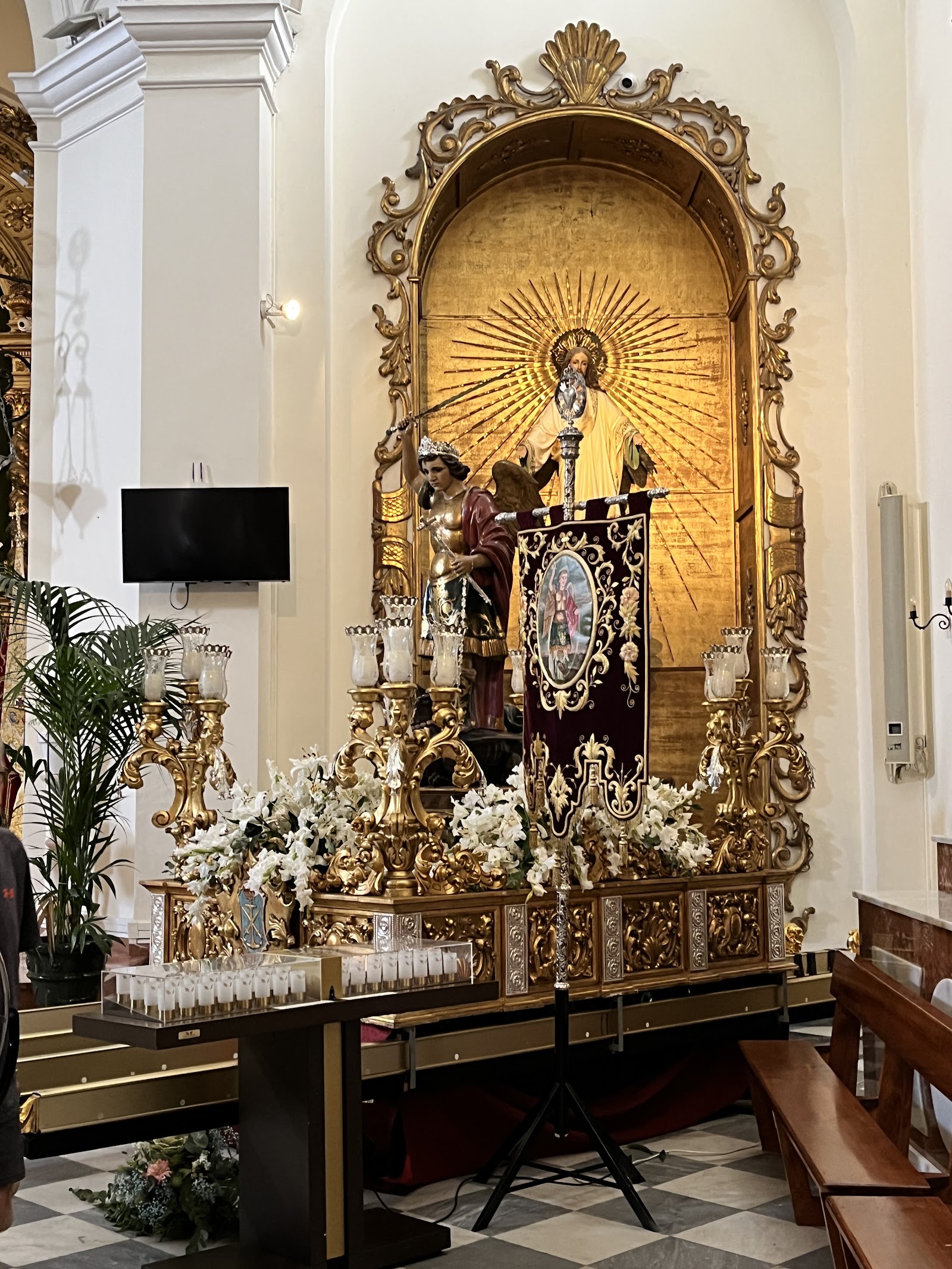
Step inside and the architecture does something quietly unusual: Mudéjar vaulting runs the length of the central nave while half-barrel and groined vaults cover the lateral aisles, a combination that reflects centuries of layered building rather than a single vision. The church is also one of very few in the world to display all three archangels, with San Miguel — one of Nerja's patron saints — given particular prominence.

💛 What travellers fall for
People who return more than once tend to time a visit around the San Miguel procession in mid-October, when the saint's image leaves from here and the streets fill with singing. Others come back simply to sit in the cool of the nave on a hot afternoon, when the Mudéjar vaulting overhead rewards a few minutes of looking up.
The story behind Iglesia de El Salvador
A military watchtower once occupied this site. Construction of a church began in 1505, and the foundations of the current building were laid in 1697. Work continued in fits and starts; the bell tower went up in 1724, and then an extension programme running from 1776 to 1792 shaped the structure largely as it stands today — a Baroque academicist building of three naves divided by pillars and half-point arches.
The Spanish Civil War left serious damage, and a significant portion of the church's artworks were lost. A careful restoration in 1997 addressed what remained. Two works of art anchor the interior now: a mural of the Encarnación by painter Francisco Hernández and a Bronze Christ cast by sculptor Aurelio Teno (1927–2013), whose work gives the rebuilt interior something to hold onto.
Good to know
Entry is free. Hours follow the worship schedule, so check locally before going — morning and early evening are your best windows. Dress modestly. The church sits a short walk from the Balcón de Europa, easy to combine with time on Playa de Calahonda or Playa de la Torrecilla without backtracking.
Where is Iglesia de El Salvador?
More tickets & tours for Iglesia de El Salvador
Book directly at the provider
What travellers say about Iglesia de El Salvador
Beautiful church in the center of town. Make sure you check out the inside as well. The door is off to the side of the bulling.
A very pretty, small and quite intimate church in the heart of Nerja. It's a pleasure to enter, even for a moment, to pray. Cool and very atmospheric. It's worth a quick visit if you're nearby.
Beautiful and intimate small church next to the balcony.
A small church close by the Balcon de Europe. Lovely architecture and nativity scene when we visited in January. We wanted to light a candle and were a little disappointed after putting 1€ in the slot nothing happened. The gentleman at the entrance did not understand so we made a donation at the door.
I do love this Chapel for its location in the centre of Nerja. I've visited regularly over the past 10 years or more when in Nerja. I love to see a wedding or celebration unfolding as the warm days endure. It's beautiful. The reason for my 4 stars is there are no candles to light anymore. They've been replaced by plastic - made in China battery operated ones which frankly is disappointing and makes the whole place feel a bit fake and a façade. Jesus wept
More of Nerja
Discover where to stay, what to do and the best deals for your trip.
Explore Nerja →More attractions in Nerja
All of Nerja →
Background adapted from Wikipedia (CC BY-SA) · map data © OpenStreetMap contributors · ratings & place photos via Google · other photos with per-image credit. Ticket links may earn us a commission at no extra cost to you.