
Église de la Madeleine
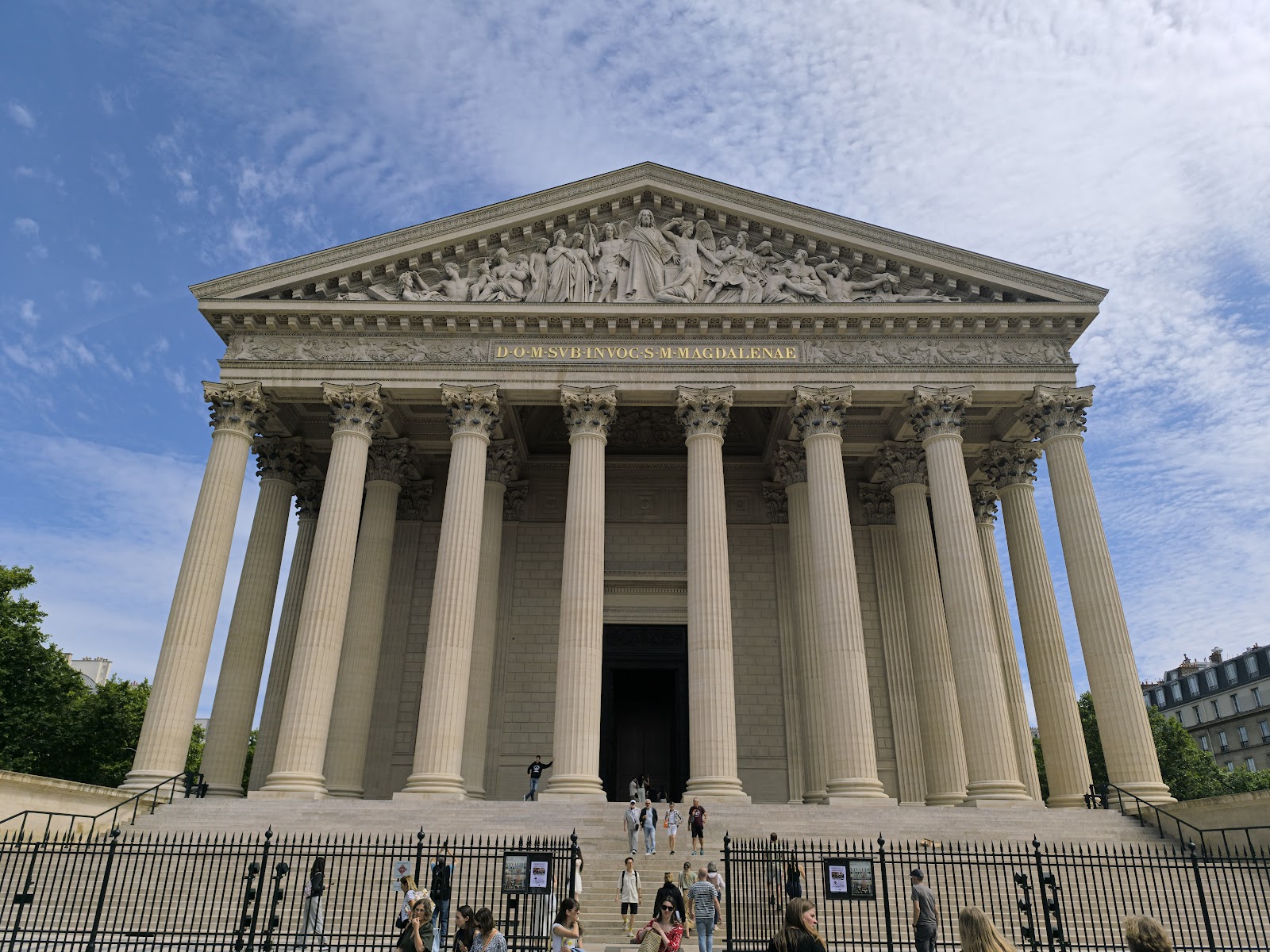
Stand at the top of the steps and you're looking down Rue Royale all the way to Place de la Concorde — a view that was deliberate from the start, a city's axis made visible. La Madeleine closes that corridor with 52 Corinthian columns, each twenty metres tall, wrapping the entire building in a single unbroken colonnade.
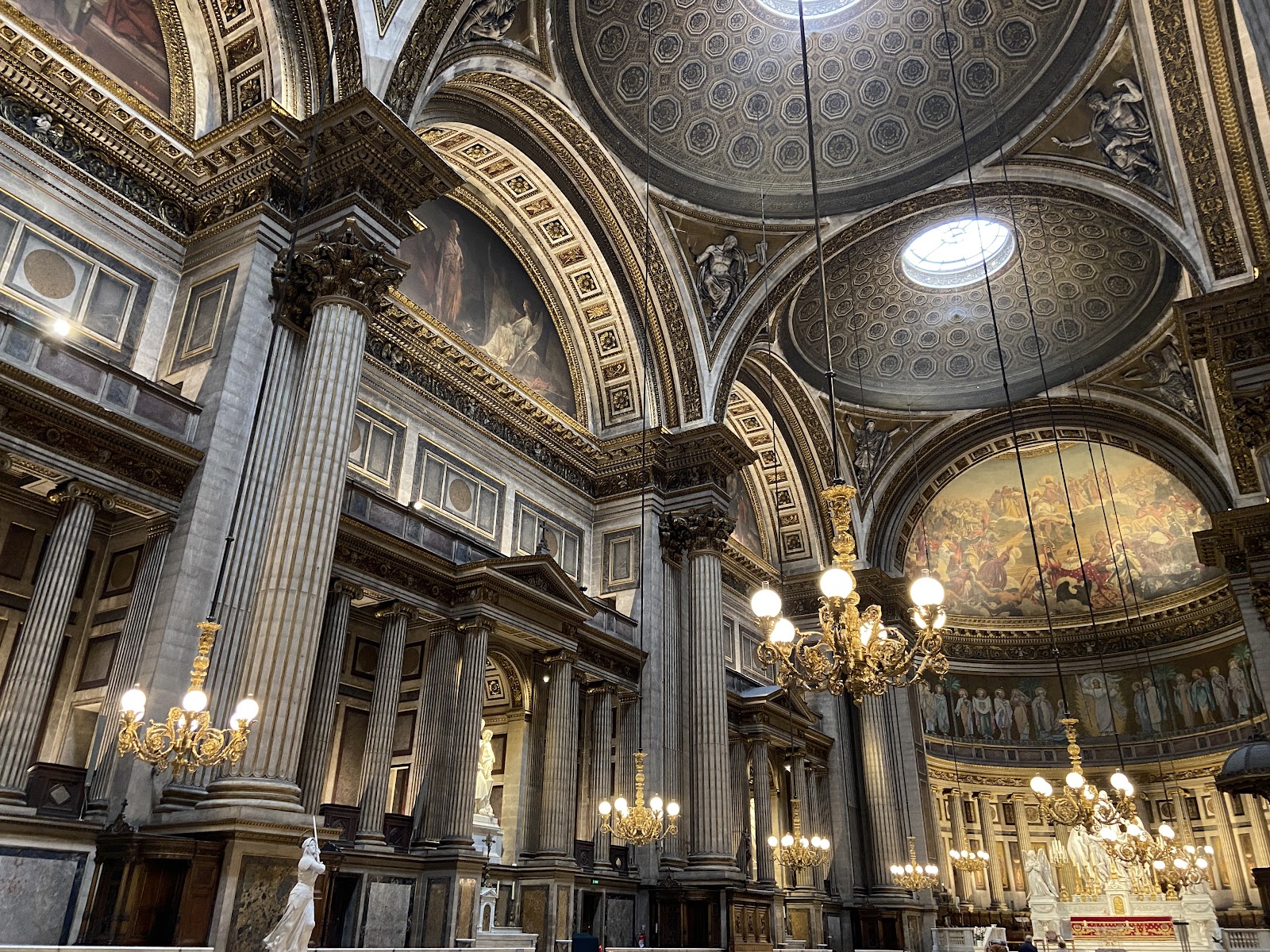
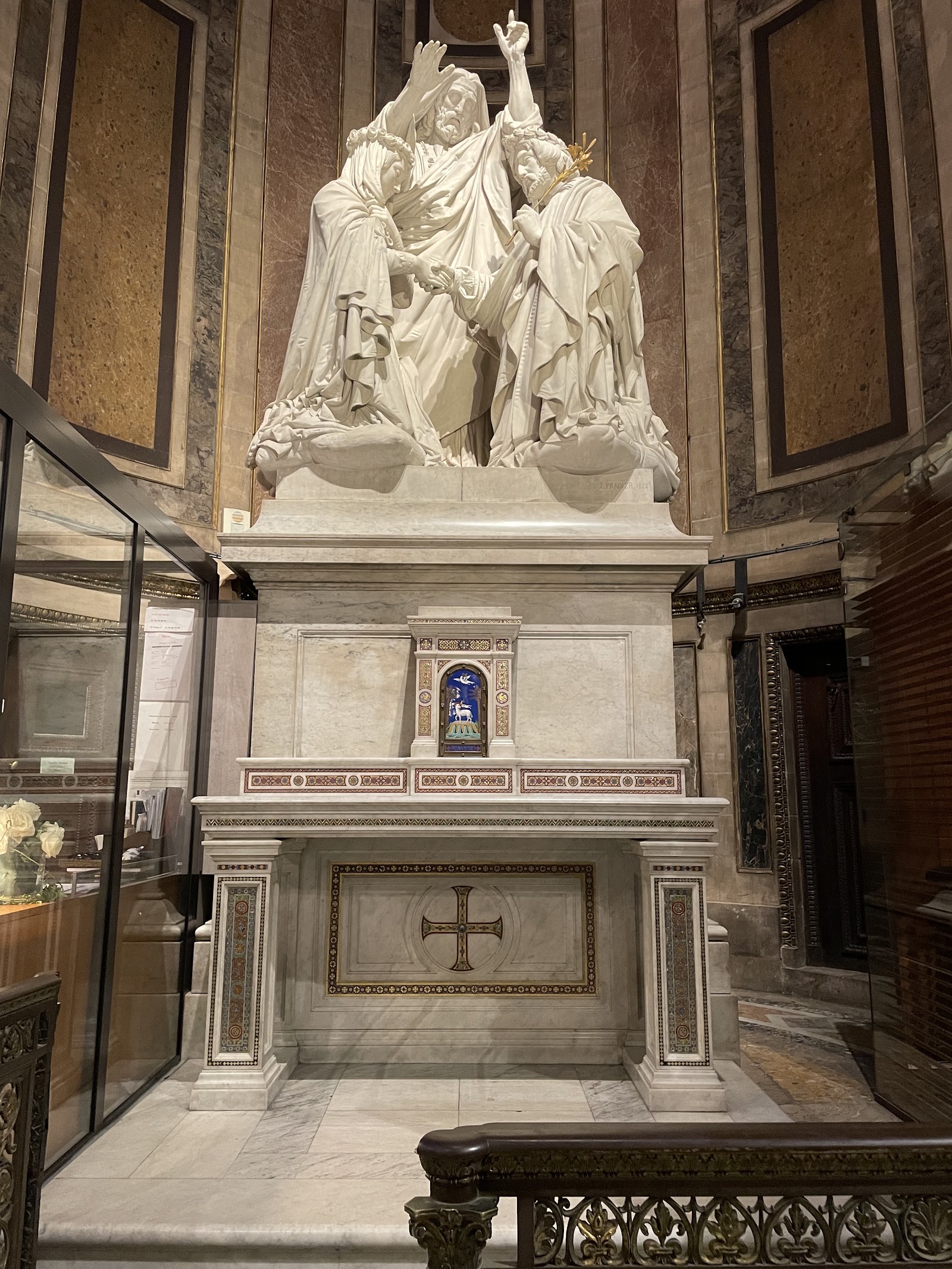
Inside, the shift is theatrical. No windows pierce the walls; light falls only through three shallow domes, pooling on Charles Marochetti's stone sculpture of the Ascension of Sainte Marie Madeleine and on Jules-Claude Ziegler's vast fresco of Christianity's history curving across the half-dome above the altar. The Cavaillé-Coll organ, installed in 1846, is still played on Sundays.
💛 What travellers fall for
People who come back tend to time it for one of the organ recitals held two or three Sundays a month — free to attend, with contributions accepted at the door. The bronze entrance doors, at 3.2 tons heavier than those of St Peter's in Rome, reward a slow look: all ten commandments worked in bas-relief across their surface.
The story behind Église de la Madeleine
Construction started in 1764, commissioned by Louis XV as the focal point of the newly planned Rue Royale. Architect Pierre Constant d'Ivry drew on the model of Saint-Louis-des-Invalides, but died in 1777; his successor Guillaume-Martin Couture dismissed his designs. The Revolution halted work in 1789 with only the foundations and a classical portico complete.
Napoleon saw different possibilities. In 1806 he personally chose architect Pierre-Alexandre Vignon's design, intending the building as a monument to his armies rather than a place of worship. After Napoleon's fall in 1814, plans shifted back to a church, and it took another three decades — and a fourth architect, Jacques-Marie Huvé — before La Madeleine was finally consecrated on 9 October 1842.
Good to know
Metro lines 8, 12, or 14 drop you at Madeleine station, steps from the entrance. The church is open daily 9:30 AM to 7:00 PM with no admission fee. A restoration project begun in 2020 means some scaffolding may be present. Before or after, the food shops on Place de la Madeleine — Fauchon to the northeast, Hédiard to the west — are worth a detour.
Where is Église de la Madeleine?
Location
- In Paris 8th Arrondissement
- 48.8700, 2.3247
- Open in Google Maps
Rating
4.7 ★ · 13,749 Google reviews
More tickets & tours for Église de la Madeleine
Book directly at the provider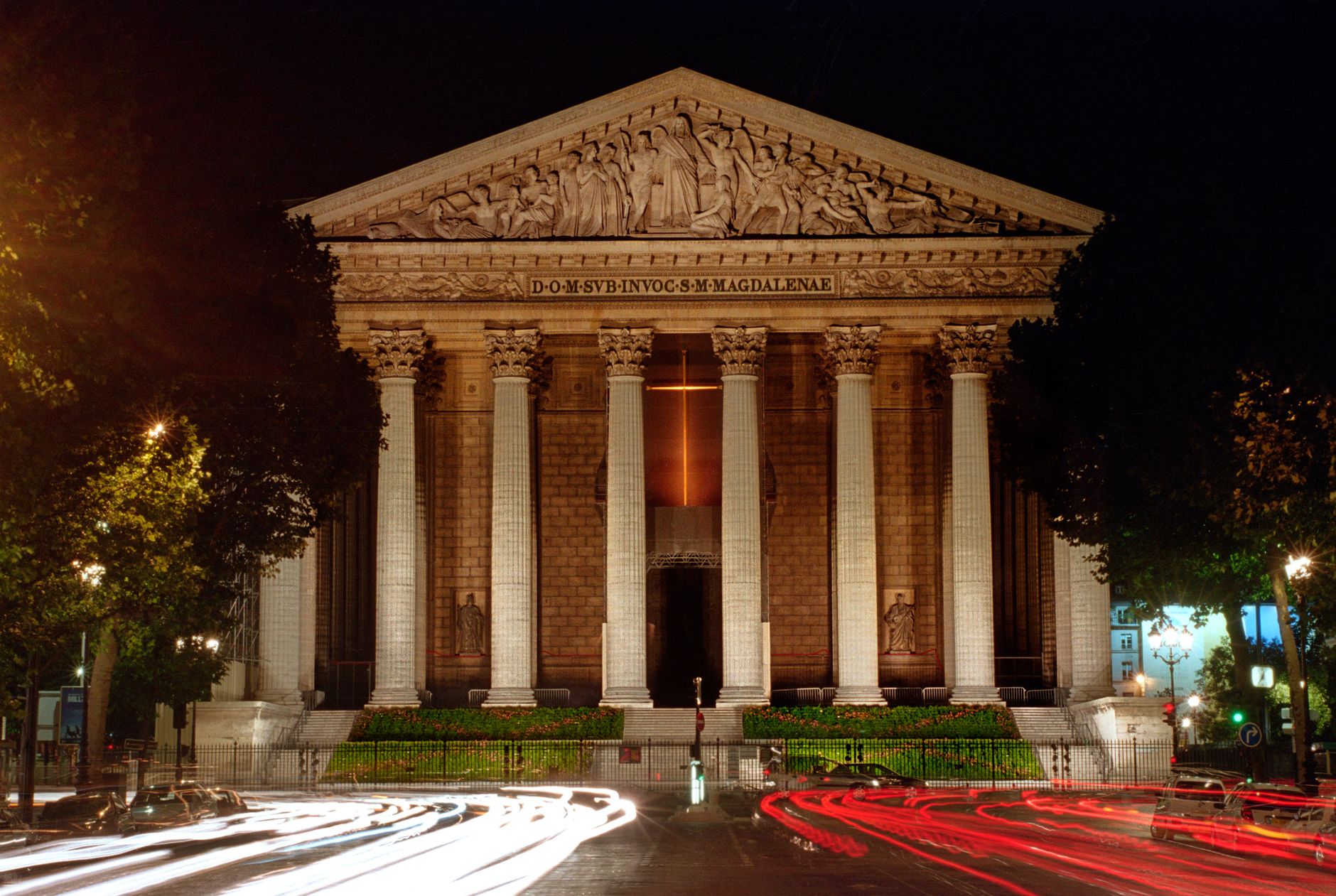
What travellers say about Église de la Madeleine
Potentially the most beautiful church in Paris, if not the world. Starting off under the Bourbon monarchs, and heavily influenced by Napoleon Bonaparte. The gold and marble glitters, the statues breathe and the artwork sings. Designed to look like a Greek or Roman temple from the outside, it adds a beautiful symmetry at the front along a boulevard that ends with the mirror image of the National Assembly, and the place du Concorde. And completely free to enter…
La Madeleine is a truly beautiful and elegant landmark that stands out with its grand architecture and impressive presence. Inspired by classical Roman temples, the exterior is majestic, while the interior feels peaceful and refined. The details, symmetry, and atmosphere make it more than just a historical building — it feels timeless. Whether you visit for the architecture, the history, or simply to admire its beauty, it is definitely one of the highlights of Paris.
What an impressively beautiful church in the heart of Paris. The outside of the church is rectangular with columns surrounding the building. The design of the building does not look like many of the other churches/cathedrals in Paris. The inside is also very different with dark colors throughout but so beautiful. There is a main aisle that draws you to the center altar which is massive. There are no side aisles separated by columns but there are many side chapels. The statues are extremely large and appear to be a brilliant white stone with a feel that appear to look like ivory. Overall, worth a walk through if visiting Paris.
An imposing neoclassical church designed in the style of a grand Roman temple. Situated in the heart of the 8th arrondissement, its fifty-two Corinthian columns create a majestic presence that commands attention. The interior features a vast nave and impressive mosaics that highlight the site's history as a former temple of glory for the army of Napoleon. The building serves as both a place of worship and a prestigious venue for classical music concerts due to its world-renowned pipe organ.
What a unique church! First at church, then a monument to Napoleon, then a church again. The Corinthian columns and interior like nothing I’ve ever seen in a Catholic Church before. Trust me, I’ve been to a lot of Catholic churches. I was so happy we finally made it to this Parisian landmark.
More of Paris 8th Arrondissement
Discover where to stay, what to do and the best deals for your trip.
Explore Paris 8th Arrondissement →More attractions in Paris 8th Arrondissement
All of Paris 8th Arrondissement →
Background adapted from Wikipedia (CC BY-SA) · map data © OpenStreetMap contributors · ratings & place photos via Google · other photos with per-image credit. Ticket links may earn us a commission at no extra cost to you.