
Cour d'Honneur (Court of Honor)


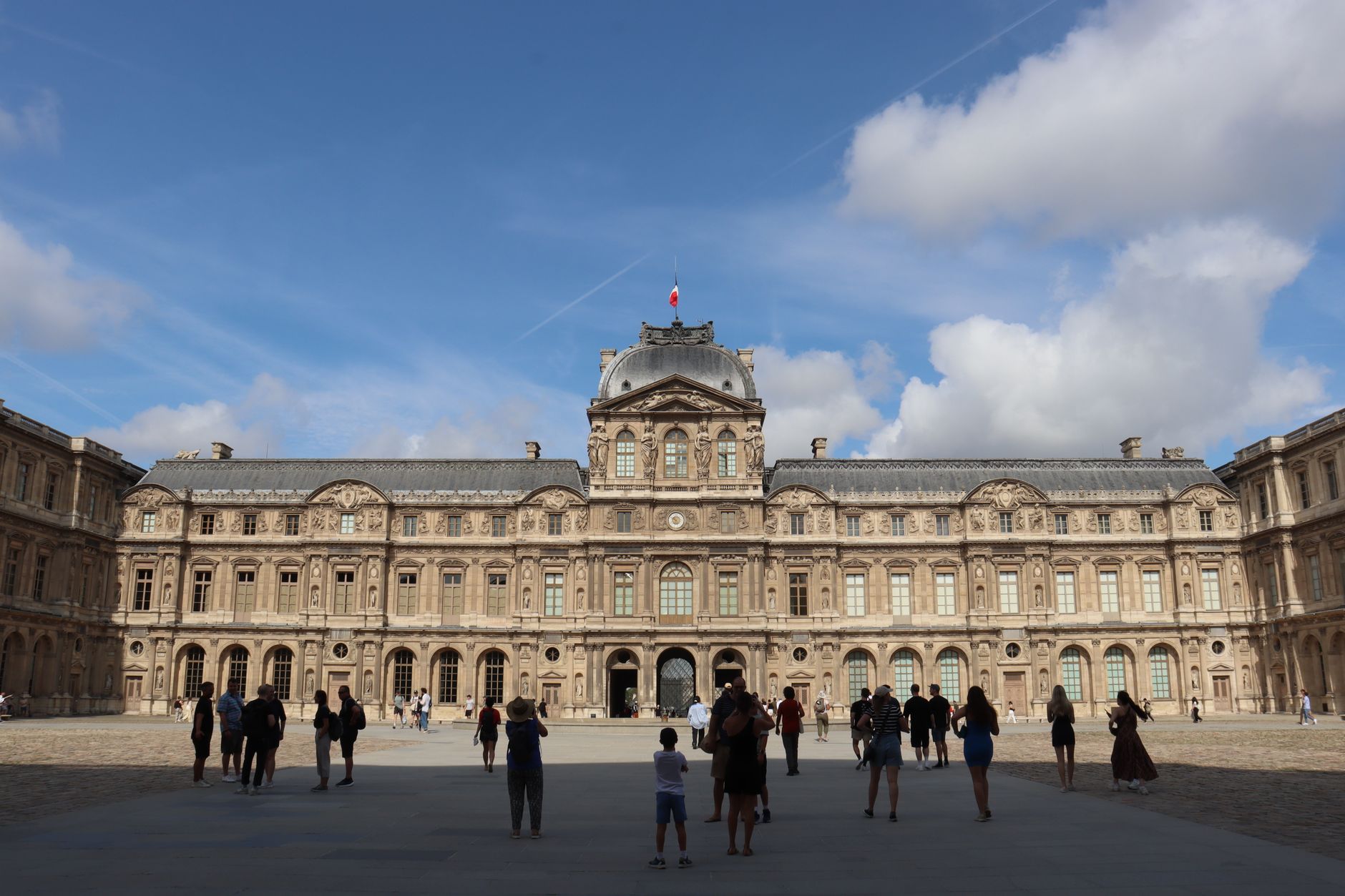


The first thing you notice is the quiet. Step through the painted-wood gallery into the Cour d'Honneur and the medina's noise drops away, replaced by the low echo of your own footsteps on 1,500 square metres of Carrara marble. The courtyard stretches roughly 50 by 30 metres, framed on all sides by slender pillared arcades whose ceilings are layered with floral and geometric paintwork — the kind of detail that takes a moment to fully register.
At the eastern end, the Salle d'Honneur opens like a punctuation mark: long, shadowed, its painted ceiling among the finest in the palace. The 2018 restoration brought the marble back to something close to its original sheen, so the whole space reads as intended — not as ruin or relic, but as a room still in conversation with whoever enters it.
💛 What travellers fall for
People who've been more than once tend to say the same thing: get here when the doors open at 9am. By 10:30 the tour groups arrive and the courtyard fills fast. Early light is flat but the space is yours. Mid-morning, around 10am, the marble starts to glow. If you want the stained-glass colour patterns in the Petit Riad, come back after 3pm.
How Cour d'Honneur (Court of Honor) came to be
The courtyard's origins trace to the 1860s, when Si Moussa — a former slave who had risen to become one of Sultan Hassan I's most influential aides — began constructing what would become Bahia Palace. After his death, his son Bou Ahmed inherited both the title of Grand Vizier and his father's ambitions. Between 1894 and 1900, Bou Ahmed expanded the palace substantially, and it was he who converted the Cour d'Honneur into a harem for his four wives and twenty-four concubines.
The marble paving — Italian Carrara, shipped and laid in 1896–1897 — was the work of architect Muhammad ibn Makki al-Misfiwi, originally from Safi. The surrounding warren of roughly 80 rooms, each wife's apartment opening onto its own garden, reflects a domestic hierarchy that the architecture makes quietly legible even today.
Who and what shaped it
People who shaped it
Landmark buildings
See Cour d'Honneur (Court of Honor) in motion
Plan your visit
On the map
When to go
Spring (March to May) and autumn (late September to mid-November) are the most comfortable seasons, with daytime temperatures between 20°C and 28°C in spring and gradually cooling from the low 30s through November. In summer the courtyard's thick walls keep the interior noticeably cooler than the streets outside, though by midday the marble reflects a fierce heat if you linger.
Right now
Background & history adapted from Wikipedia (CC BY-SA) · specs from Wikidata (CC0) · weather from Open-Meteo · map data © OpenStreetMap contributors · photos from Wikimedia Commons / Unsplash with per-image credit. No third-party reviews or social posts reproduced.