
Ceintuurbaan
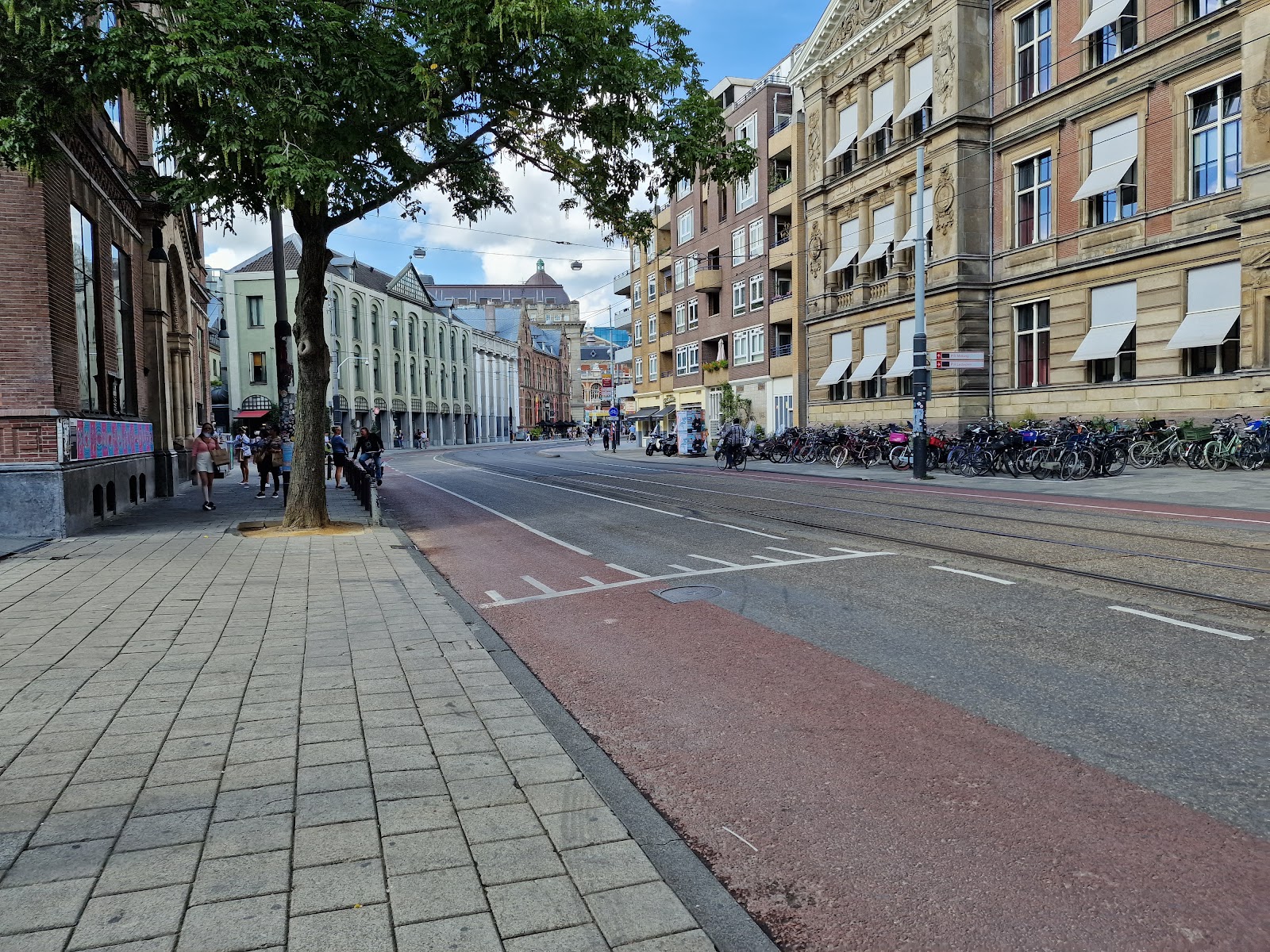
Ceintuurbaan runs straight and wide through De Pijp like a seam between two eras — to the north, the denser, older streets of Oude Pijp; to the south, the more spacious Nieuwe Pijp that followed. The boulevard was always meant to carry a certain weight: 30 metres across, lined with buildings held to higher standards than the neighbourhood around them. That ambition still shows in the bay windows and vertical flourishes on the corner properties, and in the two early cinemas — one Art Deco, one quietly distinguished — that anchor opposite ends of the street.
Today Ceintuurbaan is the kind of street that rewards walking rather than arriving at. Cafés and restaurants fill the ground floors; trams cross it at three points; the metro surfaces here too. It moves at the pace of people who actually live nearby.
💛 What travellers fall for
People who spend time in De Pijp tend to use Ceintuurbaan as a hinge. CT Coffee and Coconuts at number 282–284 — the old Ceintuur Theater, with its concrete cantilever balcony still overhead — draws long weekend mornings. Filmtheater Rialto at 338 is worth checking for programme listings before you arrive; it runs independent and repertory cinema in a building that has been doing exactly this since 1920.
The story behind Ceintuurbaan
Ceintuurbaan began as a practical answer to a polder. In 1881, the municipality of Nieuwer Amstel — under Mayor Alexander Boers — named the new road to create a ring connection through the Binnendijksche Buitenvelderse Polder, threading De Pijp into the wider city. The intended 30-metre width signalled boulevard ambitions from the start. In 1892, the section alongside what would become Sarphatipark was separated off under that park's name, leaving two distinct runs of Ceintuurbaan. By 1896, Amsterdam had annexed the whole area.
A Berlage-designed bridge opened in 1902, linking De Pijp residents across the Boerenwetering. Two cinemas followed in the early 20th century — the Rialto in 1920, the Ceintuur Theater in 1921, the latter designed by Willem Noorlander in an Art Deco style that remains singular in the neighbourhood. The Ceintuur closed as a cinema in 1976; CT Coffee and Coconuts now occupies it, the cantilever balcony still in place.
Good to know
Trams 3, 12 and 24 cross Ceintuurbaan at several points. The De Pijp metro station (Noord/Zuidlijn, the deepest in the Netherlands) has an entrance directly on Ceintuurbaan at Ferdinand Bolstraat. Use OVpay contactless or a GVB day ticket. The street itself runs year-round with no closures.
Amsterdam's weather is changeable in any season, and Ceintuurbaan is fully exposed to it. Summer — June through August — is the easiest for walking the length of the street, though rain arrives without much warning. Spring and autumn are cooler and wetter but rarely unpleasant; winter mornings here can be raw, which makes the café stops feel more earned.
Where is Ceintuurbaan?
Location
- In De Pijp
- 52.3540, 4.8970
- Open in Google Maps
More tickets & tours for Ceintuurbaan
Book directly at the provider
More of De Pijp
Discover where to stay, what to do and the best deals for your trip.
Explore De Pijp →More attractions in De Pijp
All of De Pijp →
Background adapted from Wikipedia (CC BY-SA) · map data © OpenStreetMap contributors · ratings & place photos via Google · other photos with per-image credit. Ticket links may earn us a commission at no extra cost to you.