
Assemblée Nationale (Palais Bourbon)
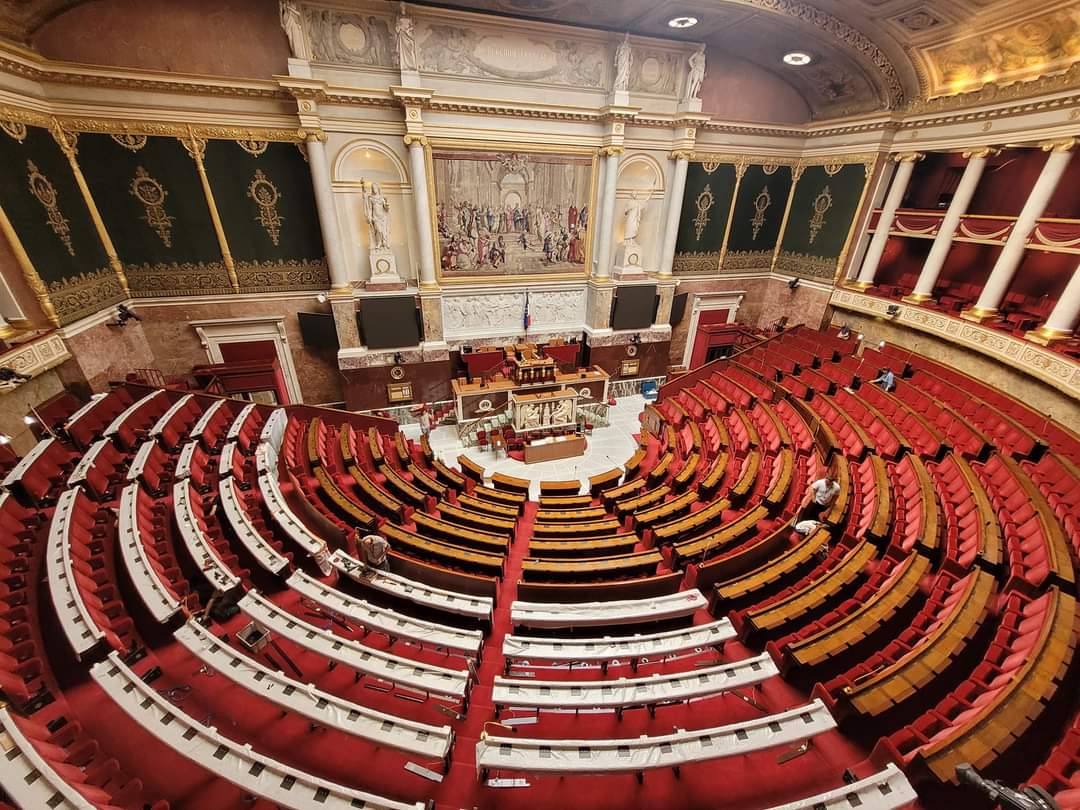
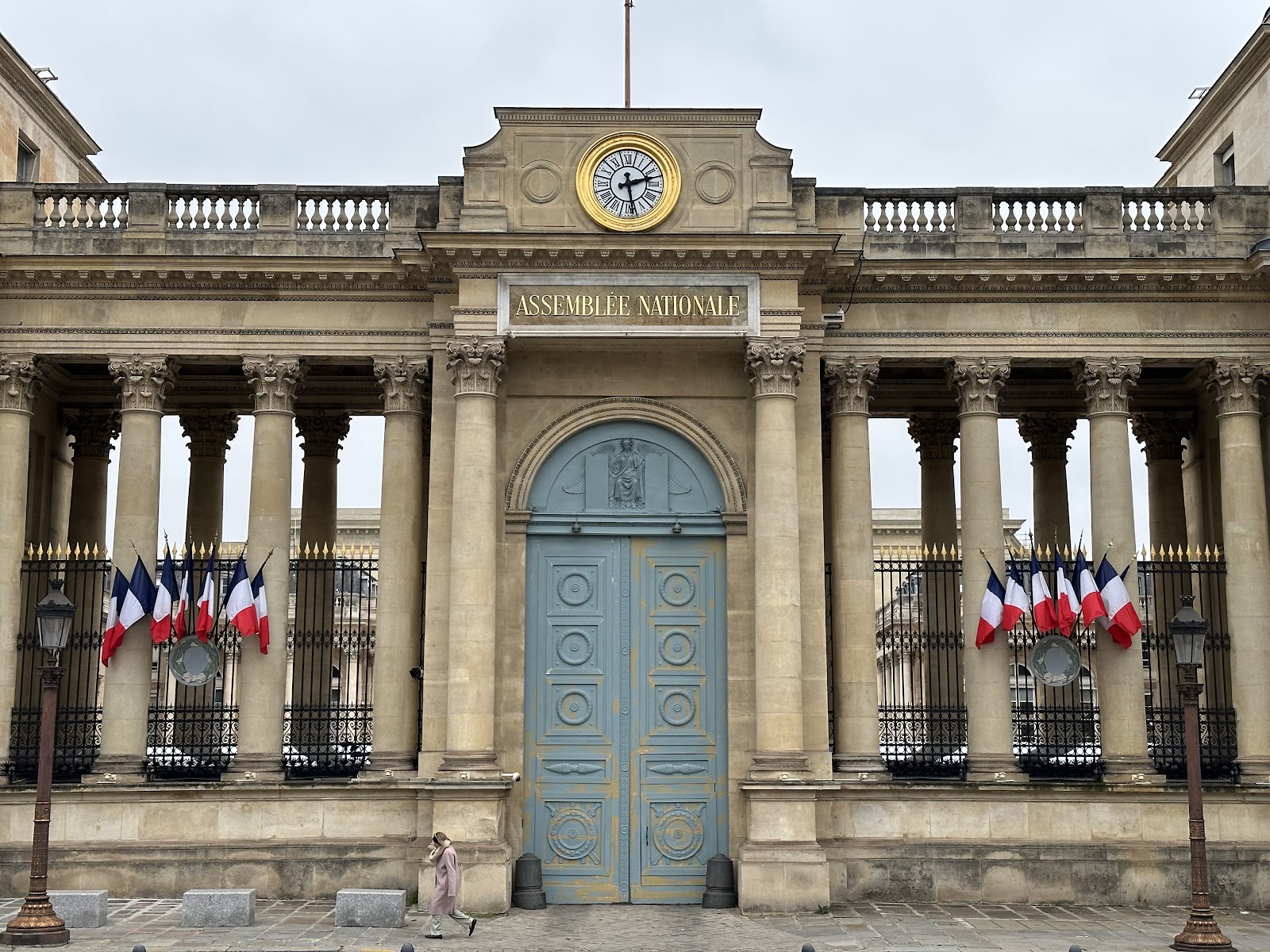
The twelve Corinthian columns of the Palais Bourbon's river façade were designed specifically to answer the Madeleine church across the Seine — a piece of Napoleonic city-planning you can verify by standing at the Pont de la Concorde and sighting the two buildings in line. Behind that 1806 theatre-set front, 577 elected deputies still sit in red-velvet chairs arranged in the original Roman-hemicycle shape, debating in a chamber that has held French law-making, more or less without interruption, since 1795.
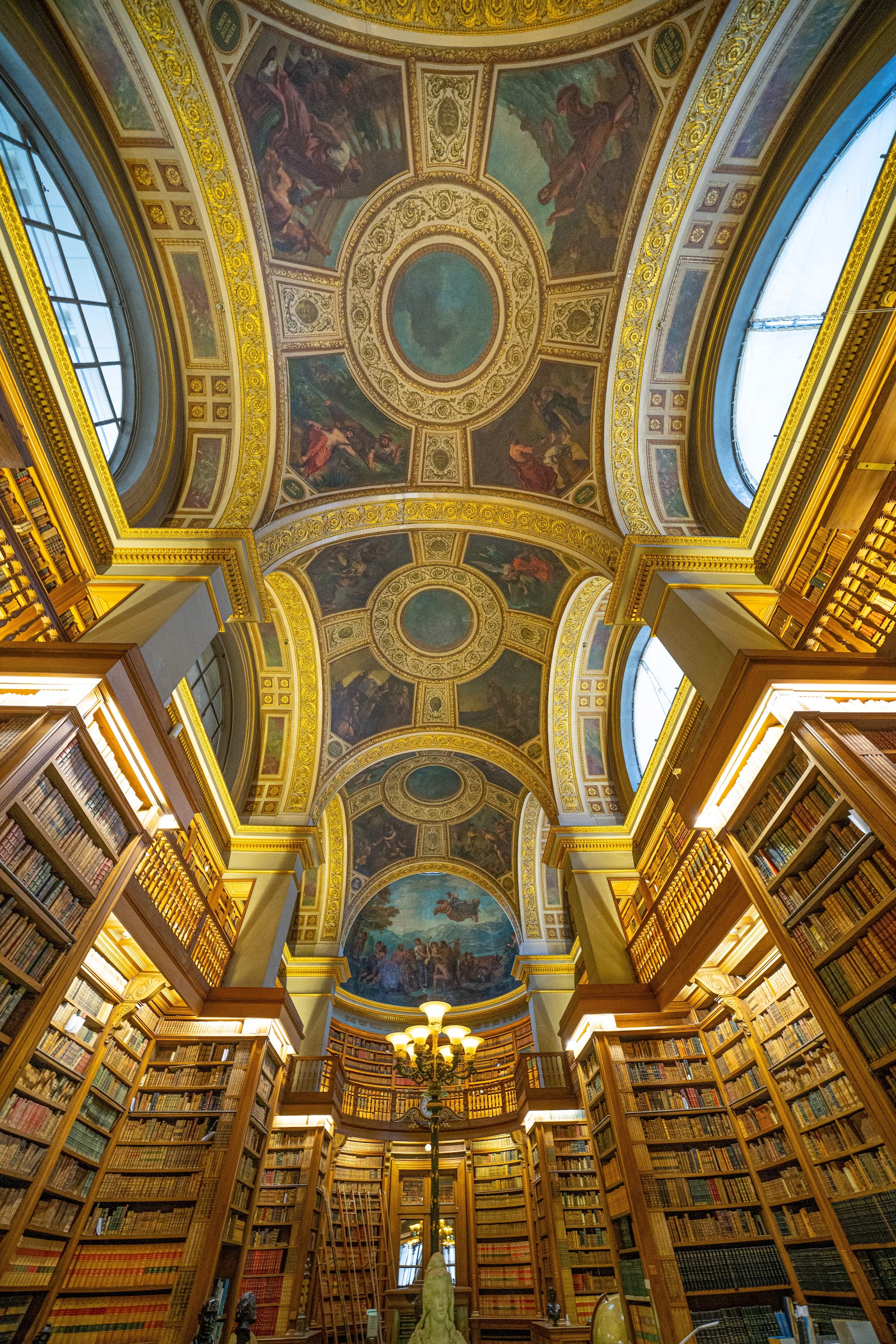
The building is larger than it looks from the street: 124,000 square metres, over 9,500 rooms, and a library whose domed ceilings Eugène Delacroix spent years painting with allegories of Science, Philosophy, Theology, Legislation, and Poetry. That library also holds a manuscript by Rousseau and records from Joan of Arc's trial.
💛 What travellers fall for
People who visit on a guided open day tend to linger in the library longer than planned — Delacroix's ceiling paintings reward slow looking in a way the hemicycle, impressive as it is, doesn't quite match. The four-ton Jules Dalou bas-relief in the Salle des Pas-Perdus is easy to walk past without registering its scale; stop and look at it properly.
The story behind Assemblée Nationale (Palais Bourbon)
The palace was built between 1722 and 1728 for Louise Françoise de Bourbon, a legitimised daughter of Louis XIV, with four architects — Lorenzo Giardini, Pierre Cailleteau, Jean Aubert, and Ange-Jacques Gabriel — working across its construction. The Prince of Condé enlarged it in 1768 by absorbing the neighbouring Hôtel de Lassay. The Revolution confiscated it, and by 1795 it had become the meeting place of the Council of Five Hundred, the legislative body of the Directory.
Napoleon commissioned Bernard Poyet to add the colonnaded Seine façade in 1806. The hemicycle chamber was renovated and reopened in 1832. During the liberation of Paris in August 1944, fighting inside the building started a library fire that destroyed twenty thousand books. The institution formally became the Assemblée Nationale with the Fourth Republic's constitution in 1946.
Good to know
The interior is accessible only on guided visits, typically offered on certain Saturdays and during open-heritage weekends — check the Assemblée Nationale website before you go. The nearest metro stop, Assemblée Nationale, is a three-minute walk. The Seine-facing façade and Walter de Maria's 1989 sphere are always visible from the street.
Where is Assemblée Nationale (Palais Bourbon)?
Location
- In Paris 7th Arrondissement
- 48.8629, 2.3190
- Open in Google Maps
Rating
4.5 ★ · 1,028 Google reviews
More tickets & tours for Assemblée Nationale (Palais Bourbon)
Book directly at the provider
What travellers say about Assemblée Nationale (Palais Bourbon)
The National Assembly is a thoroughly beautiful home to French Democracy. With magnificent gold gilded reception rooms and a stunning library, with wood panelling, painted ceilings and gold gilding. In addition, bronzes and artworks representing the history of France. Most magnificent is the hemispherical chamber. You can really feel the concept of “the mountain” in French democracy, and the ideas of “left” and “right” parties. A truly lovely building and tour.
Seeing the Palais Bourbon in person gives a strong sense of history and political weight. The long colonnaded façade facing the Seine feels monumental and dignified, yet elegant in a very Parisian way. What I enjoyed most was the balance between grandeur and calm. Unlike many famous landmarks crowded with tourists, this building carries a quieter authority. Standing in front of the columns, you feel the presence of centuries of French political life and national decision-making. It is not a place that overwhelms with spectacle, but rather one that impresses through symmetry, proportion and symbolism. A meaningful stop when walking along the Seine and discovering the institutional heart of France.
Nice old building. It serves as the seat of the French National Assembly, the lower house of the French Parliament. Originally built for the Duchess of Bourbon and completed in 1728, its structure is reminiscent of the Grand Trianon at Versailles. The grand Neoclassical facade with its iconic colonnade (twelve Corinthian columns) was added between 1806 and 1810 by Napoleon I to mirror the Madeleine Church across the Seine. Situated on the Quai d'Orsay, it overlooks the Seine and is connected to the Place de la Concorde via the Pont de la Concorde.
The National Assembly of France and especially the Library with Eugène Delacroux's mural paintings are absolutely amazing! 😍 The guided tour was full of fascinating information 👍👏
Extraordinary visit to the French parliament with an extended overview of this beautiful monument close to all citizens. Fantastic guide with detailed explanation and a huge chance to see l'hémicycle. Something you don't see everyday. Simply outstanding. Thank you for this great opportunity.
More of Paris 7th Arrondissement
Discover where to stay, what to do and the best deals for your trip.
Explore Paris 7th Arrondissement →More attractions in Paris 7th Arrondissement
All of Paris 7th Arrondissement →
Background adapted from Wikipedia (CC BY-SA) · map data © OpenStreetMap contributors · ratings & place photos via Google · other photos with per-image credit. Ticket links may earn us a commission at no extra cost to you.