
Arc de Triomphe
Napoleon's triumphal arch — climb it for the city's best avenue-spoke view.
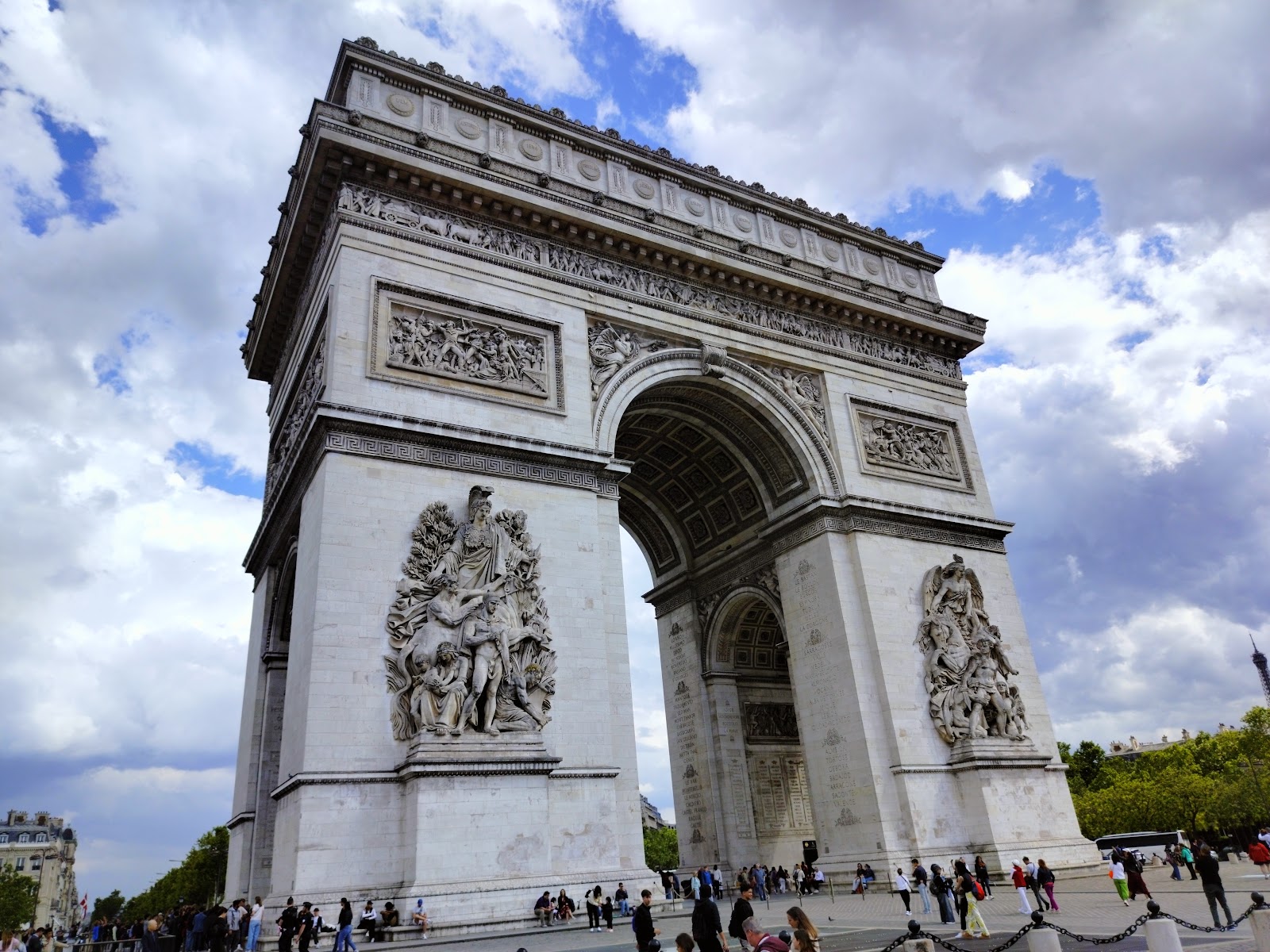
Napoleon commissioned this arch in 1806, the morning after Austerlitz, and it took thirty years to finish — long enough that he never saw it completed. What stands at the top of the Champs-Élysées today is 50 metres of limestone, twelve avenues radiating outward from its base like spokes from a hub, and at its foot an eternal flame that has burned since 1920 above the Tomb of the Unknown Soldier.
The view from the rooftop terrace is the reason to climb the 284 steps. Paris arranges itself around you in a way that no map quite prepares you for — the geometry of Haussmann's boulevards suddenly legible, the Eiffel Tower due southwest, the city's logic made visible all at once.
💛 What travellers fall for
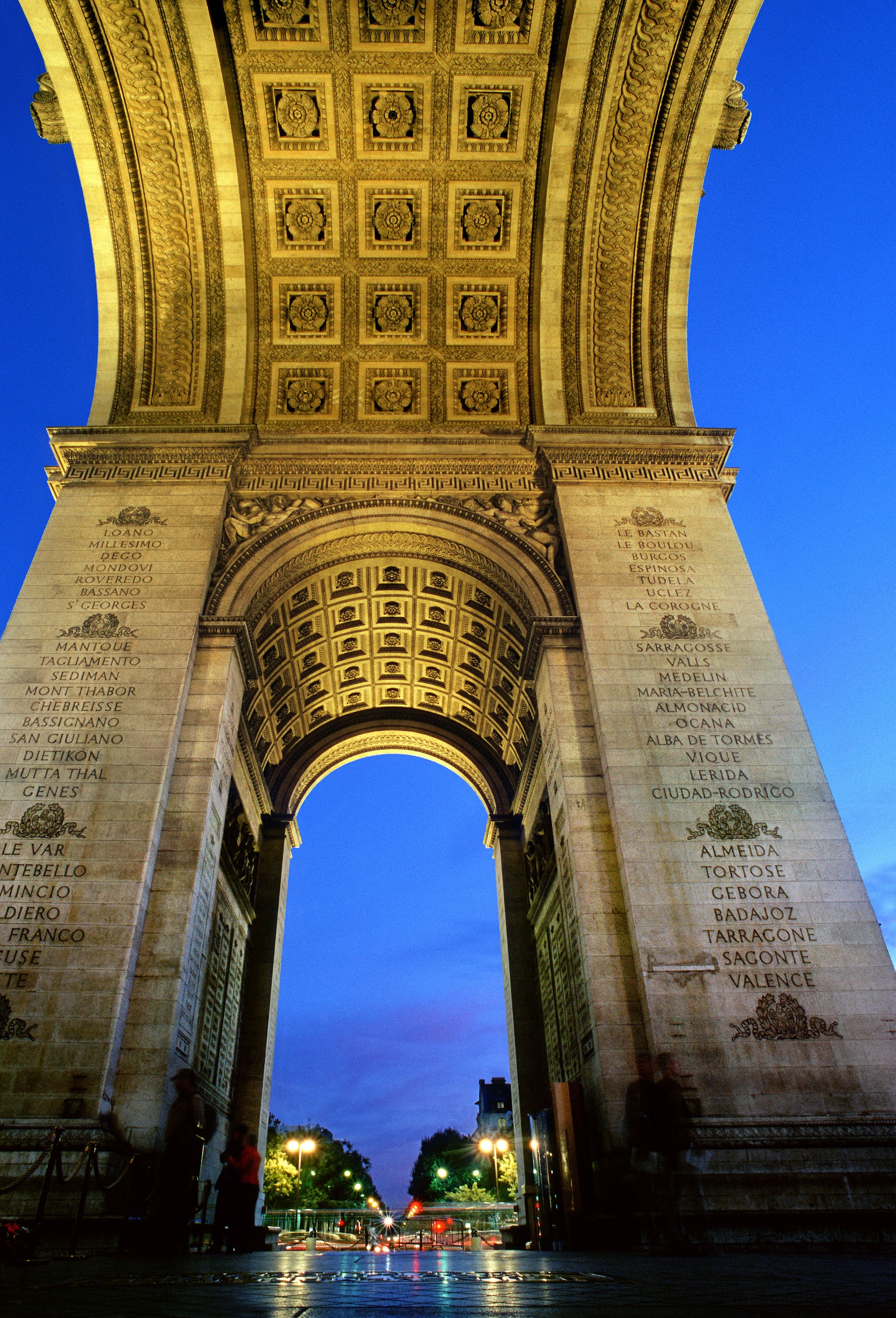
People who return tend to go up at dusk, when the streetlights along the avenues switch on in sequence below you. They also linger at François Rude's bas-relief La Marseillaise on the arch's northeast pillar — the faces in it are worth more than a glance. Skip the lift; it won't take you to the top anyway.
The story behind Arc de Triomphe
Napoleon laid the foundation stone on 15 August 1806 — his own birthday — and appointed Jean-François Chalgrin to design it in the Neoclassical idiom of ancient Rome. Construction moved slowly enough that when Napoleon brought his new bride Marie-Louise into Paris in 1810, only the foundations were complete; he had a full-scale wooden mock-up erected so she could see what it would become. Chalgrin died in 1811, and the project passed through several hands before Louis-Étienne Héricart de Thury and Guillaume-Abel Blouet finally finished it under Louis-Philippe I.
The arch was inaugurated on 29 July 1836. Its four sculptural groups were carved by different hands — Jean-Pierre Cortot, Antoine Étex, James Pradier and François Rude, whose La Marseillaise remains the most studied of them. Beneath the arch, the Tomb of the Unknown Soldier was installed on Armistice Day 1920, and the eternal flame lit above it has not been extinguished since.
Good to know
Metro lines 1, 2 and 6 stop at Charles de Gaulle-Étoile, directly below. Admission is €22 in high season, €16 in low season and free for under-18s and EU residents aged 18–25. Bags larger than 40×40×20 cm are not permitted. Last entry is 45 minutes before closing.
Spring brings mild temperatures around 12–20°C with occasional showers — a coat is useful, and the terrace can be breezy. Summer is warm and the long evening light makes a late visit worthwhile; the monument stays open until 11pm from April through September.
Where is Arc de Triomphe?
More tickets & tours for Arc de Triomphe
Book directly at the provider
What travellers say about Arc de Triomphe
Amazing. Loved it. Brilliant views of the city (fraction of the cost of the Eiffel Tower) and really loved walking around the top and soaking up the 360 views. Uncrowded and really great must do place to visit. So much history to learn about it. Lot of steps, so be warned. But there isn't a rush
The Arc de Triomphe is an absolute masterpiece and an essential stop on any Parisian adventure. Standing proudly at the center of the Place Charles de Gaulle, this colossal monument radiates historic grandeur. Up close, the sheer scale of the architecture is breathtaking, and the intricate stone reliefs—especially François Rude’s *La Marseillaise*—showcase phenomenal artistry. Paying your respects at the Tomb of the Unknown Soldier beneath the massive vault adds a deeply moving, solemn layer to the visit. The absolute highlight, however, is climbing the 284 steps to the panoramic rooftop terrace. The rewarding 360-degree view offers one of the finest vantage points in the entire City of Light. Watching the twelve grand, tree-lined avenues radiate outward like a star is visually mesmerizing. It provides an unmatched perspective of the spectacular Eiffel Tower rising above the classic grey-tiled rooftops, making it the perfect photo spot. Whether you visit in the morning to beat the crowds or scale it at twilight to watch the Champs-Élysées illuminate, the monument delivers a magical experience. Blending deep historical significance with some of the most sensational views in France, it truly captures the heart and soul of Paris.
Visiting the Arc de Triomphe at sunset was an absolutely beautiful experience and perfect for taking photos. The view from the top is spectacular, and it is definitely worth climbing the stairs to see the city from that perspective. A great tip is to check the exact sunset time in advance and arrive at least 45 minutes early. This gives you plenty of time to pass through security and make your way up to the top so you don't miss the perfect moment. It is an amazing experience that is absolutely worth it!
Visiting the Arc de Triomphe was an unforgettable experience and one of the most iconic moments of my trip to Paris. The monument is absolutely magnificent, with impressive sculptures and extraordinary architectural details that honor an important part of French history. Standing beneath it, you can truly appreciate its scale and symbolic significance. Climbing to the top was definitely worth it. The panoramic views of Paris are breathtaking, especially the perfect perspective down the Champs Élysées and the surrounding avenues radiating from the monument. The atmosphere around the Arc de Triomphe is vibrant and full of energy, making the experience even more memorable. Overall, a must visit landmark in Paris historic, majestic, and offering some of the best views in the city.
Nice monument. Be sure to take one of the underground tunnels to the Arc de Triomphe as the traffic in the roundabout is very intense. I would recommend to go up to the top of the monument, there is a very nice view over Paris. There is no elevator, so some steps to get up. There are toilets on the top floor and souvenir shops. Well worth a visit.
More of Paris
Discover where to stay, what to do and the best deals for your trip.
Explore Paris →More attractions in Paris
All of Paris →
Background adapted from Wikipedia (CC BY-SA) · map data © OpenStreetMap contributors · ratings & place photos via Google · other photos with per-image credit. Ticket links may earn us a commission at no extra cost to you.