
Times Square
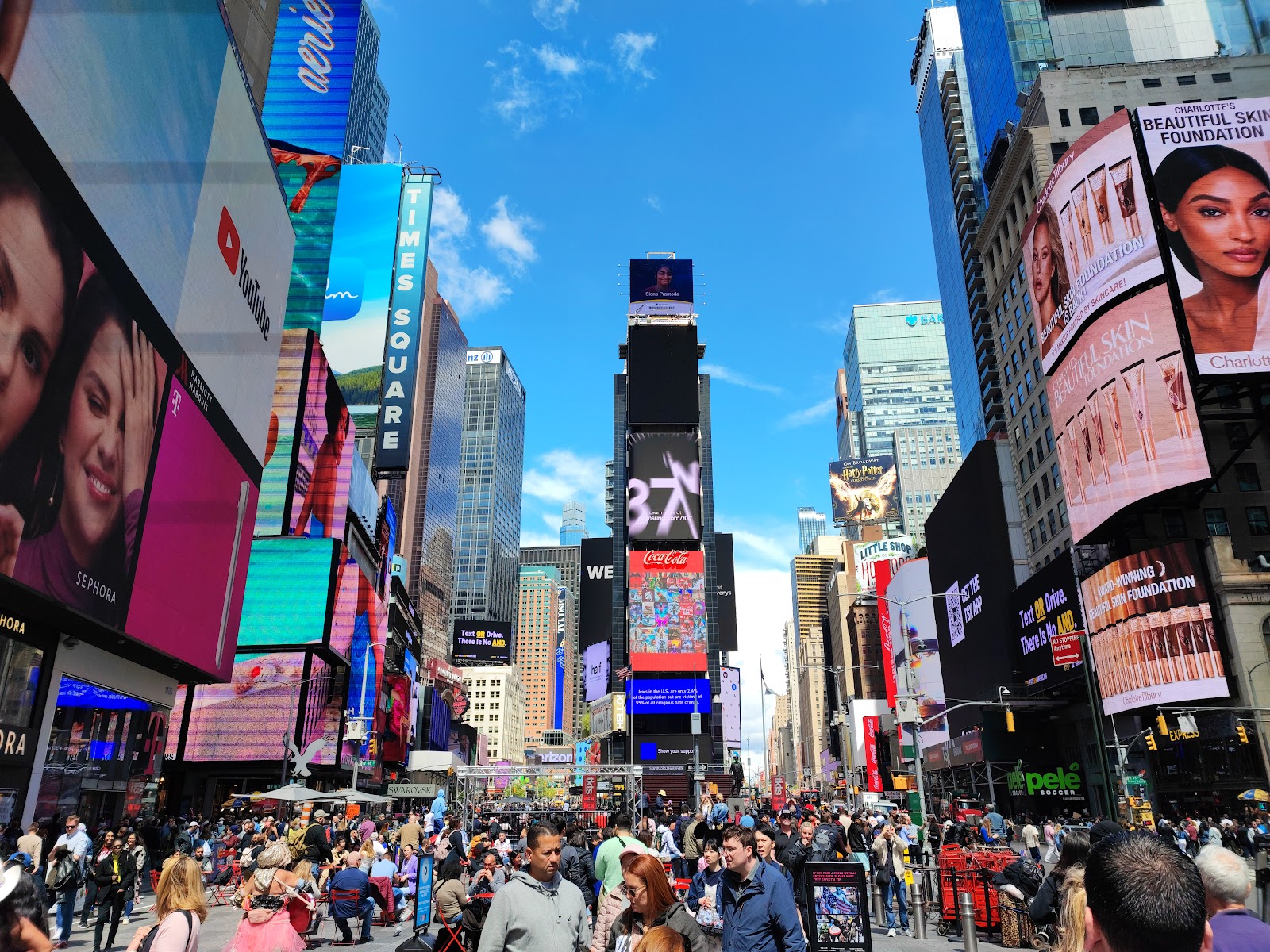
Times Square is not a square. It's a bowtie of asphalt where Broadway and Seventh Avenue cross, and standing in the middle of it — screens stacked twenty stories high, cabs threading the gaps, strangers from everywhere reading the same crawling news ticker — you understand why a century of people called this the crossroads of the world.
The pedestrian plazas between 42nd and 47th Streets have folding chairs and wide sidewalks now, which makes it easier to stop and look up without being carried along by the current. That small change — reclaiming the street from traffic — turns the place from a thoroughfare into something you can actually inhabit.
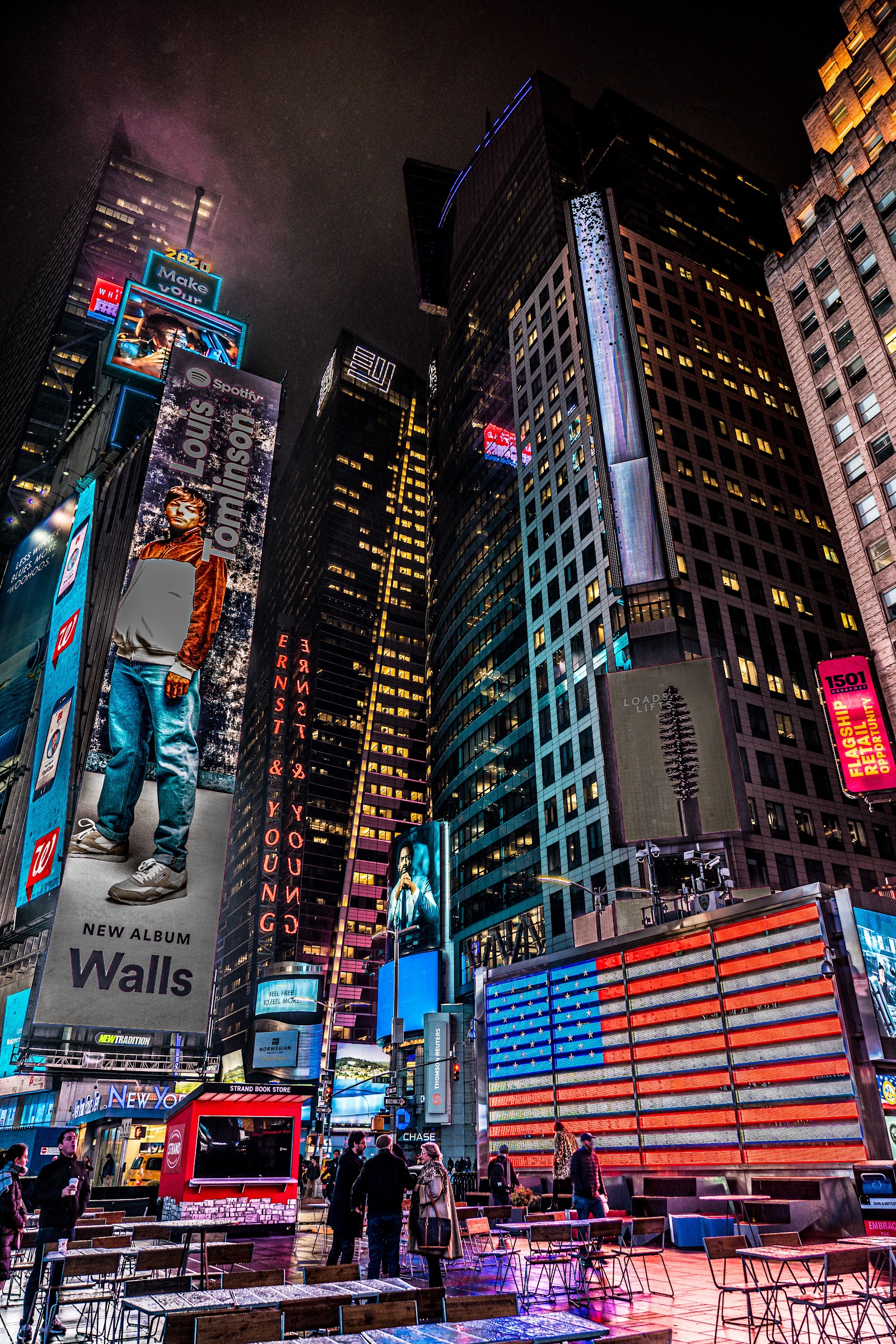
💛 What travellers fall for
People who come back tend to seek out Father Duffy Square, the northern triangle where the bronze George M. Cohan stands with his hat tilted, and climb the red glass staircase of the TKTS booth for a slightly elevated angle on the whole spectacle. Same-day discounted theater tickets are sold there too, which is reason enough to make it a stop before dinner.
The story behind Times Square
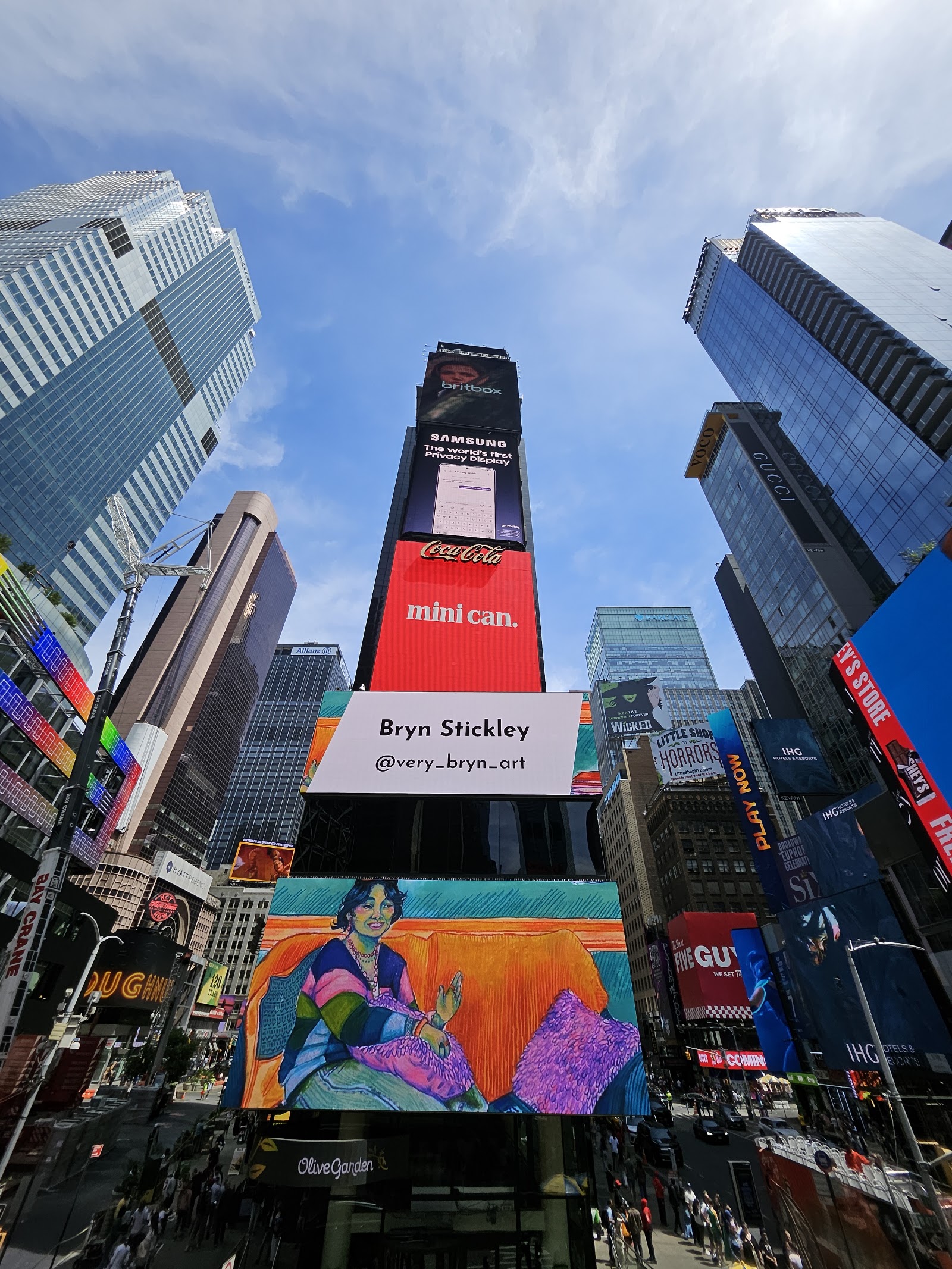
Long Acre Square was carriage-maker territory until 1904, when Adolph Ochs — publisher of The New York Times — moved his paper to a new tower at the junction of Broadway and Seventh Avenue and lobbied the city to rename the intersection after it. Architect Cyrus L.W. Eidlitz completed One Times Square that same year in neo-Gothic terracotta and granite; it briefly stood as the second-tallest building in Manhattan. The first New Year's Eve ball drop followed on December 31, 1907.
By the 1920s the theaters had made it famous. By the 1980s, the area had become so derelict it contributed only $6 million in property taxes to the entire city. The turnaround came in the 1990s, when the State of New York purchased nine historic 42nd Street theaters and the district began its transformation into what it is today. One Times Square itself lost its original facade in 1963 when Allied Chemical stripped it to bare marble and concrete; it survives now largely as a billboard tower and the platform for that geodesic ball — 12 feet across, nearly 12,000 pounds — that descends every December 31.
Good to know
The Times Square–42nd Street subway complex serves ten lines — more than anywhere else in Manhattan — and runs around the clock. Arrive by 1, 2, 3, N, Q, R, W, or the 42nd Street Shuttle. Skip New Year's Eve unless you've planned months ahead; the crowds require arriving hours early and leaving very late.
Summer in Times Square means heat radiating off pavement and screens alike, with July highs around 84°F. Winter is cold and often sharp, but the light from the signs means the square never really goes dark or gloomy — a fact that makes a January night there its own kind of experience.
Where is Times Square?
Location
- In New York City
- 40.7580, -73.9855
- Open in Google Maps
Rating
4.7 ★ · 243,646 Google reviews
More tickets & tours for Times Square
Book directly at the provider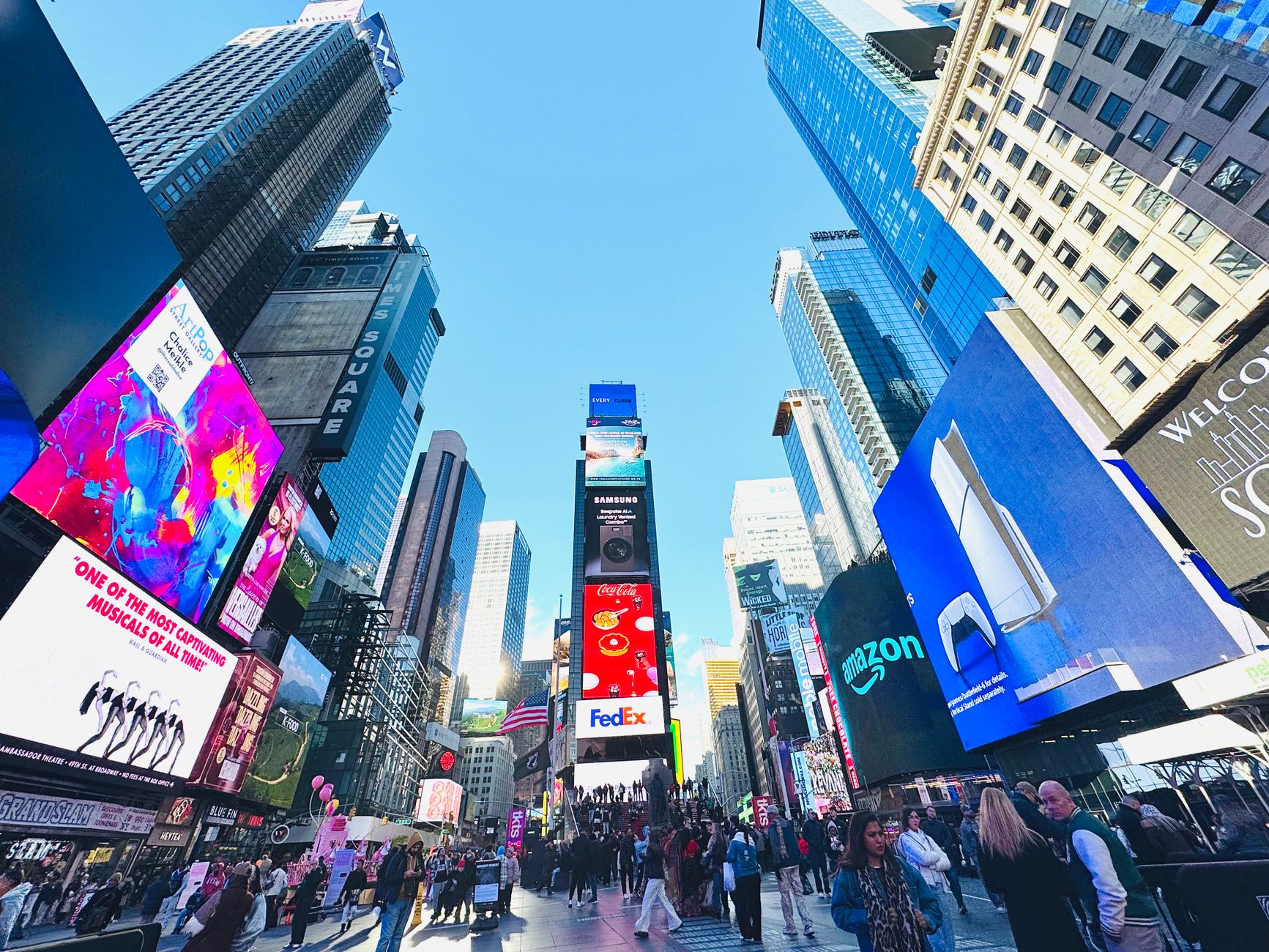
What travellers say about Times Square
Love it or hate it, you have to see it at least once… I absolutely love this place.. Bright lights, giant screens, crowds, street performers and so much energy all around… Times Square is exactly what you imagine New York to be. Yes, it’s busy and crowded, but that’s part of the experience. The atmosphere, especially at night, is incredible and there’s always something happening. The huge billboards, towering skyscrapers and bright lights make it feel like nowhere else in the world. No matter what time of day you visit, it's always buzzing with people and there’s always something happening. One of those iconic places that makes you feel like you are truly in New York. What’s not to like? I have been here many times and can happily come back again and again. It never gets old…
Visiting Times Square is an absolute sensory overload in the best way possible! It is the true heartbeat of New York City and a place everyone has to experience at least once. Walking into the area, you are immediately surrounded by towering, ultra-bright LED billboards, towering skyscrapers, and an incredible, buzzing energy that you simply cannot find anywhere else in the world. It genuinely feels like the center of the universe. Here are a few tips and highlights for your visit: When to go: While it is bustling during the day, you absolutely must see it at night. The way the neon lights illuminate the streets is breathtaking and makes for the best photos. The Red Steps: Make sure to climb the famous red glass steps above the TKTS booth in Father Duffy Square. It is the perfect vantage point to sit down, take in the panoramic views of the glowing billboards, and just people-watch. The Crowds & Chaos: Be prepared for massive crowds! It is always packed with tourists, commuters, and street performers. A quick warning: Keep an eye out for the costumed characters and CD sellers scattered around the pedestrian plazas. If you take a picture with them, they will aggressively demand a tip, so it is best to politely keep walking if you aren't interested. While locals might avoid it, as a visitor, the sheer scale and electricity of Times Square completely live up to the hype. It is the perfect starting point before catching a Broadway show or grabbing a bite in Midtown!
Times Square is honestly one of the most chaotic places I’ve ever been to, in the best possible way. The first thing that hits you is just how much is going on at once, bright screens everywhere, huge ads flashing above your head, people moving in every direction, music, noise, taxis, everything. It feels a bit overwhelming when you first arrive, like your brain doesn’t really know where to look. There’s something happening in every direction, and it never really stops. You’ve got street performers doing their thing, tourists stopping every two seconds to take photos, and people dressed up trying to get your attention. But after a while, you kind of get used to the chaos, and it becomes really fun to just stand there and take it all in. It actually feels like you’re in the middle of something huge and alive. At night especially, when all the screens are glowing, it’s crazy how bright it is, almost like daylight. It’s not a place where you go to relax. It’s more of a place where you just experience it, soak it in, and maybe laugh a bit at how intense it all is. It’s loud, it’s crowded, it’s a bit much, but that’s exactly the point. Overall, it’s a crazy experience, but definitely something you should see at least once. You leave with a lot of impressions, and it kind of sticks in your memory because there’s nothing else quite like it.
Times Square is the absolute definition of New York's high-intensity, non-stop energy. The sheer scale of the massive digital billboards, the towering architecture, and the constant movement of people create an atmosphere that feels entirely unique and overwhelming in the best way possible. It is a place that feels completely alive, day or night. The visual impact is the main draw here, with the brilliant lights illuminating the entire corridor and making it feel like daylight even late into the evening. Walking through the main plazas, the sensory experience is unmatched, offering endless opportunities for city photography and people-watching. It is a well-maintained, iconic destination that perfectly captures the fast-paced, vibrant heartbeat of Manhattan. For anyone looking to experience the true, classic hustle of the city, standing in the middle of the bright lights is an absolute must.
Very fun place. We got there before dark and it felt safe and easy to walk around. As it got dark it got more packed but still not to crazy. It was a weekday so I’m sure that’s why. Felt safe at all times and plenty of cool little shops and food to shop at. Night time is definitely more exciting and fun but day is also nice maybe especially with kids. Love All the high buildings. Would not want to drive a car though.
More of New York City
Discover where to stay, what to do and the best deals for your trip.
Explore New York City →More attractions in New York City
All of New York City →
Background adapted from Wikipedia (CC BY-SA) · map data © OpenStreetMap contributors · ratings & place photos via Google · other photos with per-image credit. Ticket links may earn us a commission at no extra cost to you.