
Théâtres Romains de Fourvière
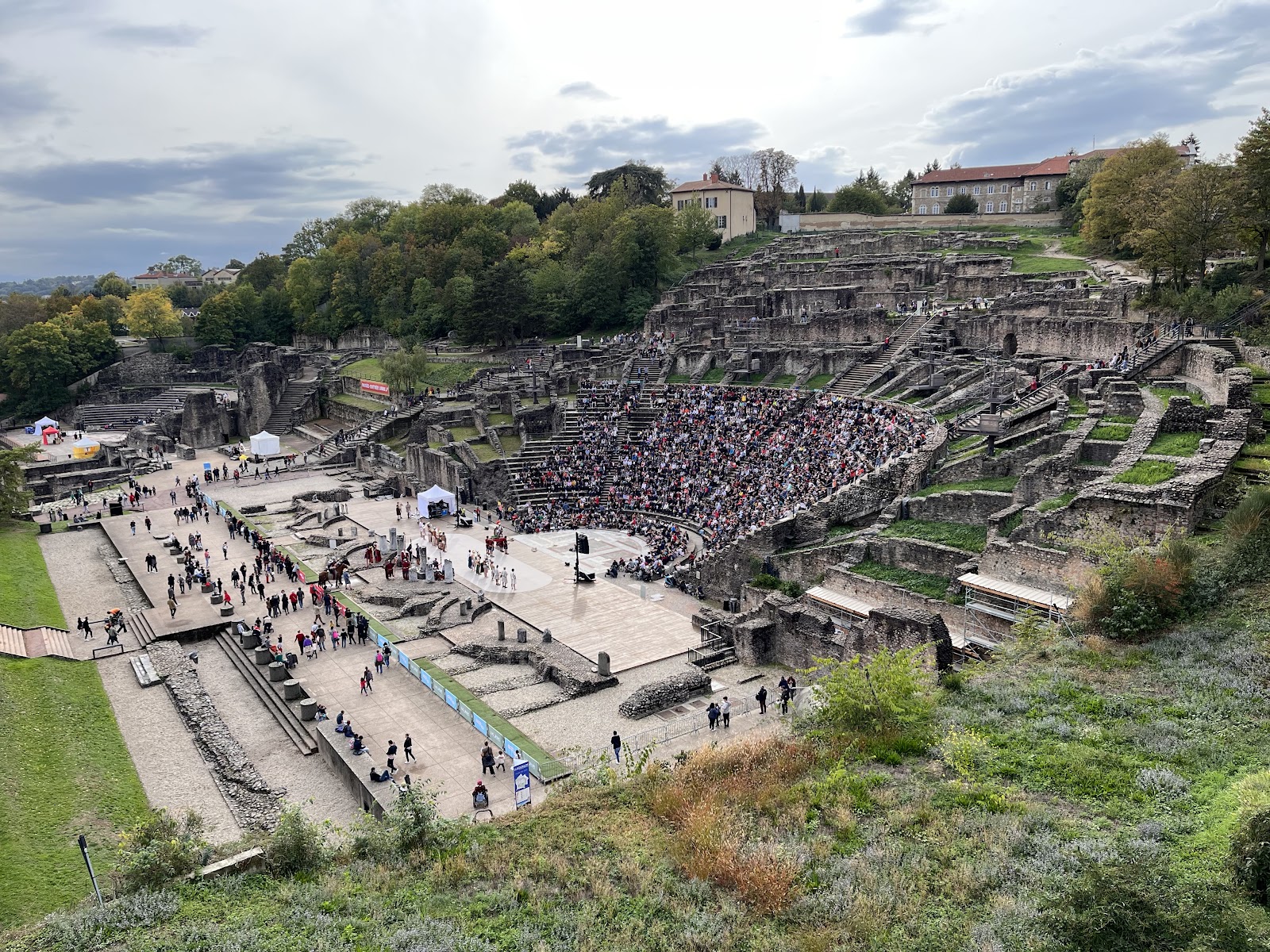
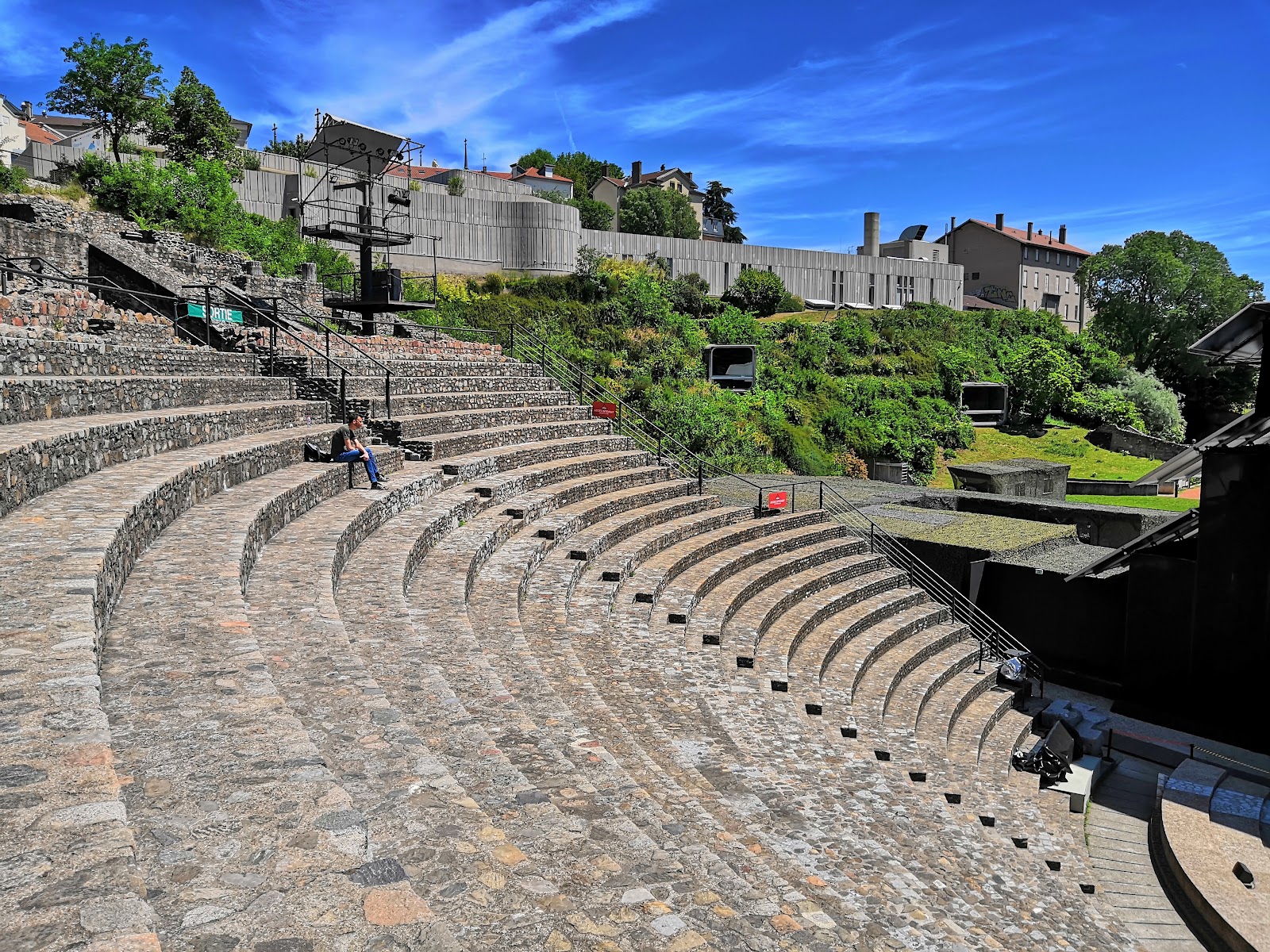
Two thousand years ago, this hillside above the Rhône held the largest theatre in Roman Gaul. You can still sit in its stone gradins — the same semicircular tiers that once held 10,000 people — and look out over a city that has grown up, layer by layer, around the ruins ever since.
The site pairs the Grand Theatre with a smaller Odéon whose orchestra floor is still paved in coloured marbles sourced from Greece, Egypt, Africa and Asia Minor. The Romans called this place Lugdunum, the capital of the Three Gauls, and the scale of what they left behind makes that title legible.
💛 What travellers fall for
People who come back tend to arrive early, before the tour groups, and walk the original Roman road that threads through the complex. The Odéon's marble floor stops most visitors cold — the colours have no business being that vivid after twenty centuries. The buried Musée de la Civilisation Gallo-Romaine, designed by Bernard Zehrfuss, rewards an extra hour.
The story behind Théâtres Romains de Fourvière
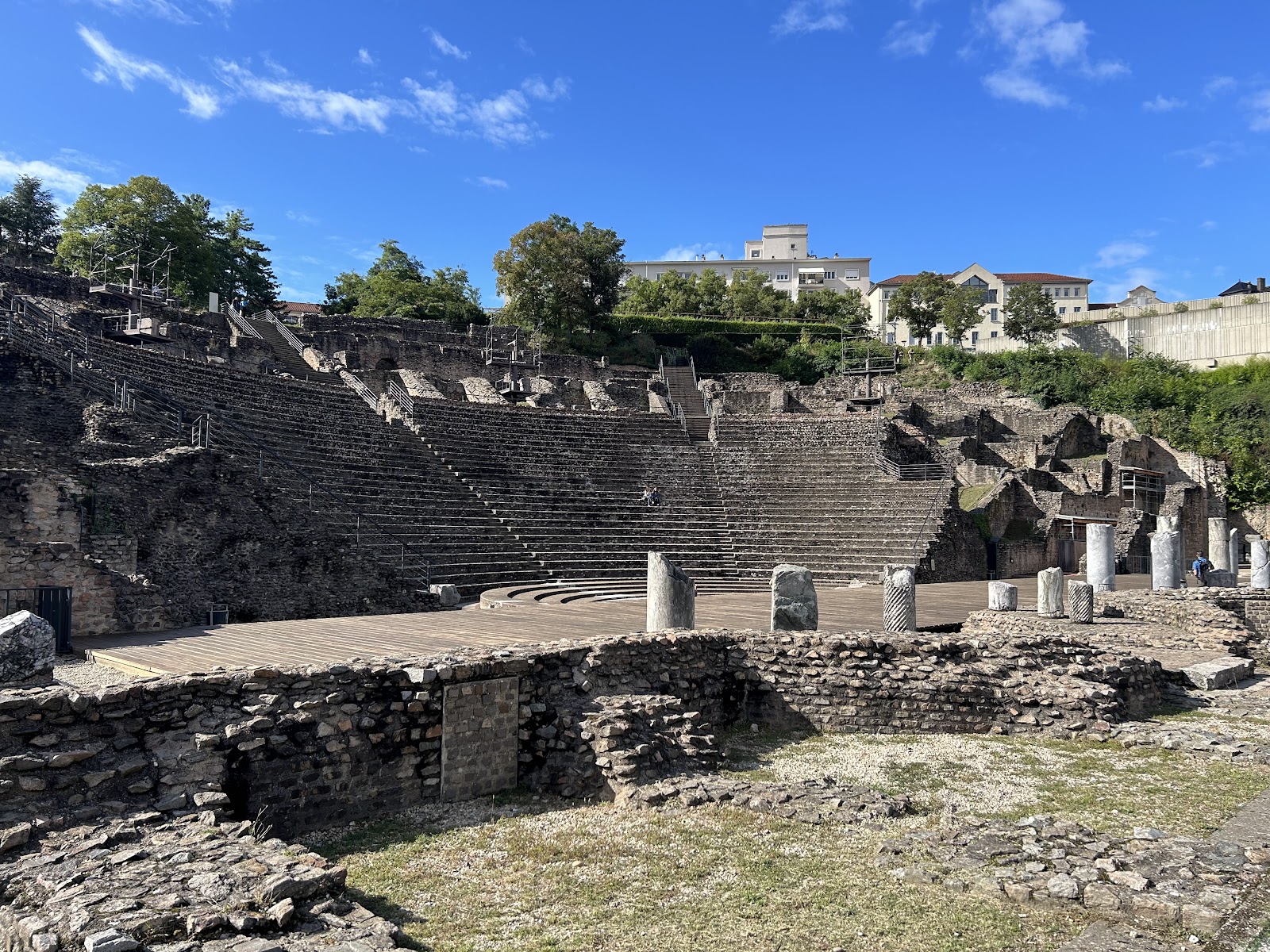
The Grand Theatre went up around 15 BC, with an initial diameter of 90 metres. By the early 2nd century it had been expanded to 108 metres and could seat 10,000 — a scale that puts it alongside the theatres of Vienne and Autun as among the largest in the western Empire. The Odéon, probably built under Hadrian, followed in the same century.
From the 3rd century onwards, Fourvière declined and the monuments were quarried for stone, eventually disappearing under vegetation. They were classified as historic monuments in 1905, but serious excavation only began in 1933, when archaeologist Pierre Wuilleumier and mayor Édouard Herriot — who used the project to employ workers during the economic crisis — started uncovering what the hill had swallowed. Archaeologist Amable Audin completed the Odéon excavation between 1953 and 1958. The first post-antiquity performance followed in 1946: Aeschylus's *The Persians*. The Nuits de Fourvière festival, born that same year, now draws over 130,000 spectators each June and July.
Good to know
Take the funicular from Vieux Lyon to Minimes–Théâtres Romains — it's on the standard TCL ticket and drops you four minutes from the entrance. The theatres themselves are free and open year-round. The adjacent museum charges a separate entry fee. Pack water; the ruins offer little shade.
Summer brings full sun to the exposed stone terraces, so mornings are considerably more comfortable than afternoons in July and August. In winter the theatres stay open but the festival is long gone — you'll have the gradins largely to yourself.
Where is Théâtres Romains de Fourvière?
More tickets & tours for Théâtres Romains de Fourvière
Book directly at the provider
What travellers say about Théâtres Romains de Fourvière
Roman Theatre of Fourvière is an ancient Roman amphitheatre located on Fourvière Hill in Lyon, adjacent to the modern city’s historic core. It is part of the archaeological site of Lugdunum, which preserves significant remnants of Roman-era urban life. The theatre dates back to the 1st century AD and was used for performances, public gatherings, and cultural events. Today, it remains remarkably well-preserved and is still actively used during the annual Nuits de Fourvière festival, hosting concerts, theatre, and cultural performances. The site is open to visitors and offers free access to much of the ruins, allowing close exploration of the stone seating areas and stage structure. Its elevated position also provides panoramic views over Lyon. Overall, it is one of the most important historical landmarks in the city, combining archaeological value with ongoing cultural use.
It’s free to enter the theatre part and it’s open 24x7. At night it lights up and it looks a lot more impressive than during daytime. The most impressive part was the original road that was more than 2000 years old that you get to walk on. Not suitable for disabled people with wheelchair. Elderly people needs to be careful as the rocky paving Road is very uneven to walk on. The future of the city is very impressive
Interesting spot but too much of it has modern adaption which kind of spoils the experience. There are nice spots to take pictures of the city below. The adjacent museum has a nice selection of artifacts.
A nice historical place to visit. Worthy to walk up stairs to see the views of not just this place itself but also the city and its surroundings. Historic learning is also another plus point.
A place to marvel, was for the community back then, still is now (so I heard). Will be wonderful to be part of activities here, but even just a quick stop on the way back from the Basilica already gave me glimpses of stories this awesome place has. Basking in the morning sun, this open air theater sure is special. Do visit the museum if you have the chance.
More of Lyon
Discover where to stay, what to do and the best deals for your trip.
Explore Lyon →More attractions in Lyon
All of Lyon →
Background adapted from Wikipedia (CC BY-SA) · map data © OpenStreetMap contributors · ratings & place photos via Google · other photos with per-image credit. Ticket links may earn us a commission at no extra cost to you.