
Tempelhof
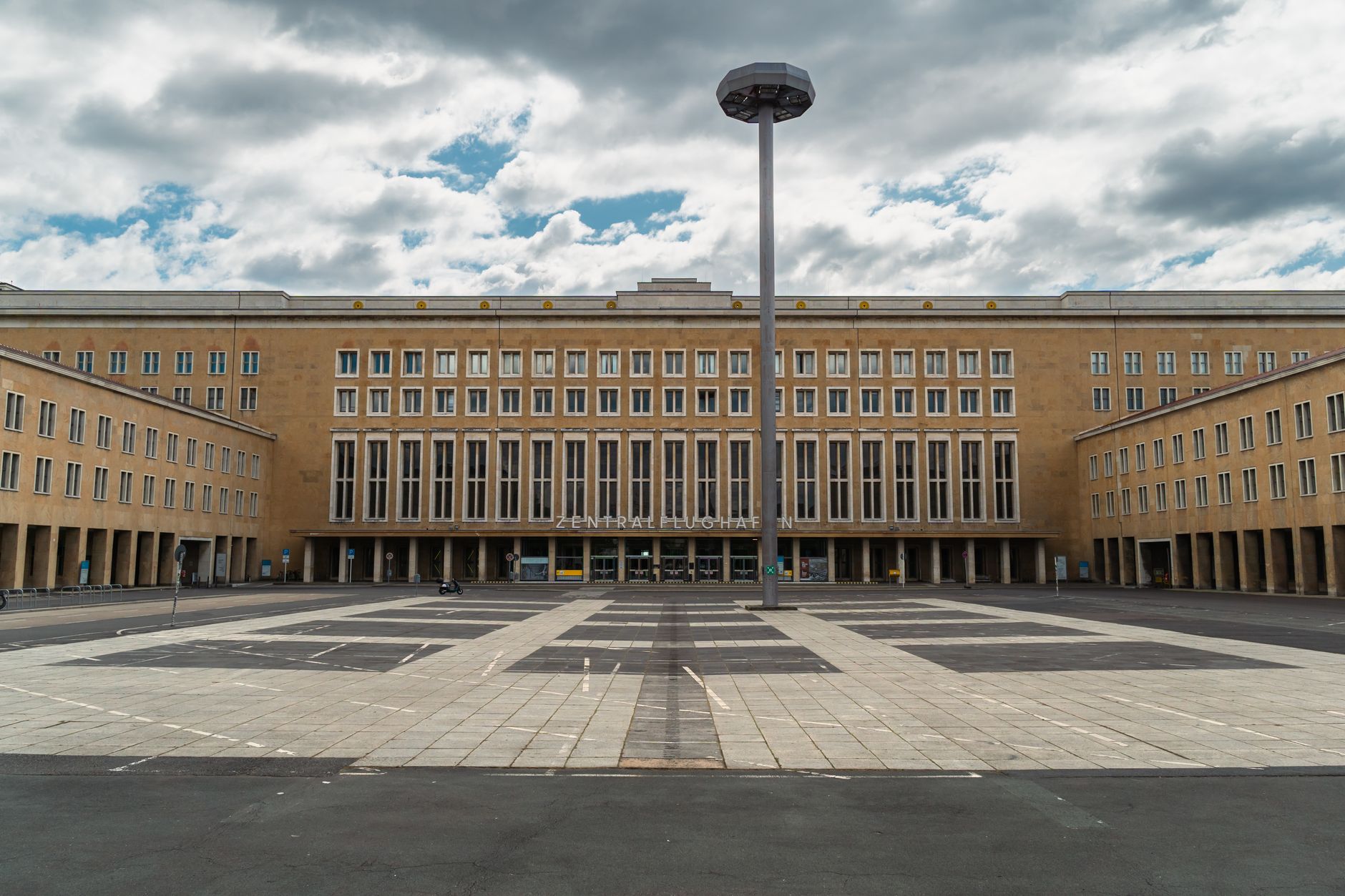
Stand at the edge of Tempelhofer Feld on a Sunday afternoon and you will see Berlin doing what it does best: taking something enormous and repurposing it without apology. The runways are still there, cracked at the edges, and people skate and cycle and barbecue on them while skylarks nest between the taxiways in spring. The terminal building — a 1.2-kilometre curve of shell limestone that Norman Foster once called 'the mother of all airports' — closes the northern horizon like a cliff face.
This is the former Tempelhof Airport, closed in 2008 and handed back to the city as 386 hectares of flat, open sky. It is one of the few places in Berlin where you can stand in the middle and see nothing but grass and air in every direction.
💛 What travellers fall for
People who come back tend to time it carefully. The field closes between the runways from late March through July to protect ground-nesting skylarks — worth knowing before you plan. The CHECK-IN Visitor Center on Platz der Luftbrücke is a reliable starting point; the two-hour guided tour through the terminal's 9,000 rooms is the part most repeat visitors say they underestimated.
Deals in Tempelhof
Book directly at the provider
How Tempelhof came to be
The land has been in use for longer than the airport suggests. A 1247 deed records it as a Komturhof — a commander's court of the Knights Templar — and Friedrich Wilhelm I turned it into a parade ground in 1722. Flight arrived early: an airship detachment in 1887, Orville Wright demonstrating a biplane here in 1909, and official airport designation on 8 October 1923. Deutsche Luft Hansa was founded at Tempelhof on 6 January 1926.
The terminal you see today was designed by Ernst Sagebiel and built between 1936 and 1941, its scale a deliberate statement of the regime that commissioned it. After the war it became the stage for the 1948–49 Berlin Airlift, when Western Allied aircraft supplied the blockaded city through this single airport. The building has been a listed monument since 1995. A darker footnote: the Columbiahaus on the field's northern edge served as the only official SS concentration camp on Berlin city territory after May 1933.
Who and what shaped it
People who shaped it
Landmark buildings
See Tempelhof in motion
Plan your visit
On the map
When to go
Summers run warm — around 23–25°C in June through August — and the flat, open field offers no shade, so bring water and a hat. Winters are cold and can be snowy, with temperatures near freezing from December through February; the field stays open but the experience is a different one entirely.
Right now
Background & history adapted from Wikipedia (CC BY-SA) · specs from Wikidata (CC0) · weather from Open-Meteo · map data © OpenStreetMap contributors · photos from Wikimedia Commons / Unsplash with per-image credit. No third-party reviews or social posts reproduced.