
Synagogue of Santa María la Blanca

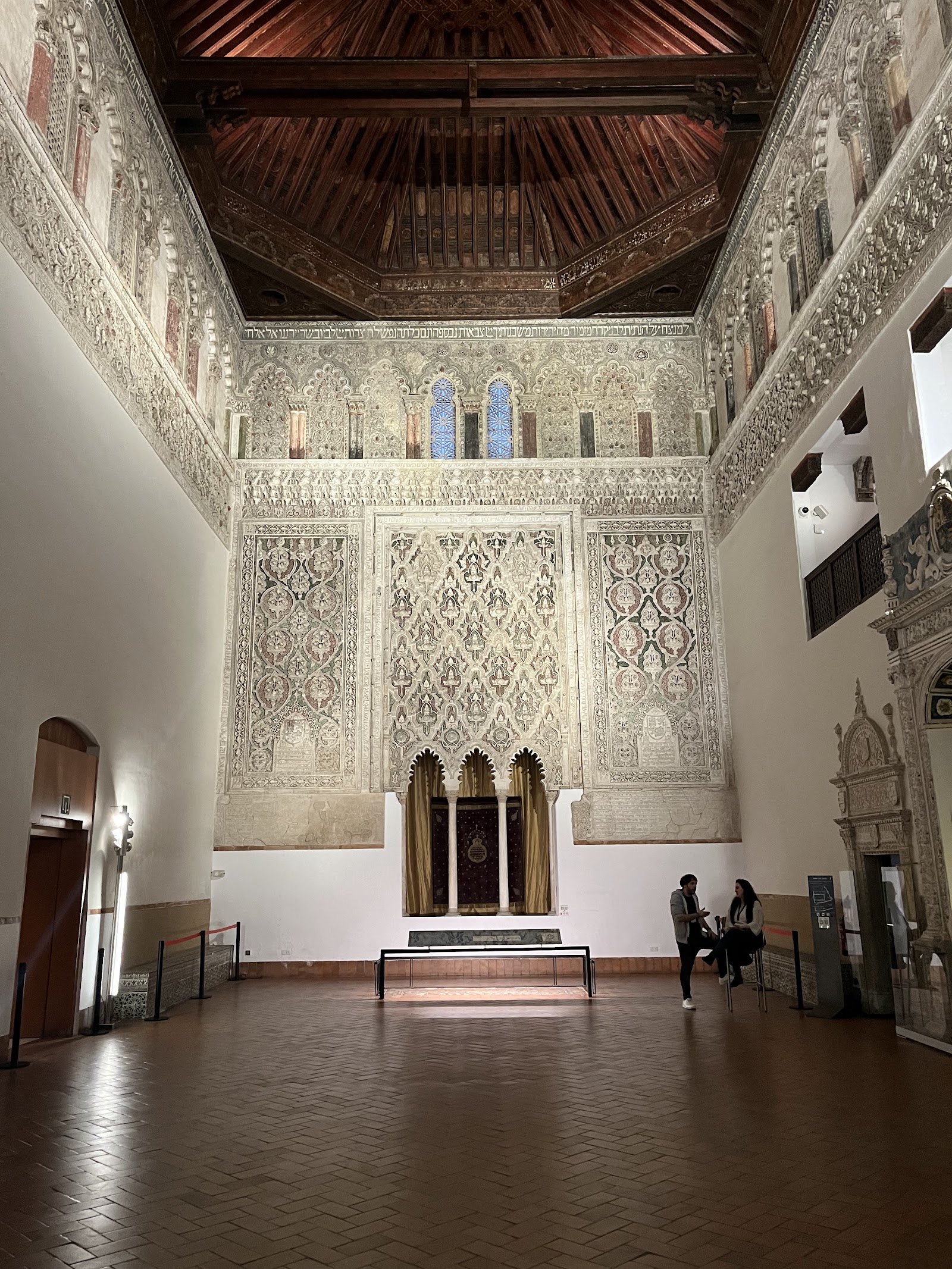
The first thing you notice inside Santa María la Blanca is the forest of octagonal piers — twenty-four of them, pale and close-set, their horseshoe arches repeating down five aisles like a held breath. The capitals are carved with pinecones and leaves, Mudéjar work so precise it reads as ornament rather than structure.
What makes the building quietly strange is what it has been: a Jewish synagogue, a Catholic church, a military storehouse, and now a museum — each chapter leaving its mark without quite erasing the one before. The coffered wooden ceiling and the Plateresque altars are still here, layered over the original Moorish geometry.

💛 What travellers fall for
People who come back tend to arrive on a Sunday afternoon, when entry is free from 15:00 and the crowds have thinned after lunch. The north-facing entrance is worth pausing at — it was a deliberate choice, orienting the building away from both Christian east and Muslim Mecca. That detail alone changes how you read everything inside.
The story behind Synagogue of Santa María la Blanca
Around 1205, a Toledo Jew named Joseph ben Meir ben Shoshan — son of a finance minister to King Alfonso VIII of Castile — is believed to have commissioned the building, his epitaph upon death that year referencing a synagogue he had built. Moorish craftsmen raised it in Mudéjar style, one of only three such synagogues surviving from the Christian Kingdom of Castile.
The building's later history arrived violently. The pogroms of 1391 and the anti-Jewish preaching that followed left the Jewish quarter of Toledo changed beyond recovery. The synagogue was sacked and appropriated by the Catholic Church, consecrated as a church in the early fifteenth century, and eventually transferred to the Order of Calatrava. It was listed as a Bien de Interés Cultural in 1930. Since 2013, the archdiocese has spent around €800,000 on conservation.

Good to know
Entry is €4; free Sunday afternoons from 15:00. Children under 10 enter free. The Toledo Monumental wristband (€14) covers seven sites and makes sense if you're spending a full day in the old city. Audioguides cost extra but are available in six languages. Photography is allowed without flash.
Where is Synagogue of Santa María la Blanca?
More tickets & tours for Synagogue of Santa María la Blanca
Book directly at the provider
What travellers say about Synagogue of Santa María la Blanca
What an beautiful architecture. I was amazed with the simplicity and grace of the interior. It's one of the best places to remember from my current trip.
Stunning church no longer in daily use only for events.. this church is included in the special group wrist band, make sure you get ahead of time to see it. The synagogue is located in the former Jewish quarter of the city between the Monastery of San Juan de los Reyes and the Synagogue of El Tránsito. It is one of three preserved synagogues constructed by Jews in a Mudéjar or Moorish style under the rule of the Christian Kingdom of Castile. In 1930, the building was added to the list of monuments of Spanish Cultural Heritage
Worth a stop to take in the architecture. The synagogue is located in the former Jewish quarter of the city between the Monastery of San Juan de los Reyes and the Synagogue of El Tránsito. It is one of three preserved synagogues constructed by Jews in a Mudéjar or Moorish style under the rule of the Christian Kingdom of Castile. In 1930, the building was added to the list of monuments of Spanish Cultural Heritage.
Pretty interior but not much to see. Very minimal information and only in Spanish. Not worth 4 euro. Much preferred the monastery of San Juan down the street for the same price! Way more to see there
Not a special place at all. The entrance costs 4€, 3€ for students, but the inside is absolutely not worth it, as the sinagogue doesn't possess any particular feauture or beauty. In addition, on average the visit shouldn't take more than 5 minutes, considering the latter is still a generous time. To conclude, my opinion would be to let people not pay at all for such a place, a free offer would be enough.
More of Toledo
Discover where to stay, what to do and the best deals for your trip.
Explore Toledo →More attractions in Toledo
All of Toledo →

Background adapted from Wikipedia (CC BY-SA) · map data © OpenStreetMap contributors · ratings & place photos via Google · other photos with per-image credit. Ticket links may earn us a commission at no extra cost to you.