
Sea Point

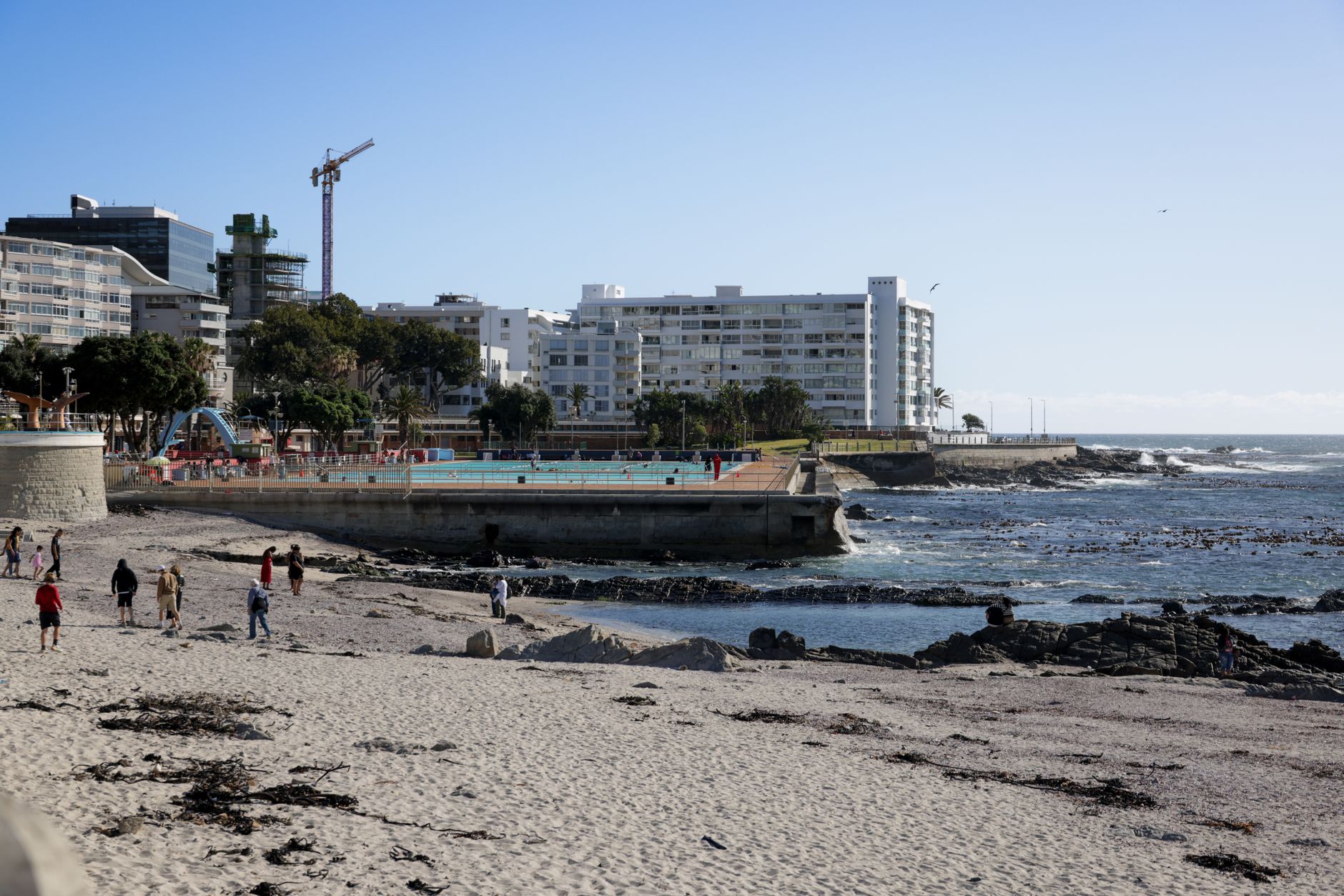
The Mouille Point lighthouse has been burning since 1824, and on a clear morning its red-and-white column is the first thing you see as you turn onto the Sea Point promenade. The seawall beneath your feet was laid in the early 1920s to hold back the Atlantic, and it still does — the ocean here is cold, green, and indifferent to swimmers, which is why the Pavilion pool, opened in 1914 and rebuilt in Art Deco concrete in the 1950s, remains the smarter choice.
Sea Point is a long, narrow strip of apartment blocks and beach-facing restaurants wedged between Lion's Head and the South Atlantic. Main Road runs its spine with coffee shops, Jewish delis, and late-night restaurants; Beach Road faces the sea. The promenade connecting them to Bantry Bay in one direction and Mouille Point in the other is about seven kilometres of democratic pavement — joggers, dog walkers, skaters, and people eating ice cream in February heat all sharing the same narrow strip.
💛 What travellers fall for
People who come back regularly tend to arrive at the Pavilion early, before the school groups. They also mention the Hebrew congregation on Marais Road as a marker for the neighbourhood's texture — the kosher delis and bakeries nearby are worth a detour even if you're not observant. The promenade is best at dusk when the Cape Doctor has blown itself out.
Deals in Sea Point
Book directly at the provider


How Sea Point came to be
The name dates to 1776, when a naval commander encamped his men on this stretch of Atlantic coast to keep them clear of a smallpox epidemic sweeping Cape Town. Permanent settlement came slowly — François Le Sueur, a Huguenot from Bayeux, had arrived as early as 1739, and European families followed through the early 1800s. By 1862 a tramline ran to Camps Bay; by 1905 the railway had arrived from Cape Town. The 1875 census counted 1,425 residents shared with Green Point; by 1904 that figure had risen to 8,839.
The liberal parliamentarian Saul Solomon — founder of the Cape Argus and a persistent opponent of racial inequality — shaped much of the suburb's 19th-century character. His legacy sits uneasily alongside what came later: under the Group Areas Act, a forced-removal order issued in 1957 displaced all non-white residents to the Cape Flats by 1961. The repeal of that act in 1991 began a slow return to something more mixed, and the neighbourhood today reflects that layered, unresolved history as much as it does its promenade and pool.
Who and what shaped it
People who shaped it
Landmark buildings
See Sea Point in motion
Plan your visit
On the map
When to go
Summers (December to February) are dry and bright, peaking around 22°C in February, though the Cape Doctor — a strong southerly wind — keeps afternoons brisk even in full sun. Winters are mild by most standards but genuinely wet, with June the soggiest month; if you're here then, the promenade empties out and the city feels like a different place entirely.
Right now
Background & history adapted from Wikipedia (CC BY-SA) · specs from Wikidata (CC0) · weather from Open-Meteo · map data © OpenStreetMap contributors · photos from Wikimedia Commons / Unsplash with per-image credit. No third-party reviews or social posts reproduced.