
Sagrada Família
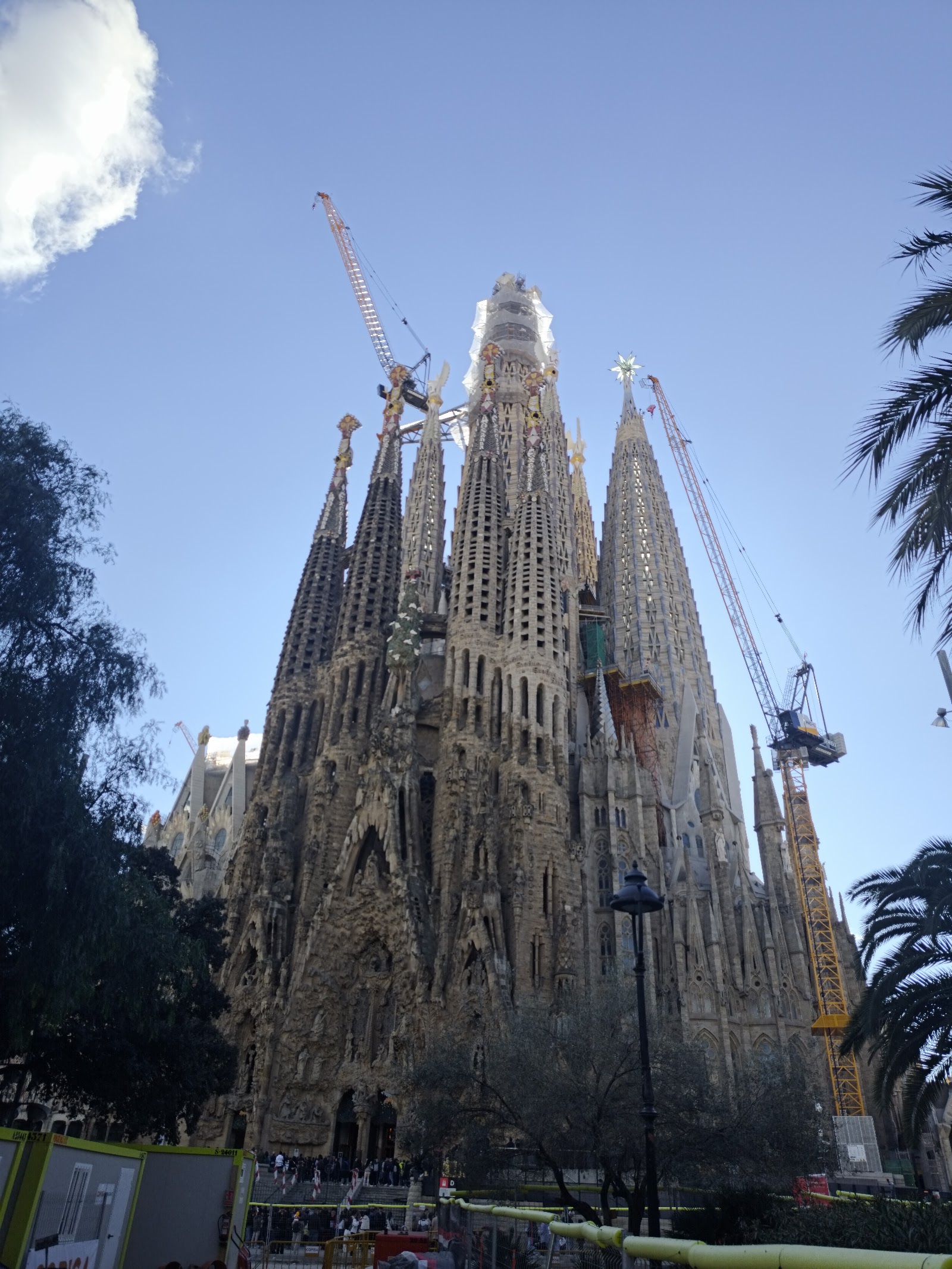
Stand at the Nativity façade and look up: stone drips like wax, towers dissolve into crosses, and somewhere above you a crane is still at work. Sagrada Família has been under construction since 1882 and is now, finally, approaching its end — the Jesus Christ tower reaches 172 metres, making it the tallest church on earth.
This is not a ruin or a relic. It is a living building, funded entirely by ticket sales and donations, consecrated by Pope Benedict XVI in 2010, and still being finished. The gap between what Gaudí drew and what his successors are building is one of the more absorbing arguments in architecture.
💛 What travellers fall for
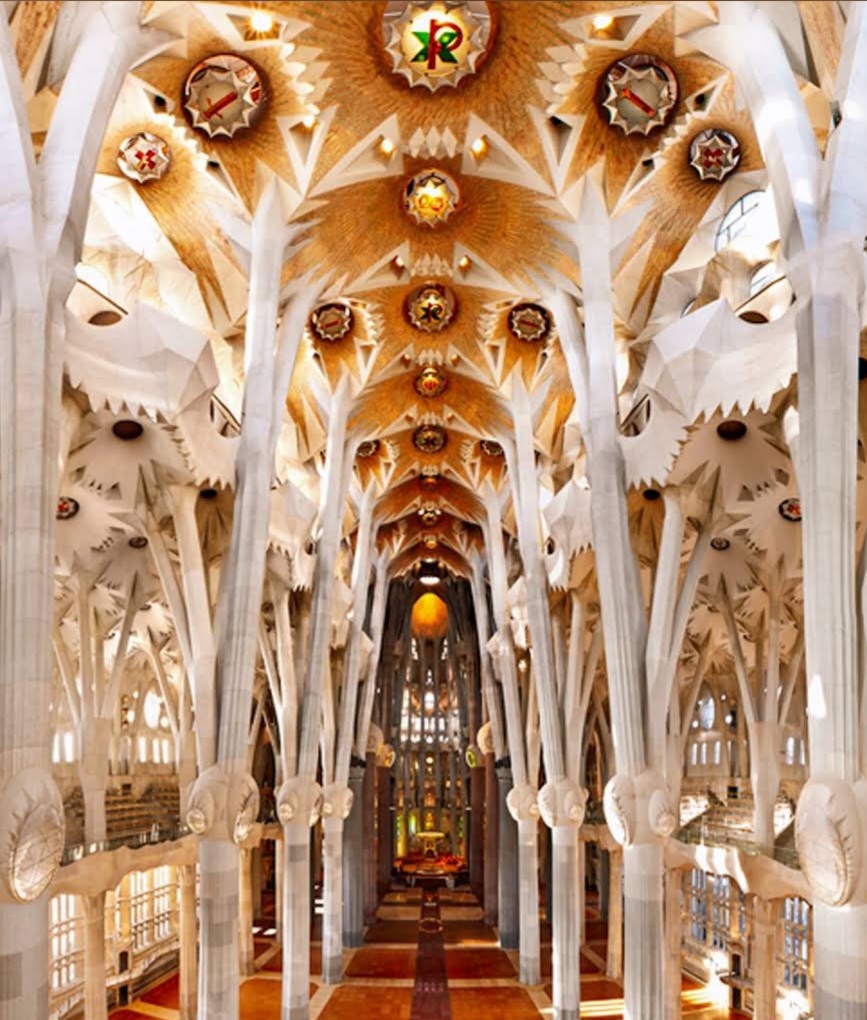
People who return tend to pick one façade and stay with it. The Nativity side, on c/ de la Marina, rewards slow looking — flora, fauna, faces worked into every surface. The Passion façade, by sculptor Josep Maria Subirachs, is starker, almost brutal. Come back at different hours: the interior light shifts completely as the sun moves.
The story behind Sagrada Família
A bookseller named José María Bocabella founded the Asociación Espiritual de Devotos de San José after a Vatican visit in 1872 and commissioned a church. Francisco de Paula del Villar laid the cornerstone on 19 March 1882, working in a conventional Neogothic style. Antoni Gaudí took over in 1883 and redirected everything — organic forms, symbolic towers, a Latin cross plan with columns shaped like branching trees.
Gaudí died in 1926, struck by a tram. He is buried in the crypt. Much of his documentation was destroyed during the Spanish Civil War, leaving successors to interpret and extrapolate. Domènec Sugranyes continued the work; sculptor Josep Maria Subirachs joined in 1986 for the Passion façade; Jordi Faulí assumed direction in 2012. The Nativity façade and crypt were designated a UNESCO World Heritage Site in 2005. Completion is expected in 2026, the centenary of Gaudí's death.
Good to know
Take Metro L2 or L5 to Sagrada Família. Book tickets online, often two months or more ahead — they sell out routinely. Adding a tower visit extends your time to around three hours. Re-entry is not permitted on the same ticket. Sunday international masses are free but seating is limited.
Where is Sagrada Família?
More tickets & tours for Sagrada Família
Book directly at the provider
What travellers say about Sagrada Família
This was more than I expected it to be. Our tour was amazing! If you can, book a tour. Our guide was very passionate and knowledgeable about the basilica. Initially, I thought I knew what we were getting into but quickly found out I had no clue. On top of this being an immense building project, it is also filled with symbolism. Everything in the cathedral has a declarative and deliberate purpose, nothing is random. Also, there is a fantastically assembled museum under the church. Don’t miss out on this amazing experience.
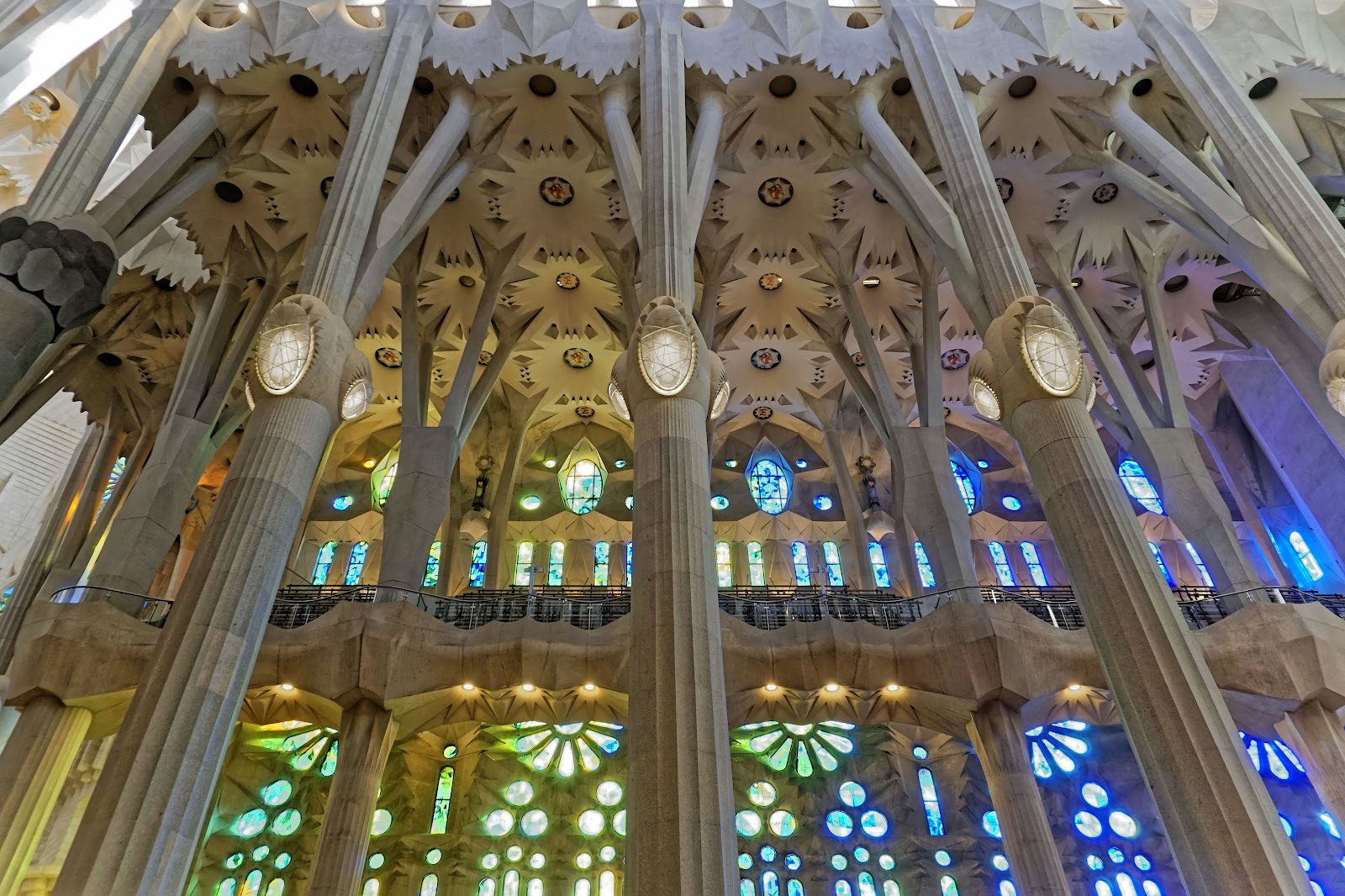
Make sure to reserve your ticket at least three weeks in advance. Otherwise, you may have to buy a secondhand ticket like I did, which cost almost twice as much. That said, this is absolutely a MUST-GO and the reason why you're in Barcelona. Just know that the theme of the cathedral is a forest, and once you step inside, you can genuinely feel it. The columns and light make it feel as though you are standing beneath a canopy of trees. It is hard to put into words how someone could design such a masterpiece, and how beautifully that vision has been carried out in the building itself.
Been living in this city for 3 years and got the chance to visit this year only. Get the audioguide and walk through Sagrada. Beautiful experience, the history and meanings thoroughly explained. In the end, don’t forget to enter the museum downstairs. Overall, beautiful experience. A tip: buy the tickets from the official app, it costed around 26-28 euros.
30-Minute Tour Guide – Basílica de la Sagrada Família 0–5 mins: Nativity Façade (East side) Start at the most detailed and artistic façade. Admire the intricate carvings depicting the birth of Christ—this side reflects Antoni Gaudí’s original vision. 5–10 mins: Exterior Walk Around Walk along the perimeter toward the Passion Façade. Observe the contrast in styles—modern, minimalistic sculptures representing the crucifixion. 10–15 mins: Enter the Basilica Interior Step inside and take in the breathtaking columns resembling a forest. Look up at the ceiling and enjoy the play of light through the stained glass windows. 15–20 mins: Stained Glass & Nave Pause in the central nave. The colored light changes across the day—warmer tones on one side, cooler on the other—creating a unique atmosphere. 20–25 mins: Passion Façade (West side) Move to the Passion side and observe the dramatic, angular sculptures telling the story of Christ’s suffering. 25–30 mins: Souvenir / Exit Area & Reflection Spot Finish near the exit or surrounding gardens. Take a moment to capture final photos and enjoy the view of the basilica from outside. ⸻ Quick Tips * Book tickets in advance to save time * Early morning or late afternoon for best light * Spend a moment just observing—details are everywhere A compact but rich experience covering architecture, symbolism, and best viewpoints in 30 minutes.
La Sagrada Família is one of those places that genuinely leaves you speechless in person. Photos do not fully capture the scale, detail, and atmosphere of the architecture. Every side of the basilica has different artistic details, and the closer you look, the more you notice. The interior was the highlight for me. When sunlight enters through the stained glass windows, the entire space fills with colors and creates an almost surreal feeling. It feels peaceful, artistic, and massive at the same time. Even if you are not deeply interested in architecture, the creativity and vision behind the structure are impressive. Knowing that construction has continued for generations makes the experience even more special. A few tips: • Book tickets online in advance because queues can get very long. • Morning or late afternoon light makes the stained glass look incredible. • Spend time walking around the exterior before entering — every façade tells a different story. • Audio guides are worth it if you want to understand the symbolism and history. Definitely one of the most unforgettable landmarks in Europe and a must-visit in Barcelona.
More of Barcelona
Discover where to stay, what to do and the best deals for your trip.
Explore Barcelona →More attractions in Barcelona
All of Barcelona →
Background adapted from Wikipedia (CC BY-SA) · map data © OpenStreetMap contributors · ratings & place photos via Google · other photos with per-image credit. Ticket links may earn us a commission at no extra cost to you.