
Pontresina
The name gives it away, if you know your Latin: Pontresina means 'bridge of Saracenus', a medieval landowner whose crossing over the river mattered enough to outlast him by nine centuries. The village sits at the mouth of the Roseg valley in the Engadin, a little quieter than St. Moritz ten minutes down the rail line, and it has been receiving guests since 1850 — the same year Johann Coaz stood on the summit of Piz Bernina, the highest point in the Eastern Alps.
What distinguishes Pontresina from its neighbours is a kind of layered seriousness. The Mountain Guide Association was founded here in 1871. Richard Strauss drafted passages of 'Elektra' and 'Der Rosenkavalier' at the Hotel Saratz. The frescoes inside the Church of Santa Maria date to the 12th century. The place has been earning attention for a long time.
💛 What travellers fall for
Regulars tend to mention the same few things: breakfast at the Kronenhof before anyone else is up, the Roseg valley walk when the light is low, and the frescoes in Santa Maria — which reward a second look after you've spent a night here and slowed down enough to actually see them.
Deals in Pontresina
Book directly at the provider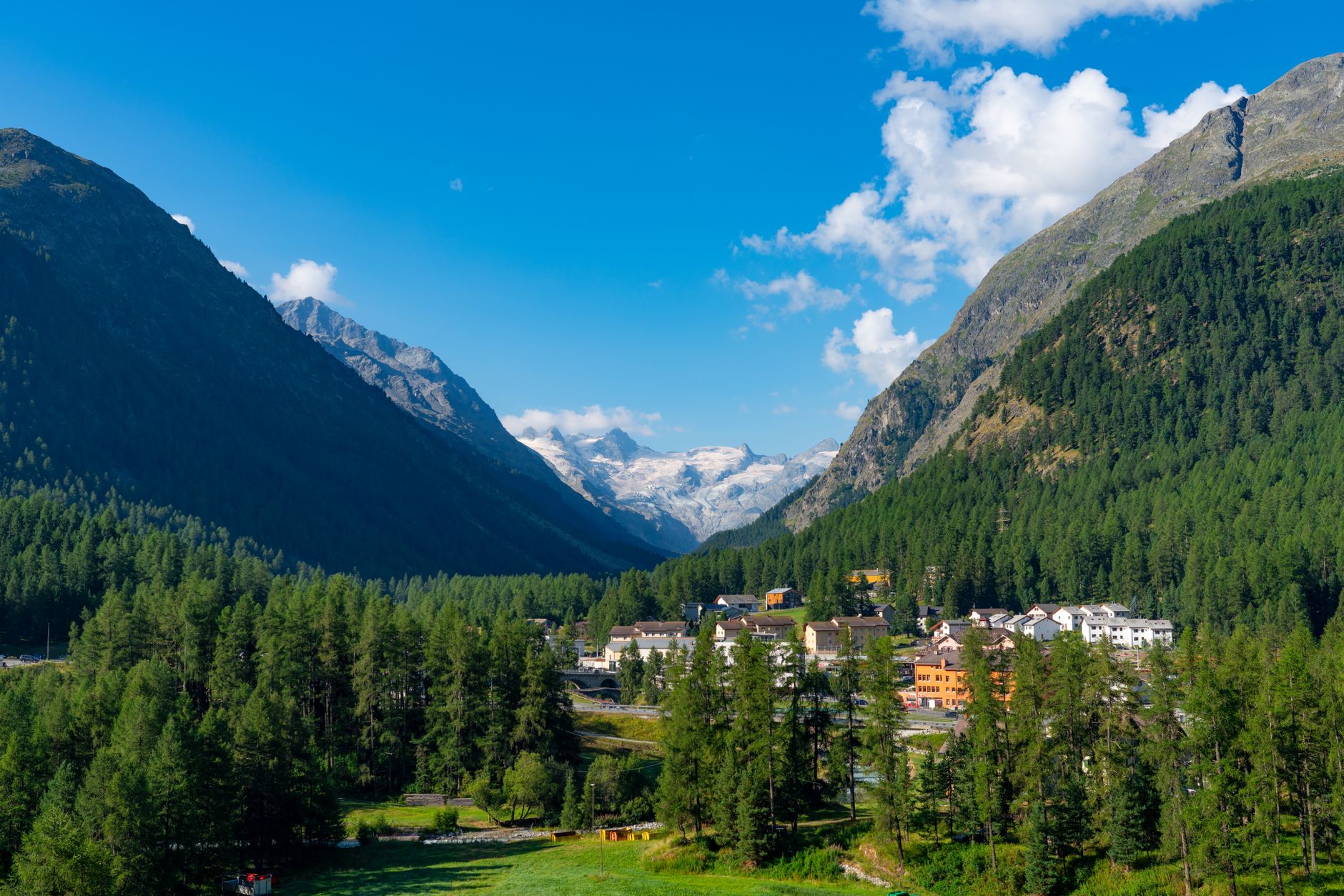
How Pontresina came to be
The first written record of Pontresina appears in 1137 — 'ad Pontem Sarisinam' — and for much of the medieval period it outranked St. Moritz as the more significant settlement in the valley. A major fire at the turn of the 18th century erased most of that earlier fabric, which is why the Church of Santa Maria, with its 12th-century tower and Byzantine-Romanesque frescoes, feels so remarkable: it survived.
The modern resort took shape quickly. The first inn opened in 1850; by 1865 Gian Saratz had expanded his family's house into a proper hotel. The Bernina Railway arrived in 1908, connecting the village to Chur and eventually to Tirano in Italy, and the guests kept coming — among them Wilhelm Conrad Röntgen, the physicist, and Richard Strauss, who found the altitude agreeable for composition.
Who and what shaped it
People who shaped it
Landmark buildings
See Pontresina in motion
Plan your visit
On the map
When to go
Winters are genuinely cold — January lows can reach -14°C — and February is the driest month if you're chasing clear skies on the slopes. Summer days in July average around 15°C, pleasant for walking, though August brings the heaviest rainfall of the year; pack accordingly.
Right now
Background & history adapted from Wikipedia (CC BY-SA) · specs from Wikidata (CC0) · weather from Open-Meteo · map data © OpenStreetMap contributors · photos from Wikimedia Commons / Unsplash with per-image credit. No third-party reviews or social posts reproduced.