
Place Masséna
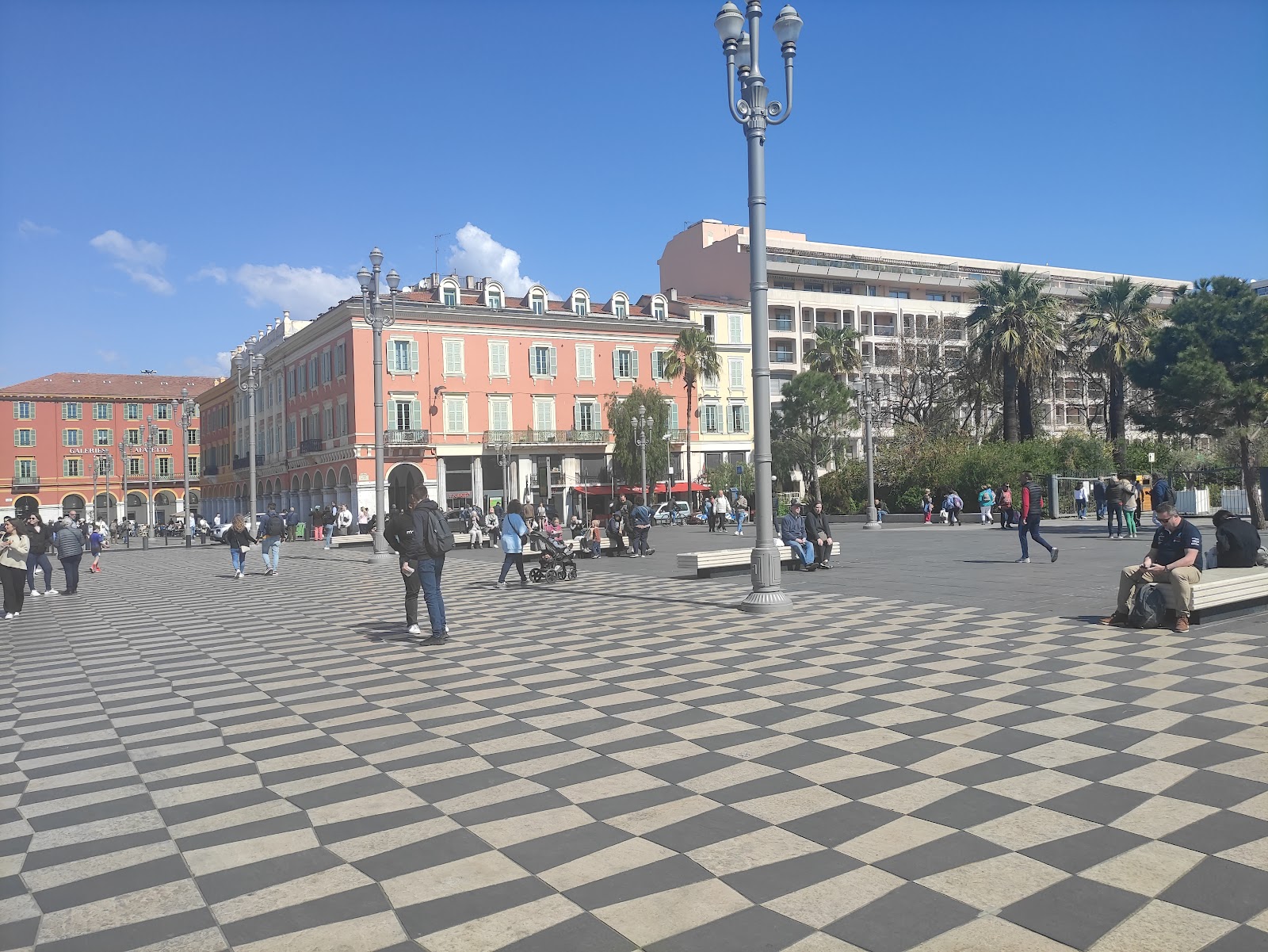
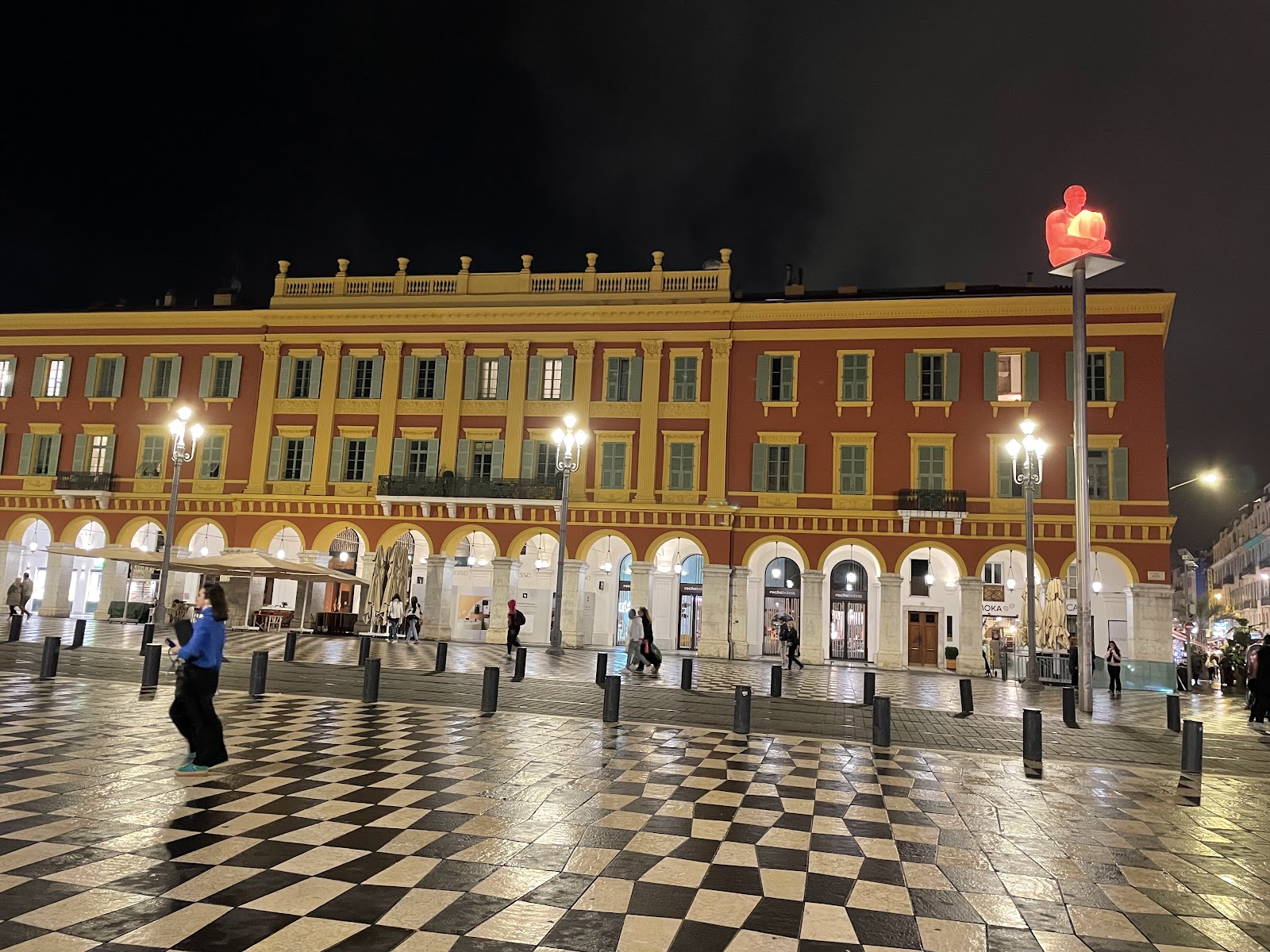
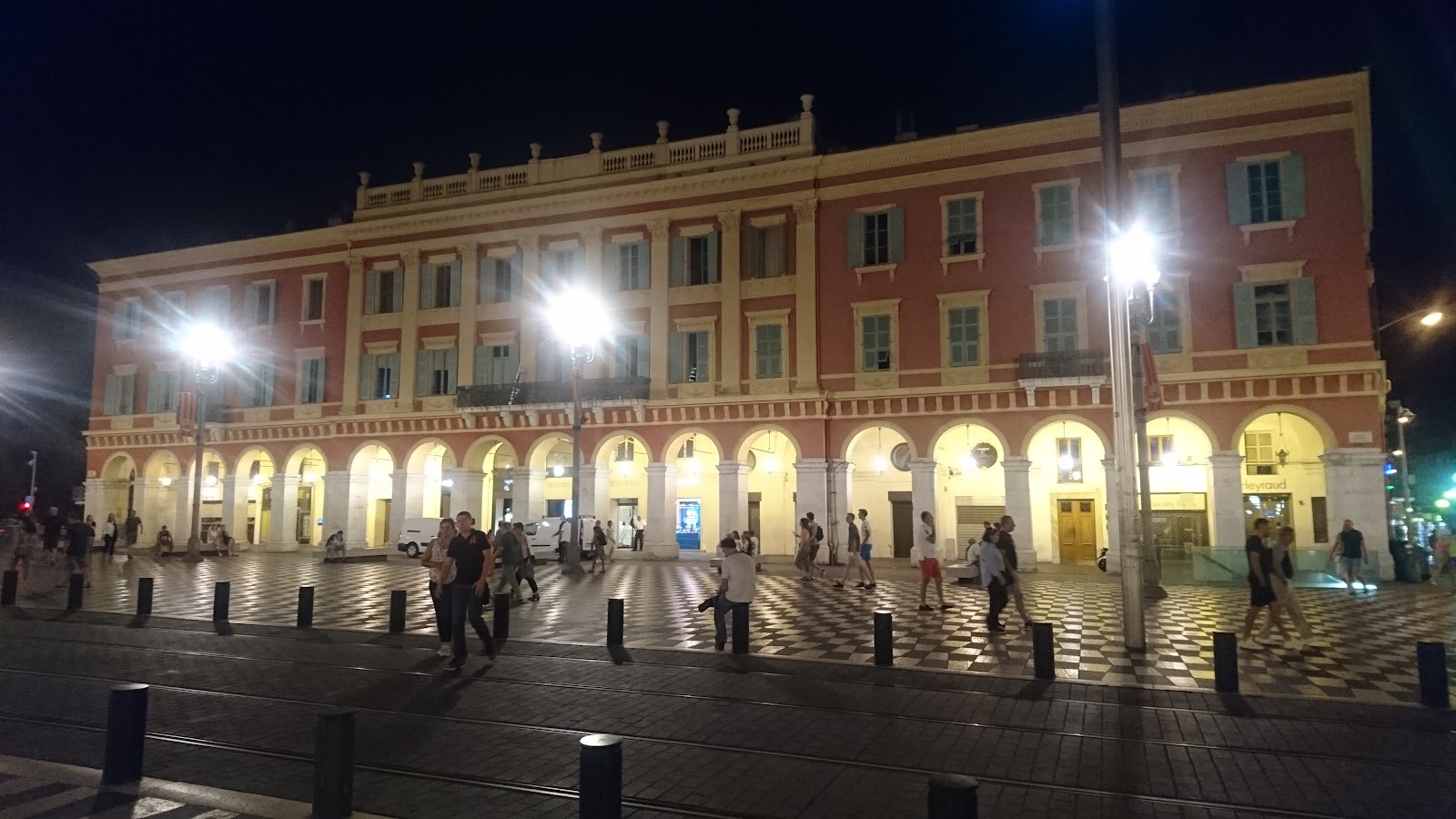
At the center of Place Masséna, seven white figures kneel on tall poles above the square — Jaume Plensa's 2007 installation, one figure for each continent, glowing and slowly shifting color after dark. During the day, the square belongs to palm trees, stone pines, and the black-and-white checkerboard pavement that catches the Mediterranean light. The red and ochre arcaded buildings framing the space were built from Pompeii stone, their deep porticos modeled on Rue de Rivoli in Paris — a detail that explains why the square feels both Italian and Parisian at once.
This is where Nice's two main shopping corridors meet: Avenue Jean Médecin to the north, Zone Pietonne to the south. The tram cuts through the center; otherwise, you walk. Late afternoon, when the apéro hour draws locals out, is when the square shows you what it actually is — less monument, more gathering point.
💛 What travellers fall for
People who come back tend to time their return for late afternoon, when the light hits the ochre facades at an angle and the café terraces under the arcades fill up. The checkerboard pavement photographs well at that hour too. After dark, stay long enough to watch Plensa's figures complete a full color cycle — it takes a few minutes and most people miss it by leaving too soon.
The story behind Place Masséna
The square took shape slowly. Work began in 1832 to cover the Paillon river, with Joseph Vernier designing the formal layout in 1843-44; construction ran until 1850. The river was covered further in stages — 1866 to 1868, then completed in 1883 — gradually creating the continuous pedestrian surface you walk across today. When Nice passed from the House of Savoy to France in 1860, Napoleon III visited and the square was formally named for André Masséna, a Nice-born brigadier general (1758-1817) who served under Napoleon Bonaparte.
The Fountain of the Sun, with its five bronze figures drawn from Greek mythology surrounding a seven-ton Apollo, was inaugurated in 1956 — though the Apollo itself was later moved to the entrance of Charles Ehrmann Stadium. The 2007 tram project, led by architect Bruno Fortier, brought the checkerboard pavement and Plensa's seven kneeling figures, the square's most recent and most photographed transformation.
Good to know
Tram Line 1 stops directly at Masséna; it's also a 15-20 minute walk from Nice-Ville station. The square runs 24 hours and costs nothing to enter. Summer evenings draw the biggest crowds; late spring and early autumn offer the same light with more room to move.
Summer (June through August) is hot, sunny, and almost entirely dry — the square bakes by midday, so the shaded arcades earn their keep. Spring and early autumn are the most comfortable for lingering outdoors. Winter is mild by northern European standards, averaging 7-13°C, with sunny stretches broken by occasional rain; the December Christmas market fills the square and makes the cooler temperatures easy to overlook.
Where is Place Masséna?
More tickets & tours for Place Masséna
Book directly at the provider
What travellers say about Place Masséna
Place Masséna is the vibrant heart of Nice. The combination of the stunning Fontaine du Soleil, the striking red architecture, and the black-and-white checkered pavement creates a unique atmosphere. It’s perfect for people-watching, taking photos, or just soaking in the energy of the French Riviera. A true landmark that you simply cannot miss!
When you arrive here you have to stand still, turn 360 degrees slowly, and take in the views and the atmosphere. A beautiful square, and on the day I visited there was a classic car rally. Wonderful.
Wow, it's a really wonderful square. If you walk a little further from here, you'll find the Christmas spot in Nice. The identical sculptures on the pillars were very interesting, and the surroundings were very beautiful. Even the fantastic weather helps us! This is why I can't help but love Nice.
We had the opportunity to visit during Carnival de Nice and it was a wonderful experience. We felt safe and everything was beautiful. The crowd was well behaved and the experience was excellent
Lovely place to sit and watch the world go by. Always busy and vibrant.
More of Nice
Discover where to stay, what to do and the best deals for your trip.
Explore Nice →More attractions in Nice
All of Nice →
Background adapted from Wikipedia (CC BY-SA) · map data © OpenStreetMap contributors · ratings & place photos via Google · other photos with per-image credit. Ticket links may earn us a commission at no extra cost to you.