
Palau Nacional / Museu Nacional d'Art de Catalunya
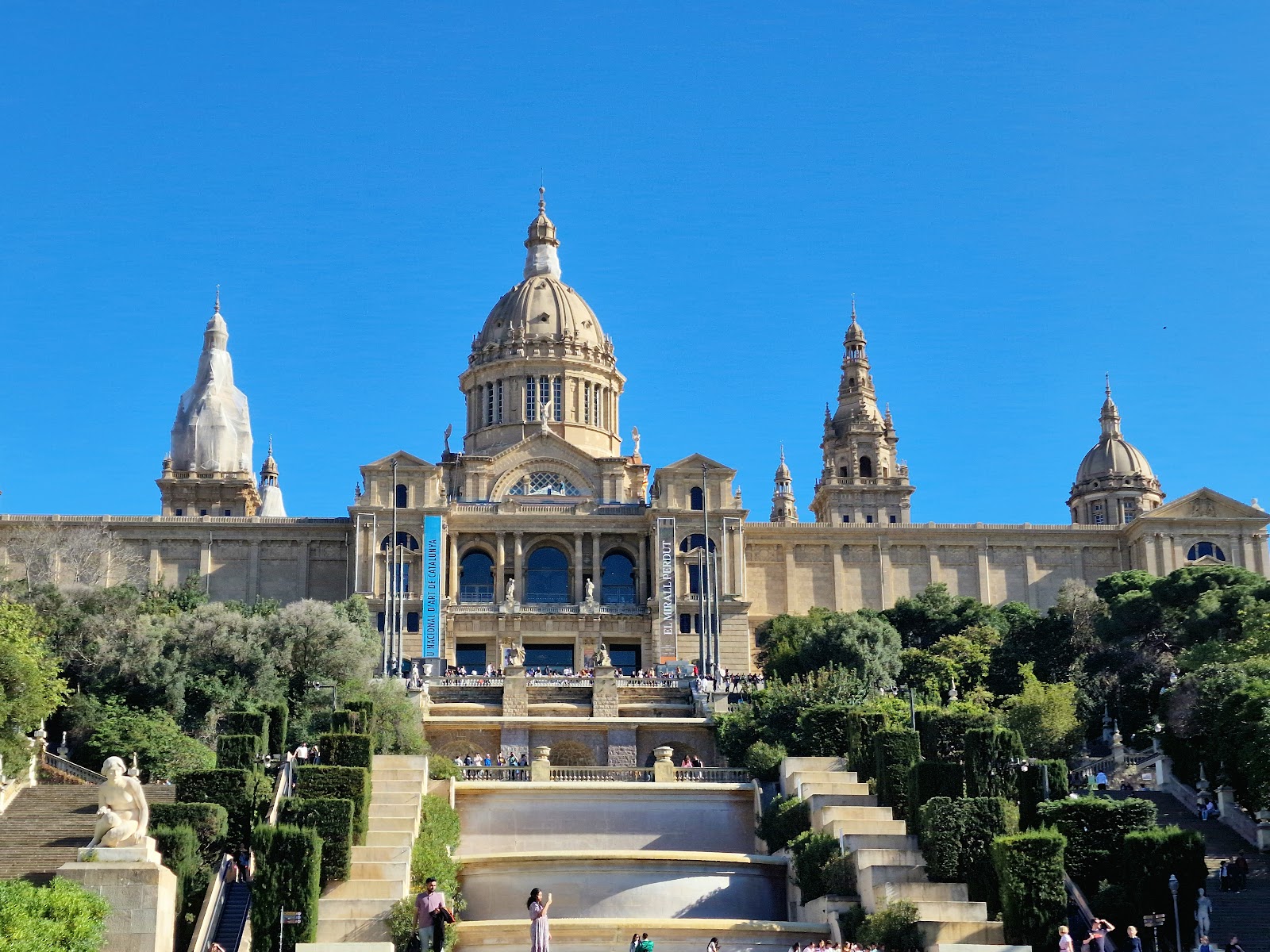
The Palau Nacional sits at the top of Montjuïc like a full stop at the end of a long sentence — its elliptical dome, modelled loosely on St Peter's in Rome, visible from much of the city below. You climb toward it along the Avinguda de la Reina Maria Cristina, past the monumental fountains that Carles Buïgas designed for the 1929 International Exposition, and by the time you reach the esplanade the whole of Barcelona is laid out behind you.
Inside, the Museu Nacional d'Art de Catalunya holds one of the world's great collections of Romanesque art — frescoes lifted intact from Pyrenean churches and reinstalled in curved apses that reconstruct their original settings. The building is the story and the container of the story at once.

💛 What travellers fall for
People who come back tend to time a late Saturday afternoon visit: free entry from 3pm, and if you linger on the terrace restaurant as the light drops, the Magic Fountain show starts below. The rooftop viewpoint — included in the regular ticket — is quieter than the esplanade and worth the extra flight of stairs.
The story behind Palau Nacional / Museu Nacional d'Art de Catalunya
The Palau Nacional was built for Barcelona's International Exposition of 1929, with its foundation stone laid on 30 June 1926. The design came from architects Eugenio Cendoya and Enric Catà, working under Pere Domènech i Roura, though the initial concept had been proposed by Josep Puig i Cadafalch as early as 1920. King Alfonso XIII presided over the inauguration on 19 May 1929. The building became the Museu d'Art de Catalunya in 1934, with Joaquim Folch i Torres as its first director.
Decades later, Italian architect Gae Aulenti — who had already transformed Paris's Gare d'Orsay into a museum — led the building's comprehensive remodelling alongside Josep Benedito. The Romanesque art galleries opened in December 1995, the Gothic section in July 1997, and the full museum reached its current form with a complete inauguration on 16 December 2004.

Good to know
Take Metro Line 1 or 3 to Plaça Espanya, then walk up through the Montjuïc escalators — about 10–15 minutes. Free entry every Saturday from 3pm and the first Sunday of each month (reserve online in advance). Closed Mondays, and on 1 January, 1 May and 25 December. Budget two to four hours.
Where is Palau Nacional / Museu Nacional d'Art de Catalunya?
More tickets & tours for Palau Nacional / Museu Nacional d'Art de Catalunya
Book directly at the provider
What travellers say about Palau Nacional / Museu Nacional d'Art de Catalunya
The Museu Nacional d’Art de Catalunya in Barcelona is an absolute must-visit for anyone interested in art, history, or architecture. The museum itself is breathtaking, housed in the impressive Palau Nacional on Montjuïc, offering incredible views over the city before you even step inside. The collection is outstanding, especially the Romanesque frescoes, which are unlike anything you’ll see elsewhere in the world. The Gothic, Renaissance, and modern art sections are also beautifully curated, giving a deep and well-rounded look at Catalan and European art history. The building is just as impressive as the artwork—grand halls, high ceilings, and spacious galleries make the experience feel calm and immersive, even when it’s busy. The rooftop terrace is a highlight, offering one of the best panoramic views of Barcelona. Staff were helpful and the layout is easy to navigate, making it enjoyable for both serious art lovers and casual visitors. Overall, the Museu Nacional d’Art de Catalunya is one of the cultural highlights of the city and well worth the visit.
I didn’t visit the museum itself, but I came to admire the beautiful architecture and the surrounding area. The building, square, fountains, gardens, and overall organization were all stunning. It was a very pleasant place to walk around and enjoy the atmosphere. Definitely worth a visit! A small tip: make sure to check the fountain operating hours before your visit. Seeing the fountains in action makes a huge difference and greatly enhances the experience. Otherwise, you might miss one of the most impressive parts of the site.
Beautiful museum. Really big, I like to roam and I didn't complete it. There are lots of different stuff, like paintings, furniture, ceramics, sculptures, so everyone can enjoy. And even if you don't like this type of art you can enjoy the bar or the rooftop that gives an amazing view of the city. There are some Miro and even a Picasso painting. I really enjoyed this museum. Moreover they have free entrances during specific dates so check the site in advance. They also had the original chat noir poster, I was really surprised too see it here
Our Cabify driver said that we should make the time to come here. We came on a whim after being on a Gaudi kick this whole trip that made this visit a true breath of fresh air. This museum is gorgeous, inside and out. Perfect for escaping the heat and enjoying the mirador AKA lookout point. I would say COME EARLY, so you can enjoy the museum, and the mirador with peace. I loved seeing the Gothic and Romanesque exhibit. This was my grandmother’s FAVORITE part of the trip, and it was the trip that I didn’t plan (it was spontaneous) -_- Also Seniors get to enter the museum for FREE. Please make time for this. It is worth seeing with your own eyes.
Wonderful museum and one of the cultural highlights of Barcelona 🏛️✨ The Museu Nacional d'Art de Catalunya has an excellent and very diverse collection, with especially impressive Modern and Modernist Catalan art. I greatly enjoyed the elegant paintings, decorative arts, posters, furniture, and the atmosphere of Catalan artistic culture from the late nineteenth and early twentieth centuries 🎨✨ The building itself is magnificent, with beautiful architecture and spectacular panoramic views over the city from the terraces 🌇 The Gothic and Romanesque sections are also interesting and historically important, though I was personally most impressed by the Modern art collections and the overall atmosphere of the museum. The terrace café was a very pleasant place to relax with a coffee ☕ after exploring the museum. The Oval Café is very nice, comfortable, and elegant, while the Absis restaurant offers very good food and wonderful views over Barcelona 🍽️✨ From the right side of the Oval Café, there is an elevator to the sixth floor rooftop walk with truly unparalleled spectacular panoramic views of Barcelona, Montjuïc, Plaça d’Espanya, and the surrounding hills 🌇✨ Absolutely worth visiting. Highly recommended for anyone interested in art, architecture, Catalan culture, or simply beautiful views of Barcelona 🎨
More of Barcelona
Discover where to stay, what to do and the best deals for your trip.
Explore Barcelona →More attractions in Barcelona
All of Barcelona →
Background adapted from Wikipedia (CC BY-SA) · map data © OpenStreetMap contributors · ratings & place photos via Google · other photos with per-image credit. Ticket links may earn us a commission at no extra cost to you.