
Padstow
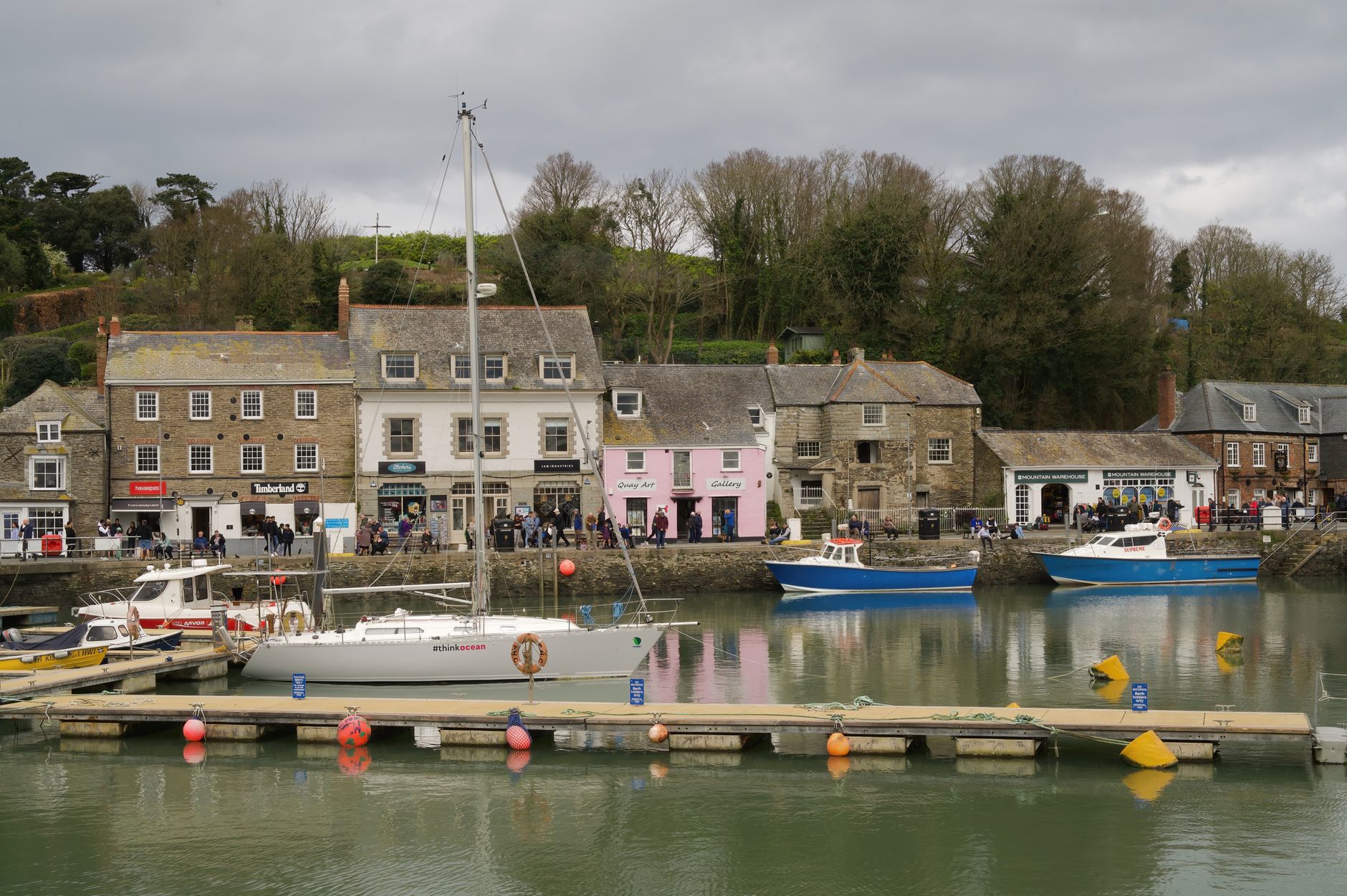
Stand at Padstow's inner harbour on a May morning and the whole town is already in motion — the Obby Oss, a creature of black canvas and ribboned hat, spinning through lanes that have carried this ritual since at least 1803. The estuary opens wide here, the Doom Bar visible at low tide, a sandbank responsible for some 600 strandings over two centuries and now lending its name to a beer sold far from Cornwall.
Padstow is a working idea of a place that tourism has complicated without quite ruining. The parish holds fewer than 2,700 people year-round, but half a million day visitors arrive annually, drawn by the harbour, the coast path, and a concentration of restaurants that traces back to Rick Stein's long presence on the waterfront.
💛 What travellers fall for
People who keep coming back tend to time it for the shoulder season — late September, when the Camel Trail is quieter and the estuary light turns amber by four. They take the passenger ferry to Rock for the crossing alone, not the destination. And they always find their way to the Golden Lion on Church Lane, a pub that has been in business since the 14th century.
Deals in Padstow
Book directly at the provider


How Padstow came to be
A Welsh monk named Petroc arrived from Ireland around AD 520 and founded a monastery at what was then called Lanwethinoc — the place that would eventually take his name, corrupted through centuries into Padstow, from 'Petroc's Stow'. The monastery didn't survive: Viking raiders destroyed it in 981. The church rebuilt in its wake, St Petroc's, still stands in the town centre, its present structure dating to the 13th and 14th centuries, with a font from the 1400s and a pulpit carved around 1530.
The Prideaux family, here since the Norman Conquest, built their Elizabethan manor — Prideaux Place — in 1592, and their descendants live there still. Sir Walter Raleigh used the Court House on Riverside to collect taxes. The railway arrived in 1899 and closed in 1967; its trackbed is now the Camel Trail, carrying around 300,000 cyclists a year between Bodmin and the harbour.
Who and what shaped it
People who shaped it
Landmark buildings
See Padstow in motion
Plan your visit
On the map
When to go
Summers run mild — 18 to 20°C between June and September — with August the warmest month for swimming, when sea temperatures reach around 17°C. Winter is genuinely wet: December averages over 112mm of rain, and the annual total sits above 1,000mm, so a waterproof is never wasted here regardless of season.
Right now
Background & history adapted from Wikipedia (CC BY-SA) · specs from Wikidata (CC0) · weather from Open-Meteo · map data © OpenStreetMap contributors · photos from Wikimedia Commons / Unsplash with per-image credit. No third-party reviews or social posts reproduced.